


Famille Rose Lamps
Famille rose lamps combine painted porcelain vessels with electrical wiring to form striking table lighting.
Famille Rose Lamps
When someone searches for famille rose lamps, they are looking at converted porcelain vessels from nineteenth-century China and later periods. These objects began life as vases, ginger jars, and oil lanterns before being adapted for modern illumination.
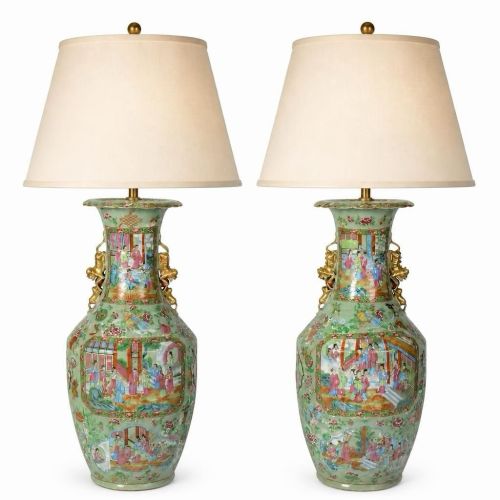
The most common form on this page is the pair of table lamps, often derived from nineteenth-century Cantonese or Rose Medallion vessels. Alongside these, single vase lamps and ginger jar conversions appear frequently.
The stylistic context draws heavily on Qing Dynasty traditions, Chinese Export design, and Chinoiserie interpretations created for Western interiors. The porcelain bodies typically retain their characteristic pink enamel palettes alongside elaborate figural and floral scenes.
How they were made
The foundation rests on hard-paste porcelain, painted with enamel colours dominated by opaque pinks and applied with detailed brushwork. Potters formed these vessels into baluster and jar shapes before firing and decorating them.
Many examples incorporate metal mounts in brass, ormolu, or gilt bronze to secure the electrical fittings and stabilise the porcelain base. Fabric and silk shades complete the conversion, often paired with wooden elements.
Ginger jars that once stored dried roots now hold electrical wiring.
What varies in quality
The distinction between ordinary and superior pieces lies in the crispness of the enamel painting and the harmony of the metal mounts. Finer porcelain vessels display intricate hand-painted details with disciplined brushwork and rich colour saturation.
The integration of brass or ormolu mounts also separates standard conversions from high-end examples. High-quality pieces use substantial, well-cast metal mounts that complement the porcelain rather than simply serving as functional adapters.
Samson Porcelain
The Famille Rose Lamps Glossary
- Famille Rose
- A palette of Chinese porcelain enamels introduced in the eighteenth century, distinguished by an opaque pink colour derived from colloidal gold. This group includes numerous floral and figural designs.
- Canton
- A major port in southern China that produced and exported vast quantities of porcelain decorated in vibrant enamel colours for Western markets. Cantonese ceramics often feature dense panels of figures and birds.
- Ormolu
- Finely ground and chiselled gold cast onto a brass or bronze base, frequently utilised for decorative mounts on porcelain lamps. This technique adds considerable weight and lustre to the object.
- Ginger Jar
- A wide-shouldered, bulbous ceramic vessel originally designed to store spices and herbs. These jars frequently serve as the main body for table lamps.
- Rose Medallion
- A specific style of nineteenth-century Cantonese porcelain decoration characterised by distinct panels filled with people, birds, and flowers, arranged around a central medallion.
Famille Rose Lamps: Frequently Asked Questions
Are these original lamps?
Most of these pieces started as porcelain vases, ginger jars, or oil lanterns before being converted into table lamps during the nineteenth or twentieth century.
The wiring and fittings are later additions adapted to hold bulbs, while the ceramic bodies and metal mounts retain their historical age.
Do they come as pairs?
A large portion of the listings consist of matched pairs, though single lamps also appear in the selection.
Pairs are particularly sought after for symmetrical placement on sideboards, buffets, or bedside tables.
What periods do they date from?
The physical evidence points primarily to the nineteenth century, including specific decades such as the eighteen-eighties and nineties.
Some examples extend into the early twentieth century, reflecting ongoing nineteenth-century design traditions.
What materials are used?
The primary material is porcelain decorated with enamel paint, frequently supported by brass, ormolu, or gilt bronze mounts.
Shades constructed from fabric and silk are commonly paired with the ceramic bases alongside wooden elements.