


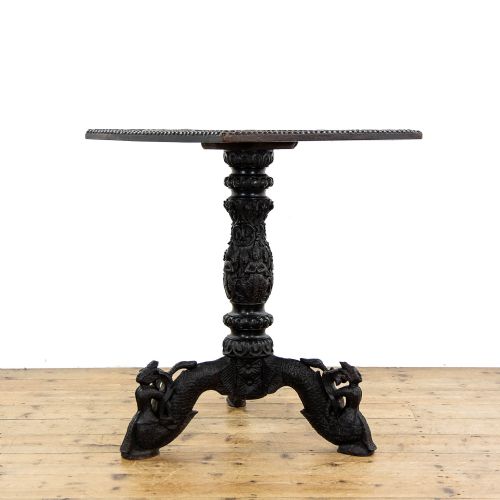
Chinese Dragon Pedestal
These chinese dragon pedestal pieces are substantial carved supports and tables built to hold urns and displays.
Chinese Dragon Pedestal
A chinese dragon pedestal or related stand brings heavy nineteenth-century carving into a room, often serving as a plant stand, torchiere, or side table. These items emerge from the nineteenth century and early twentieth century, spanning periods from Victorian to the nineteen-twenties.
Most examples found here take the form of side tables, occasional tables, or plant stands rather than floor-standing columns alone. The forms are shaped by Chinese export and Qing Dynasty traditions, alongside occasional Anglo-Indian work.
Buyers encounter forms that include inset marble tops, octagonal occasional tables, and large wooden torchieres. These surfaces were designed to elevate decorative objects, vases, and jardiniere stands within domestic interiors.
Materials and construction
Makers utilised dense timbers such as rosewood, teak, hardwood, hongmu, and ebonised wood to achieve deep, relief-carved decoration. These dark woods provided the structural strength needed for heavily carved motifs and inset stone tops.
Many tables incorporate rouge marble or general marble inserts within wooden frames to create a contrasting, cool surface. Cinnabar lacquer and bronze sectional elements also appear across the selection, showing varied surface finishes.
Joinery and carving work together to support heavy loads like bronze section jardiniere bowls. The manual labour involved in chiselling intricate dragon motifs required seasoned timber that would not split under tension.
Chinese Dragon Pedestal Retail Price Guide 2026
Typical asking prices for chinese dragon pedestal among the pieces listed under this phrase on Sellingantiques today, from the lower quarter to the upper quarter. They describe what is for sale here now, not the wider market.
Carved wooden dragons peer from beneath heavy marble tops, keeping a silent, scaly watch over nineteenth-century potted ferns.
Judging the work
The choice of material alters the character of the object, with dense rosewood and heavy hongmu demanding more skill from the carver than softer woods. Inset marble slabs must fit their wooden rebates precisely without movement or packing.
Structural integrity depends on the stability of the legs and the tightness of the joints under the weight of the top. Pieces that retain their original finish and uniform patina hold greater presence than those stripped or overly restored.
The Chinese Dragon Pedestal Glossary
- Jardiniere stand
- A low or tall table specifically designed to support a large ceramic or bronze plant bowl. These stands often feature water-resistant stone tops to protect the wood.
- Torchiere
- A tall standing lamp pillar or display column meant to hold a light source or decorative urn. In this context, the form provides elevated display space.
- Hongmu
- A dense, dark red-black hardwood traditionally used in high-end Chinese furniture construction. It accepts very fine detail during hand carving.
- Cinnabar lacquer
- A building up of numerous layers of coloured tree sap which is subsequently carved in relief. This technique creates a rich, tactile surface.
- Occasional table
- A small, movable table used for specific, temporary domestic tasks rather than permanent dining. They appear in varied top shapes including octagonal formats.
Chinese Dragon Pedestal: Frequently Asked Questions
What were these stands used for?
These pieces served primarily to elevate decorative objects, such as large porcelain vases, bronze jardiniere bowls, and indoor plants. Their sturdy construction allowed them to bear significant weight safely.
In period interiors, placing important items on carved pedestals drew the eye and protected delicate flooring or furniture from damp ceramic bases.
How do I care for marble tops?
Marble inserts require simple dusting and occasional wiping with a damp cloth to prevent grit from scratching the polished surface. Avoid acidic cleaners that can etch the stone.
Treat the surrounding wood frames with traditional wax rather than silicone polishes to maintain the appropriate sheen without softening the finish.
Are these pieces stable on carpets?
Due to the heavy use of dense hardwoods and marble, these stands carry considerable weight that aids stability. However, tall torchieres can be top-heavy.
Placing them on firm flooring or using discreet anchors ensures that high-traffic areas do not cause wobbling when items are placed on top.
How do I date these items?
Dating relies on examining the timber shrinkage, the tool marks left by the carver, and the style of the export period. Nineteenth-century examples often display tighter grain integration and older patina.
Comparing the construction methods of the joints against Victorian and early twentieth-century export standards helps confirm the production era.