

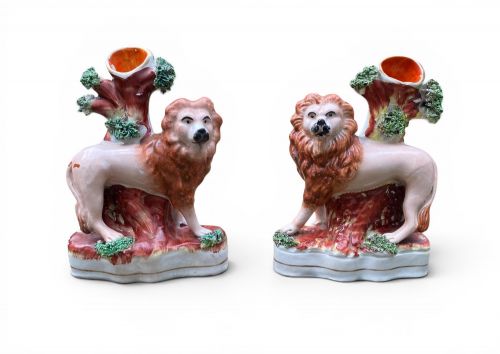


Ceramic Lion Figurine
These ceramic lion figurine pieces bring domestic spirit and history to a room, ranging from Staffordshire pairs to Japanese guardian figures.
Ceramic Lion Figurine
A ceramic lion figurine search reveals sculptural beasts spanning British earthenware, European tin glaze, and East Asian porcelain. The Staffordshire pottery tradition dominates the selection, particularly pairs of seated Medici lions and spill vases designed for nineteenth-century mantelpieces.
Beyond English earthenware, the selection includes Japanese Hirado and Bizen porcelain guardian lion dogs alongside Chinese Qing period Foo dogs. These eastern pieces reflect centuries of sculptural convention distinct from Victorian domestic Staffordshire models.
Forms vary from static guards resting a paw on a ball to narrative scenes such as the death of the lion queen. Many examples operate as functional spill vases or decorative mantle ornaments rather than purely static sculptures.
How they were made
Potters shaped these figures using earthenware, pearlware, and porcelain bodies, frequently finishing them with lead glaze, tin glaze, or rich treacle glaze. Copper lustre applications and cobalt underglaze provide metallic sheen and deep blue detail across the mane and base.
Victorian mantelpieces often gained extra drama from lions staring down visitors with surprisingly gentle human-like teeth painted by hurried potters.
What varies in quality
Quality rests in the crispness of the moulding and the expressive power of the modeled face, where sharp delineation of teeth and eyes separates superior work from softer castings. Paint application also dictates grade, with clean underglaze cobalt or rich, even treacle glazes elevating a piece above muddy or hasty brushwork.
The integrity of the form matters greatly, particularly in pairs where matching postures and balanced glazing show deliberate workshop output. Original bases, uncompromised glaze surfaces, and strong sculptural presence mark the finer examples of both Staffordshire and Asian traditions.
Rockingham Pottery·Lancaster and Sons of Hanley
The Ceramic Lion Figurine Glossary
- Pearlware
- A refined earthenware developed in the late eighteenth century featuring a thin glaze with a faint bluish tint pooling in crevices. It provides the pale body for many early Staffordshire figures.
- Treacle glaze
- A dark brown, manganese-rich lead glaze producing a shiny, treacle-like appearance on pottery. It defines the lustrous finish of many nineteenth-century Staffordshire lions.
- Spill vase
- A hollow cylindrical holder attached to a figure designed to hold wooden spills for lighting fires. Pairs of Staffordshire lions frequently incorporate these functional vessels.
- Foo dog
- A traditional Chinese guardian lion representing protection and prosperity in domestic spaces. These ceramic models often feature detailed manes and open mouths.
- Medici lion
- A classical marble lion design originating from ancient Rome and famously replicated in Renaissance Florence. Staffordshire potters frequently copied this specific pose for mantelpiece ornaments.
Ceramic Lion Figurine: Frequently Asked Questions
Are ceramic lions always found in pairs?
Many nineteenth-century Staffordshire lions were produced as symmetrical pairs to flank a fireplace or mirror. Single figures also appear regularly, often originating from broken pairs or independent spill vase designs.
Collectors seeking a mantelpiece display generally look for matched pairs, whilst single figures command interest through distinct poses or unusual glazes.
What is a lion spill vase?
A spill vase combines a decorative animal figure with an integrated hollow cylinder. Households used these vessels to hold thin wood splints for transferring flame from hearth to candle.
In ceramic lion figures, the vase tube typically rises behind the animal's back or beside its mane, blending utility with domestic display.
How do I date a Staffordshire lion?
Dating relies on the ceramic body, glaze type, and moulding style. Earlier pieces from the late eighteenth century use pearlware bodies, whilst mid-nineteenth-century examples frequently employ heavier earthenware with treacle or copper lustre glazes.
Base treatment also helps determine age, as unglazed flat bases give way to fully glazed undersides in later Victorian production.
What distinguishes a Foo dog from a British lion?
Foo dogs originate from East Asian porcelain and stoneware traditions, featuring stylized curly manes, broad snouts, and often a paw resting on an embroidered ball. They embody Buddhist guardian iconography rather than European heraldry.
British ceramic lions draw instead from classical sculpture and domestic Victorian taste, showing smoother body contours and more naturalistic feline expressions.
How should I display ceramic figures safely?
Ceramic figures require stable shelving away from heavy foot traffic vibrations. Earthenware and porcelain can suffer damage from direct knocks or unstable mantel placement.
Keeping pieces out of harsh direct sunlight preserves the hand-painted enamels and prevents any degradation of the historical glaze surfaces over time.