

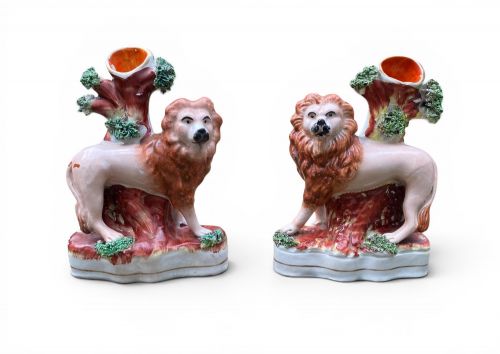


Antique Pottery Lion Figurine
These antique pottery lion figurine examples bring bold Victorian presence and earthy character straight to your mantelpiece.
Antique Pottery Lion Figurine
When you search for an antique pottery lion figurine, you enter a world of Staffordshire earthenware and glazed ceramic beasts modelled with surprising charm. The pieces available here span the eighteenth, nineteenth, and early twentieth centuries, capturing everything from traditional Medici models to spill vases and pairs of seated guardians.
You are most likely to meet nineteenth-century Victorian Staffordshire earthenware pieces, often coated in treacle glaze or metallic lustre. Alongside British figures, the selection occasionally reaches further afield to include German tin-glazed earthenware and Chinese porcelain examples.
How they were made
Makers shaped these figures using ceramic earthenware or porcelain, employing moulds to catch the muscular form of the animal. Potters then applied lead glaze, enamel, or metallic lustre glaze before firing the ceramic body in a kiln.
Listings feature earthenware, porcelain, and ceramic figures finished in lead glaze, enamel, and metallic lustre.
What varies in quality
The artistic strength of the modelling dictates the quality, separating alert and powerful beasts from stiff or lumpy representations. A confident hand in the moulding and painting gives the creature genuine character rather than a vacant stare.
The richness and depth of the glaze execution also mark out the better examples. Smooth, even lead or lustre glazes with well-preserved enamel highlights elevate a figure far above flat, hastily finished work.
Rockingham Pottery·Lancaster and Sons of Hanley
The Antique Pottery Lion Figurine Glossary
- Earthenware
- Porous pottery fired at lower temperatures, commonly used for the vast majority of Staffordshire animal figures. It requires a glaze to become waterproof.
- Medici Lion
- A classic classical sculpture pose depicting a lion resting its paw on a ball or sphere, frequently copied by British potters. Staffordshire makers adapted this grand sculptural motif for domestic mantelpieces.
- Treacle Glaze
- A dark, translucent brown lead glaze that pools richly in the recesses of the pottery. This shiny finish gives nineteenth-century figures their characteristic glossy depth.
- Spill Vase
- A hollow cylindrical container attached to a figure, designed to hold wooden spills for lighting pipes and candles. These practical additions often accompany pairs of animal ornaments.
- Metallic Lustre Glaze
- A specialised metallic film applied to ceramics to create a reflective, shimmering surface finish. Copper and silver lustre variants add dramatic sheen to manes and bases.
Antique Pottery Lion Figurine: Frequently Asked Questions
Are these pottery lions fragile?
These ceramic figures are robustly potted earthenware, yet their protruding ears and tails remain vulnerable to sharp impacts. Handling them with care ensures the glaze and clay body stay intact for years.
Displaying them away from busy edges protects them from accidental knocks. Normal household dusting keeps the glazed surfaces looking bright without risking damage.
How do I spot a Victorian lion?
Victorian Staffordshire lions typically feature moulded earthenware bodies finished with treacle glaze or painted enamel details. Many date from the mid-nineteenth century and were designed as decorative chimney ornaments.
They often appear facing left and right as matching pairs. Their stylized manes and painted glass-like eyes are characteristic of the period's commercial pottery production.
What is a spill vase figure?
A spill vase figure combines a decorative sculpture with an open cylindrical tube meant for holding wooden fire lighters. These dual-purpose objects sat by hearths to make lighting fires and pipes convenient.
Potters cleverly integrated the tall tube behind the animal's back so it blended into the overall composition. This practical domestic use defined many nineteenth-century mantelpiece ornaments.
How do I tell different glazes apart?
Treacle glaze appears as a dark, glossy, translucent brown that pools thickly in the crevices of the pottery. Lustre glazes have a metallic, reflective sheen that glints under direct room lighting.
Tin glaze provides an opaque, smooth white background typical of continental European ceramics. Each glaze type reflects the specific chemical recipes and firing techniques of its era.