


Central Asian Door Rug
A central Asian door rug is a tribal tent hanging designed to frame an entrance, offering rich woolwork and historical nomadic design.
Central Asian Door Rug
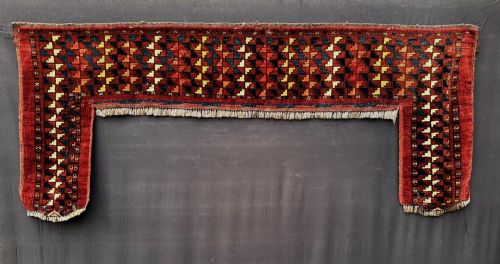
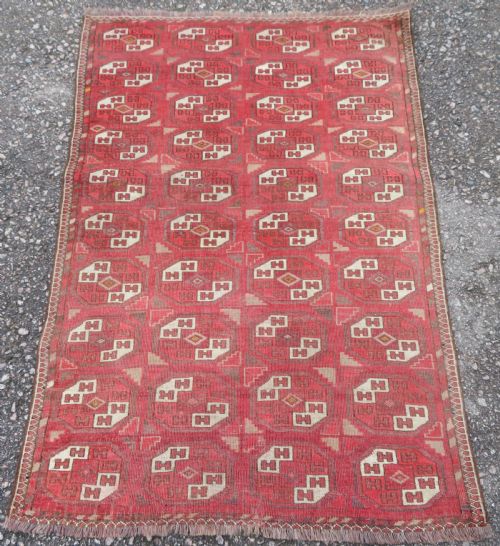
When you search for a central Asian door rug, you are looking at tribal tent hangings and portieres created by nomadic and village weavers across the region. The pieces on this page primarily take the form of ensis, gapylyks, and kapunuks, which served as protective or decorative covers for tent doorways.
Most examples originate from the nineteenth century, with dates stretching from eighteen fifty through to nineteen thirty. The makers belong to specific Turkmen and Afghan tribal groups, including the Ersary, Yomud, Tekke, Saryk, and Karadashli.
These textiles function as rugs and carpets, area rugs, and wall hangings. Their distinctive format incorporates panels and elem borders designed to be viewed vertically as architectural elements within a nomadic dwelling.
What Varies in Quality
Quality in a central Asian door rug rests upon the precision of the tribal drawing and the crispness of the geometric elem panels. Master weavers achieved exceptional clarity in complex motifs like double trees and candelabra patterns, whereas lesser examples show compressed or irregular proportions.
The depth and brilliance of the palette set superior pieces apart from ordinary work. Hand-spun wool takes dye with subtle variations that give the surface life, while handling reveals whether the structural weave remains tight and resilient.
Some door hangings feature crisp cotton whites woven directly into the wool pile to catch the dim light of a nomadic tent.
The Central Asian Door Rug Glossary
- Gapylyk
- A tent door hanging or portal cover created by Turkmen weavers. These textile forms mirror the architectural function of the doorway they decorated.
- Elem
- The lower horizontal panel at the base of a carpet or door rug. This area often contains distinct pictorial or geometric motifs.
- Portiere
- A curtain hung over a doorway. In this context, it describes the utilitarian and decorative role of the tent hanging.
- Kapunuk
- A decorative tent door hanging placed around the upper frame of an entrance. These U-shaped textiles complemented the central ensi.
Central Asian Door Rug: Frequently Asked Questions
What is a central Asian door rug?
A central Asian door rug is a specialised tribal textile woven by nomadic groups to hang over tent entrances. These pieces functioned as both architectural dividers and decorative protection for the dwelling.
Most examples belong to nineteenth-century traditions, showcasing distinct tribal patterns tied to specific weaving groups. Their format usually involves a vertical orientation with structured panel layouts.
How do I identify different tribal styles?
Distinguishing tribal styles relies on examining the structural layout, palette, and specific motif arrangements. Groups like the Tekke, Yomud, and Ersary each utilised characteristic quartered fields and elem panel designs.
Comparing the borders and secondary ornaments helps assign a piece to a particular region or tribe. Hand-spun wool and cotton structural elements also provide clues to the origin.
How should I care for a textile hanging?
Protecting a historical textile requires avoiding direct sunlight to prevent natural dye fading. Gentle vacuuming with a mesh screen protects the wool pile from damage.
Ensure the wall hanging is supported evenly across its top edge to prevent structural strain. Professional textile conservators should handle any deep cleaning or repairs.