



Cast Silver Candle Holders
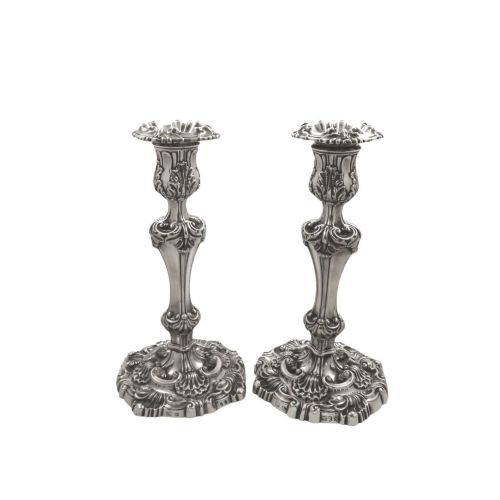
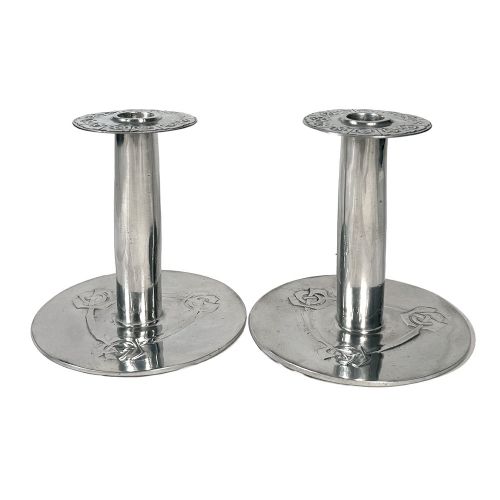
Cast silver candle holders bring substantial weight and bright reflective metal to a room, prized for their crisp detail and enduring presence.
Cast Silver Candle Holders
When you search for cast silver candle holders, you look at solid metal lighting from the eighteenth and nineteenth centuries, alongside related forms in paktong, pewter, and silvered bronze. These pieces range from George I tapersticks and George II candlesticks to Victorian revivals and Edwardian wall sconces.
The most common versions met on this page are pairs of candlesticks, alongside occasional wall sconces and sets of four. Their designs draw on Georgian, Rococo Revival, Italian Rococo, and French Neoclassical styles, showing varied forms from plain columns to elaborate grotto motifs.
Materials and construction
Makers utilised sterling silver, Britannia standard silver, and silver plate, alongside alternative metals like paktong, pewter, and silvered bronze, sometimes combining them with marble. The casting process allowed workshops to produce thick, substantial sockets and bases with significant heft.
Pieces from the mid-eighteenth century demonstrate precise seamed casting, while later nineteenth-century examples achieve high detail through complex relief work and chased surfaces. Individual components were cast separately and joined, creating sturdy structures designed to hold lighted candles securely.
Cast Silver Candle Holders Retail Price Guide 2026
Typical asking prices for cast silver candle holders among the pieces listed under this phrase on Sellingantiques today, from the lower quarter to the upper quarter. They describe what is for sale here now, not the wider market.
Mermaids hold the light on Edwardian walls, bringing mythical creatures into the evening routine.
Distinguishing quality
Quality rests in the crispness of the cast ornament and the proportion of the form, separating sharply struck details from softened or worn surfaces. Makers who mastered the medium achieved balanced weight and clean junctions between the base, stem, and nozzle.
The sophistication of the stylistic execution marks the upper tier, where Rococo scrolls or Neoclassical lines appear with absolute clarity. Inferior pieces lack this structural definition, showing blunt edges or heavy solder repairs that obscure the original work of the foundry.
John Cafe·David Green·Ferdinand Barbedienne
The Cast Silver Candle Holders Glossary
- Britannia standard
- A higher grade of silver purity introduced by English law in the early eighteenth century, containing more pure silver than sterling. It often appears on early pieces alongside specific maker marks.
- Paktong
- A copper-nickel-zinc alloy originating in China, prized in the eighteenth century for its bright appearance resembling silver. It was cast into heavy candlesticks and valued for its durability.
- Taperstick
- A small version of a candlestick designed to hold thin wax tapers rather than heavy candles. They were used for lighting pipes or sealing letters.
- Sconce
- A wall-mounted lighting fixture featuring a backplate and one or more arms to hold candles. These project light directly into a room from a wall surface.
- Seamed
- Describes metal objects constructed from individually cast or sheet components joined together along visible or concealed seams. This technique allowed for hollow forms with thick walls.
Cast Silver Candle Holders: Frequently Asked Questions
How do I clean cast silver?
Clean these pieces gently with a soft cloth and a reputable silver polish, avoiding harsh abrasive pads that wear down raised details. Take care around engraved crests or textured cast relief work.
Wash away residual polish in warm soapy water and dry thoroughly with a lint-free cloth to prevent spotting on the metal surface.
Were these used on dining tables?
These pieces served multiple domestic purposes, including lighting dining tables, sideboards, and living spaces during evenings. Pairs and larger sets provided balanced illumination across large rooms.
Wall sconces fulfilled a similar role by mounting directly to vertical surfaces, casting light outwards from panelled walls.
How can I tell the period?
Dating relies on stylistic clues like Rococo asymmetry, Neoclassical urn motifs, and the proportions of the stem and base. Earlier eighteenth-century forms often feel heavier and show simpler profiles than Victorian revivals.
Maker marks and standard silver marks provide further evidence of origin, though many metal examples rely purely on stylistic comparison.
Are paktong and silver the same?
Paktong is an alloy of copper, nickel, and zinc rather than precious silver, though it shares a similar bright metallic lustre. It mimics silver closely while offering distinct weight and durability.
Testing or examining the metal tone helps distinguish paktong from sterling silver or silver plate.