






Carved Wooden King Bedstead
A carved wooden king bedstead is a substantial sleeping frame offering period presence and generous proportions for contemporary bedrooms.
Carved Wooden King Bedstead
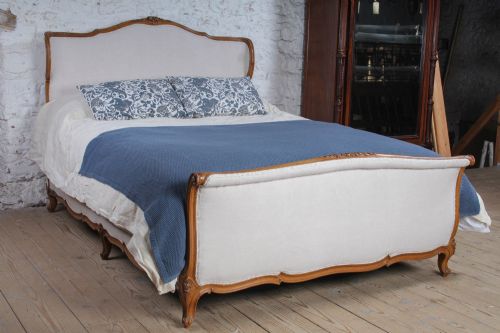
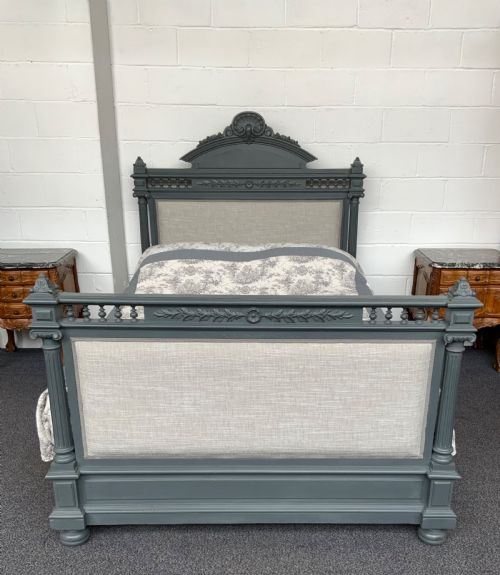
A carved wooden king bedstead provides a grand focal point for a bedroom, drawing primarily on French design vocabularies like Louis XV and Louis XVI styles. These items appear across the nineteenth and early twentieth centuries, spanning periods from Regency and Victorian eras up through nineteen twenty.
The inventory on this page consists predominantly of French regional and Parisian workshop outputs, alongside occasional Anglo-Indian colonial pieces. Buyers encountering these frames will find forms ranging from low-end upholstered versions to expansive four-poster designs and complete bedroom suites with matching bedside cabinets.
Materials and construction methods
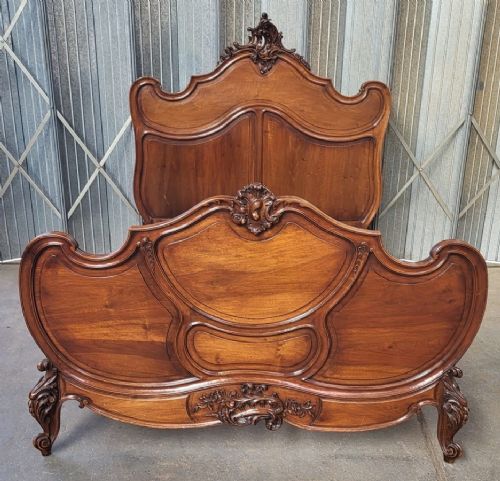
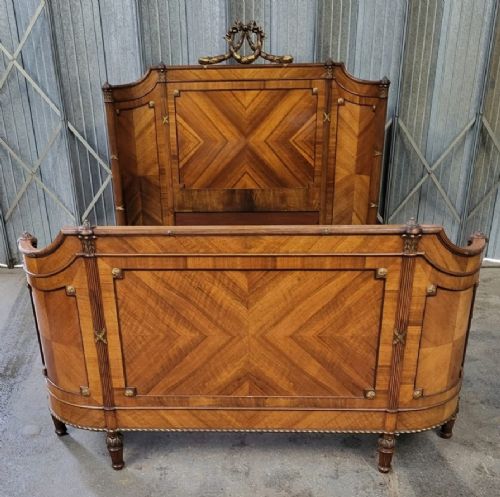
Makers constructed these bedsteads using solid timbers, most notably walnut and mahogany, alongside painted wood, bleached oak, and burr walnut veneers. Structural framing often incorporates brass detailing and quarter-veneered surfaces to enhance the visual depth of the timber.
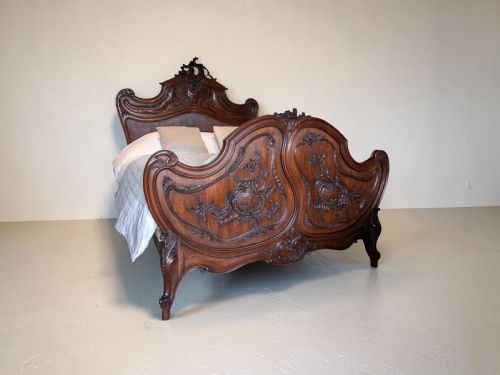
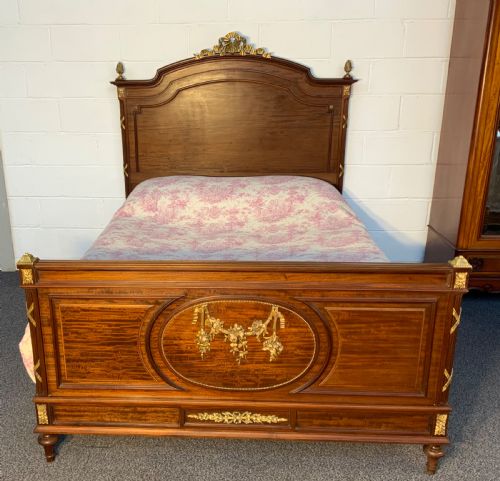
Detailing relies on hand-carving applied to the headboards and footboards, sometimes complemented by woven cane panels or newly upholstered fabric inserts. Selected examples feature parcel gilt highlights or painted finishes applied over the carved wooden elements.
Listings span from Regency and Victorian eras through nineteen twenty, utilising walnut, mahogany, oak, and cane.
Distinctions in craftsmanship and design
The distinction between standard production and superior examples lies in the crispness and depth of the hand-carving on the wood. Finer frames exhibit fluid, well-defined stylistic motifs derived from Rococo or Neoclassical revivals rather than mechanical repetition.
Material selection and execution also dictate tier, where choice figured walnut veneers, intricate brass mounts, and integrated cane work elevate the piece. The overall architectural proportion and harmony between the headboard, footboard, and optional matching cabinetry separate ordinary frames from exceptional commissions.
The Carved Wooden King Bedstead Glossary
- Bedstead
- A framework of a bed consisting of headboard, footboard, and rails designed to support a mattress and base. It differs from an integrated divan by retaining visible structural timber.
- Louis XV Style
- A nineteenth-century revival aesthetic characterised by asymmetrical curves, cabriole legs, and organic floral carving. It takes inspiration from the eighteenth-century French royal court.
- Quarter Veneered
- A method of applying thin slices of wood grain symmetrically across a panel to create a geometric pattern. This technique highlights the natural figure of walnut or mahogany.
- Caned
- A woven lattice construction utilising stripped rattan applied to headboards or footboards. This technique introduces lighter textural contrast to heavy wooden frames.
- Parcel Gilt
- A decorative treatment where specific carved details or mouldings are partially covered in gold leaf. It accents the underlying painted or polished wood surface.
Carved Wooden King Bedstead: Frequently Asked Questions
Will a modern mattress fit these antique bedsteads?
Most of these historic frames accommodate standard modern king-size dimensions, though exact internal tolerances can vary due to nineteenth and early twentieth-century sizing conventions. It remains prudent to check specific rail lengths and interior widths before pairing the frame with a contemporary mattress.
Custom slats or modern support bases can be integrated discreetly within the wooden rails to ensure proper foundation without altering the external appearance of the bedstead.
How do I care for polished walnut wood?
Maintaining polished walnut requires dusting with a soft, dry cloth and avoiding silicone-based polishes that build up residue over time. Keeping the timber away from direct heat sources and strong sunlight preserves the natural finish and prevents veneer shrinkage.
Periodic application of a traditional beeswax feed helps nourish the grain and protects the antique surface from drying out in centrally heated rooms.
How do I distinguish Louis XV from Louis XVI styles?
Louis XV style pieces are defined by sweeping asymmetrical curves, C-scrolls, and flowing organic motifs without sharp angles. The structure emphasises movement and soft, undulating lines across the headboard and footboard.
In contrast, Louis XVI style embraces classical symmetry, straight fluted columns, geometric paneling, and rectangular proportions inspired by ancient architectural discoveries.
Can these wooden beds be dismantled easily?
These historical bedsteads typically employ traditional bolt-in or slot-in iron bed rail fasteners that allow the headboard, footboard, and side rails to separate completely. This modular construction was essential for historical transport and simplifies modern room relocation.
Care should be taken when tightening metal bolts into original wood threads to ensure the structural integrity of the joints remains undisturbed.