


Carved Wood Paper Rack
A carved wood paper rack organises correspondence and journals with traditional desk-side utility.
Carved Wood Paper Rack
When you search for a carved wood paper rack, you encounter a variety of tabletop desk tidies, tiered waterfall stands, and floor-standing canterburys designed to hold letters, newspapers, and sheet music. The pieces available on this page span several distinct periods including Regency, William IV, and Victorian, alongside later 20th-century examples.
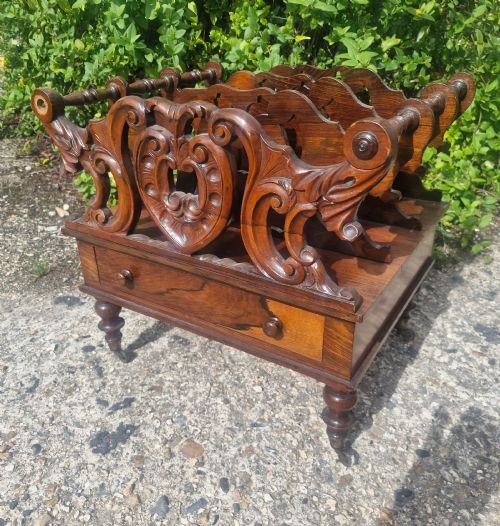
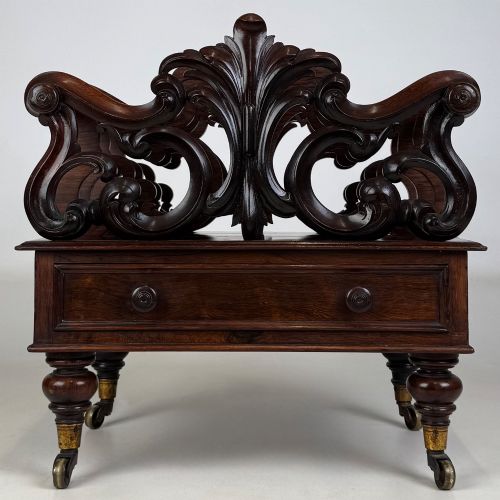
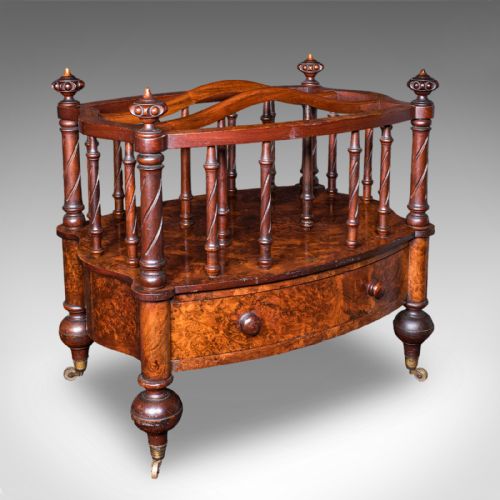
The most common form on this page is the Canterbury, typically constructed with pierced or carved vertical partitions above a low drawer and small turned feet or castors. Alongside these compartmented stands, smaller desk accessories appear as tiered stationery tidies intended to rest upon a writing surface.
Originating predominantly from English and French workshops, these items utilise rich dark timbers shaped with foliate carving, pierced scrollwork, or inlaid fretwork details.
Distinguishing quality in carved wood paper racks
Quality rests in the crispness of the carving and the selection of the timber, where figured burr walnut or richly grained rosewood indicates a higher grade of manufacture. Pieces with finely pierced fretwork, shaped scroll divisions, and integrated drawer storage demonstrate greater cabinet-making skill than plain utilitarian examples.
Structural integrity also separates standard items from exceptional ones, particularly the rigidity of vertical divisions and the preservation of original turned feet, castors, and brass mounts.
Prince of Wales feathers carved into rosewood remind us that organising yesterday's post was once a royal affair.
The Carved Wood Paper Rack Glossary
- Waterfall tidy
- A stepped desk accessory with rising tiers arranged to display envelopes, letters, and paper sheets in an overlapping sequence. These pieces sit directly upon a writing table.
- Fretwork
- Openwork ornamentation cut into wood panels or dividers to create decorative patterns. It adds lightness and visual complexity to heavier cabinet timbers.
- Scroll division
- A curved, sweeping wooden partition separating the compartments of a rack. These are frequently pierced or carved with foliate motifs.
- Bun feet
- Small, rounded spherical feet that lift the base of a cabinet or stand clear of the floor. They are turned from solid hardwood to match the primary timber.
Carved Wood Paper Rack: Frequently Asked Questions
What is a Canterbury used for?
Canterburys were designed to hold newspapers, magazines, and sheet music near seating areas in the parlour or drawing room.
The vertical partitions kept paper upright and sorted, while the lower drawer stored smaller writing accessories or correspondence.
How do I tell Regency from Victorian pieces?
Regency pieces often display restrained classical lines, sometimes incorporating brass inlay or delicate spindle turnings in rosewood.
Victorian examples tend towards heavier proportions, richer burr walnut veneers, and more exuberant foliate carving or pierced fretwork.
Can I put a paper rack on a desk?
Smaller tiered stands and waterfall tidies are specifically proportioned for placement on top of a writing desk or table.
Larger canterburys are floor-standing furniture pieces meant to rest beside a desk or armchair.
What woods were used for these racks?
Cabinet makers relied on durable hardwoods including mahogany, rosewood, walnut, and oak to construct these items.
More decorative examples featured burr walnut veneers, brass details, and occasional bone or ceramic accents.