
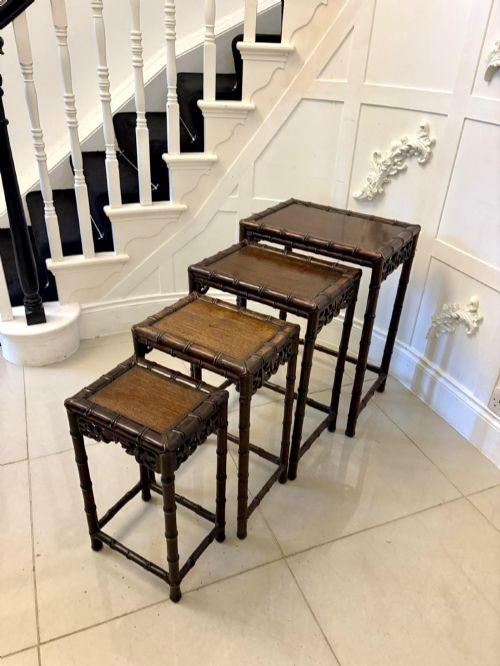
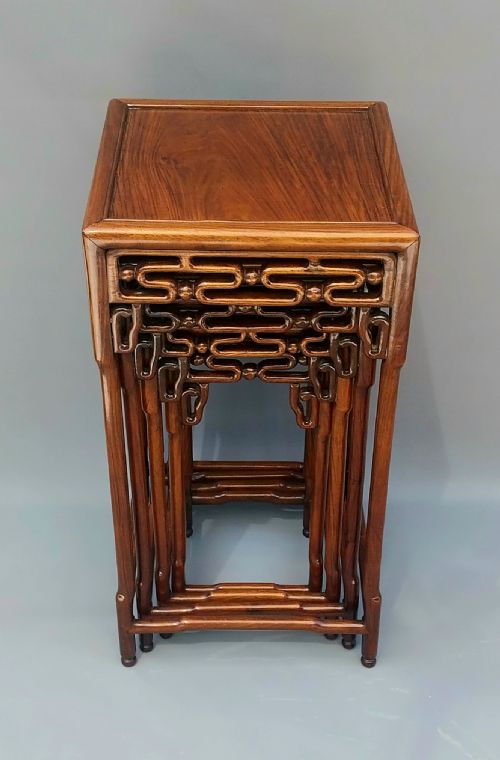


Carved Wood Nesting Tables
These carved wood nesting tables offer ingenious space-saving utility through sets of graduated surfaces carved in hardwood, rosewood, and teak.
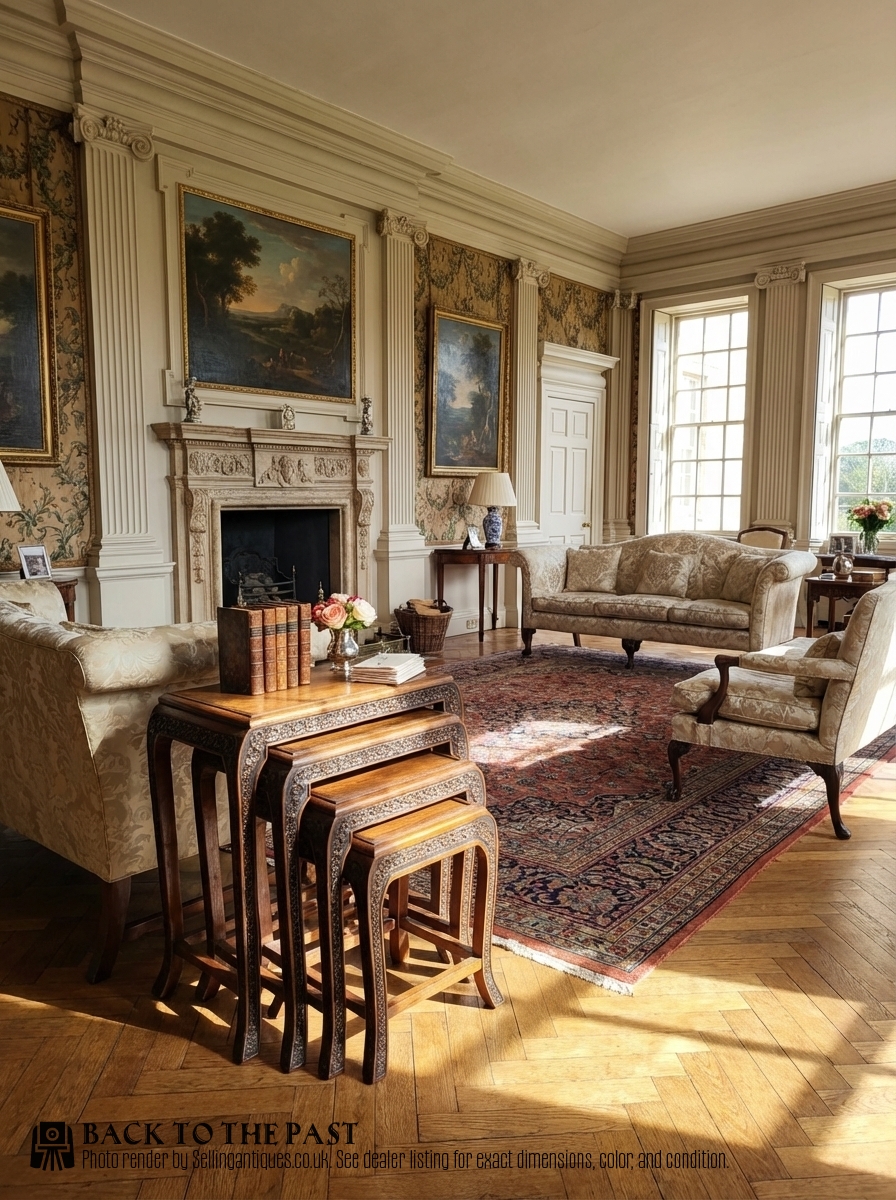
Carved Wood Nesting Tables
Carved wood nesting tables consist of sets of graduated tables designed to slide neatly beneath one another when not in use. The examples seen here predominantly span the nineteenth century, the Edwardian era, and the early twentieth century.
Originating largely from Chinese export workshops, Qing dynasty commissions, and Indian production, these pieces take the form of nests of three or four tables. They serve as versatile occasional surfaces for drinks or display in domestic interiors.
The buyer meets various iterations on this page, from traditional Chinese hardwood and hongmu sets to Anglo-Indian carved teak and occasional mahogany pieces. Each set provides practical surface space that expands or contracts instantly.
How they were made
Craftsmen built these sets using dense timbers such as rosewood, teak, mahogany, and hongmu, often framing burrwood panels or glass inserts. The selection of heavy hardwoods ensured the structural stability required for slender legs and frames.
Joinery techniques combined traditional framing with detailed hand-carving along the aprons, edges, and legs. Artisans shaped the wood to allow each smaller table to slide smoothly into the tracks or clearances of the one above it.
What varies in quality
Quality rests primarily in the crispness and depth of the hand-carving on the aprons and edges, alongside the weight and density of the chosen timber. Superior sets display finely articulated motifs without superficial masking.
Construction integrity separates finer examples from standard production, visible in the precision of the graduated fit and the stability of the joints. Heavier, well-seasoned woods maintain their alignment better over decades of sliding in and out.
The Carved Wood Nesting Tables Glossary
- Quartetto
- A traditional term for a set of four graduated tables designed to nest together. They gained popularity in English country houses during the nineteenth century.
- Hongmu
- A category of dense, dark tropical hardwoods utilised in traditional Chinese furniture making. It translates literally to red wood and provides exceptional weight.
- Graduated
- Describing tables made in diminishing sizes so the smaller pieces slide beneath the largest. This design maximises floor space efficiency.
- Chinoiserie
- European decorative style reflecting Chinese artistic motifs and techniques. It appears frequently on export furniture produced for Western markets.
Carved Wood Nesting Tables: Frequently Asked Questions
How were nesting tables used historically?
Historically, these tables remained tucked together against a wall or beside a chair until guests arrived. Servants or hosts then pulled them out individually to provide multiple guests with a stable surface for tea or reading materials.
Once the gathering concluded, the tables slid back into a single compact footprint, preserving floor space in the drawing room.
How do I care for rosewood and teak tables?
Keep these hardwood surfaces away from direct heat sources and strong sunlight to prevent the timber from drying out or splitting. Dust them regularly with a soft, dry cloth to protect the polished finish.
Apply a light application of appropriate furniture wax occasionally to nourish the wood and maintain its natural lustre.
Are these sets usually three or four tables?
The majority of pieces encountered here comprise sets of four graduated tables, often referred to as quartettos. You will also find smaller sets consisting of three tables.
Each configuration follows the same principle of diminishing proportions to ensure the smaller tiers fit completely beneath the largest frame.
How do I distinguish Chinese export pieces?
Chinese export sets typically utilise dense hardwoods like hongmu or rosewood and feature traditional relief carving depicting flora, fauna, or landscapes. Their construction often reflects regional joinery methods distinct from European cabinetry.
These pieces arrived in Western homes via maritime trade, blending Eastern materials with forms suited to Victorian and Edwardian interiors.