

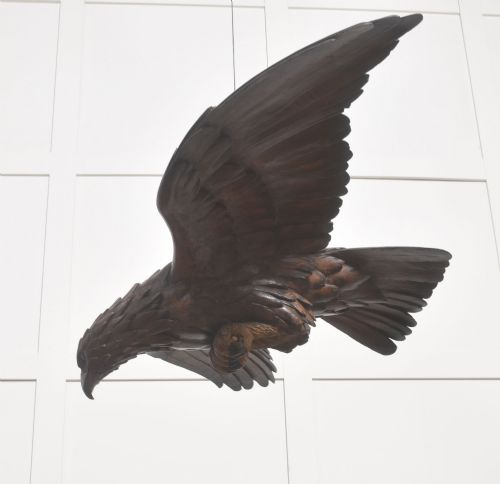


Carved Wood Eagle Sculpture
A carved wood eagle sculpture brings fierce presence to a room, forged from timber and rendered with outspread wings or watchful posture.
Carved Wood Eagle Sculpture
When you search for a carved wood eagle sculpture, you enter a domain where avian majesty meets historical woodworking traditions across centuries. The pieces collected here span the eighteenth century up to the nineteen-thirties, drawing on varied regional workshops from the Black Forest to Italy and Japan.
You are most likely to meet nineteenth-century Black Forest interpretations alongside ecclesiastical lecterns and European decorative figures. These range from imposing wall mounts and pairs of birds to detailed figures perched on naturalistic wooden bases.
Each carved wood eagle sculpture carries the aesthetic marks of its era, whether rendered in the dramatic folds of Baroque styling or the meticulous naturalism of the Meiji period. Forms shift from architectural church furnishings to freestanding cabinet sculptures and gilt Napoleonic symbols.
Materials and construction methods
Makers shaped these sculptures primarily from solid hardwoods including oak, walnut, and regional root wood, often applying dark stains to enrich the timber grain. Skilled carvers utilised hand chisels and gouges to define individual feathers, muscular talons, and powerful hooked beaks.
Selected details receive surface enrichment through gilding or fine penwork in the chinoiserie style, while certain Japanese iterations incorporate mixed media with bronze and silvered metal elements. Sculptures frequently rest upon integrated wooden plinths or natural root wood bases selected to complement the posture of the bird.
Carved Wood Eagle Sculpture Retail Price Guide 2026
Typical asking prices for carved wood eagle sculpture among the pieces listed under this phrase on Sellingantiques today, from the lower quarter to the upper quarter. They describe what is for sale here now, not the wider market.
The selection includes regional styles spanning Italian Renaissance Revival, French Empire, and Japanese Meiji aesthetics.
Markers of quality in avian carving
Quality reveals itself in the anatomical conviction of the carving and the depth with which individual feathers are layered. Superior examples demonstrate a careful observation of tension in the wings and talons, whereas lesser pieces rely on stiff, repetitive incisions that lack biological movement.
The choice of timber and the crispness of the finishing work further distinguish the output of master carvers from standard workshop production. Surface preservation matters greatly, with top-tier sculptures retaining their original patination and crisp edge definition without heavy restoration.
Luigi Frullini·Gyoko
The Carved Wood Eagle Sculpture Glossary
- Black Forest carving
- Woodwork originating from the mountainous region of central Europe, celebrated for deeply realistic depictions of animals and natural forms. These pieces often utilise lime or walnut timber.
- Ecclesiastical lectern
- A church reading desk, frequently supported by a carved wooden eagle with outstretched wings carrying the book rest. This form symbolises Saint John the Evangelist.
- Root wood base
- A naturalistic mounting formed from the gnarled root structure of a tree. Japanese and European carvers used these to anchor heavy sculptures securely.
- Penwork
- Decorative surface illustration applied to wood using ink or burnt lines. This technique enhances details such as plumage and background motifs.
- Gilt
- A thin layer of gold leaf applied to the wooden surface of a sculpture. It creates a brilliant reflective finish favoured in Napoleonic and Empire decorative objects.
Carved Wood Eagle Sculpture: Frequently Asked Questions
What periods do these eagles come from?
The pieces span several centuries, with particular representation from the eighteenth and nineteenth centuries. You will also find twentieth-century examples alongside Regency and Meiji period interpretations.
Each era imparts distinct stylistic markers, moving from ecclesiastical solemnity to the dramatic wildlife naturalism of the Victorian era.
Where were these sculptures made?
Origins vary widely across international workshops, including European centres such as the Black Forest, Italy, and England. Japanese Meiji period metal and wood hybrids also appear within the selection.
Local timber availability and regional carving traditions heavily influenced the distinct appearance of each piece.
How were church lecterns used?
Ecclesiastical eagles served as elevated reading desks in churches, holding heavy service books upon their outspread wings. The eagle traditionally symbolised the Gospel of Saint John.
These functional sculptures combined architectural stability with detailed animal carving suited for formal sacred spaces.
How do I care for carved wood?
Maintain stable indoor humidity and temperature to prevent the timber from splitting or warping over time. Dust the intricate feather carvings gently with a soft brush rather than a cloth.
Avoid placing the sculpture in direct sunlight to protect the original patination and any applied surface finishes.