


Carved Wood Caddy
A carved wood caddy is a domestic container fashioned to hold loose leaf tea, combining timber construction with surface ornament.
Carved Wood Caddy
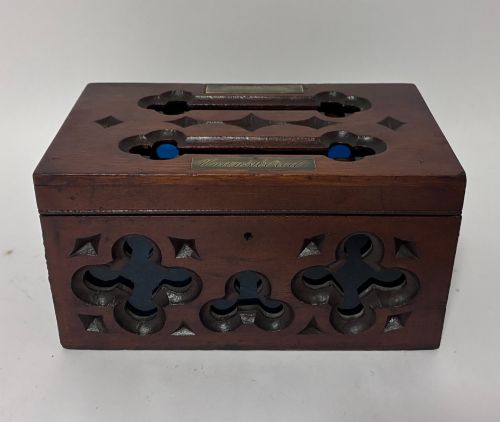
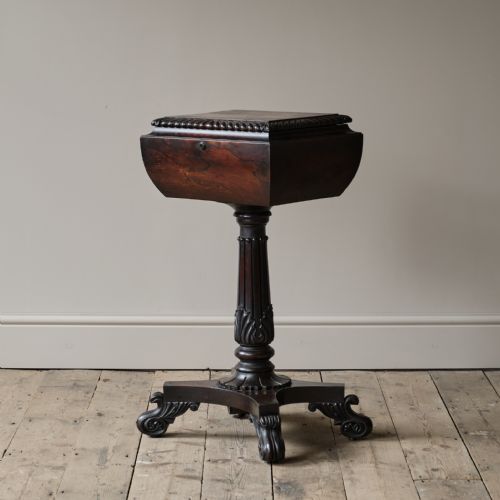
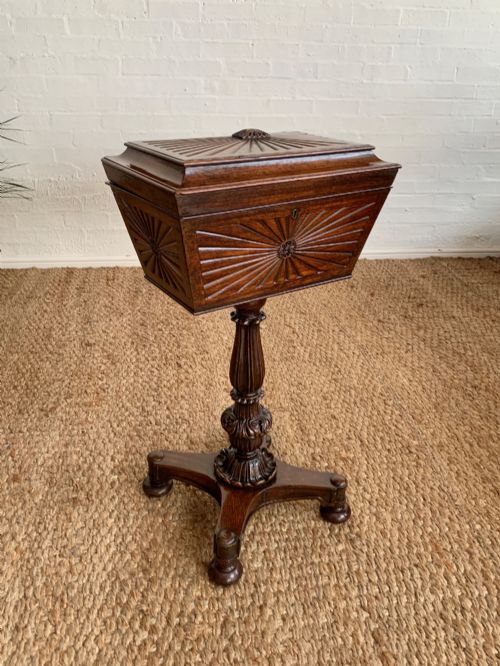
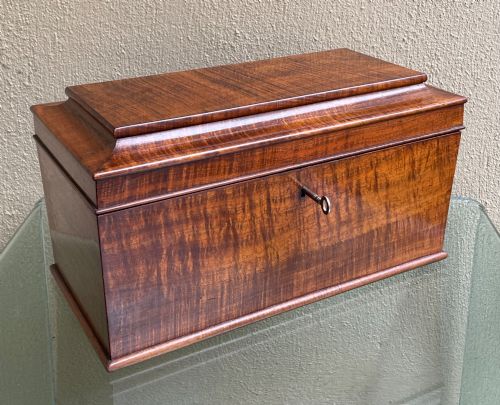
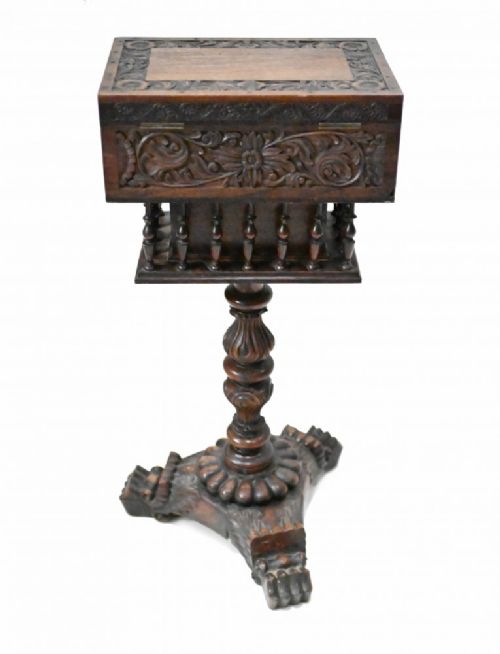
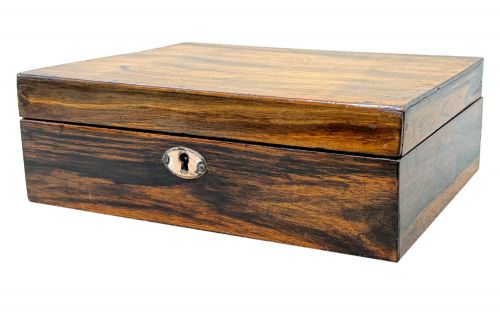
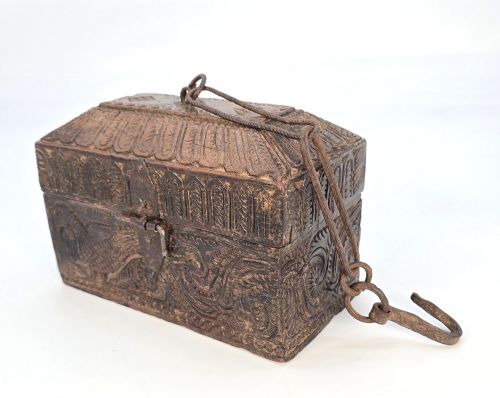
A carved wood caddy brings together domestic storage vessels and larger pieces of furniture designed for tea service, spanning the eighteenth and nineteenth centuries. The pieces range from small tabletop tea caddies and spice boxes to substantial freestanding teapoys and work tables. Regency and Victorian examples appear frequently, alongside earlier Georgian productions and items showing Anglo-Indian or Black Forest styles.
The selection includes specific regional variants and related storage forms such as cellarettes, work boxes, and occasional tables. Mahogany and rosewood form the backbone of the standard English caddy, while padouk, teak, and sandalwood indicate colonial and oriental origins. Makers fashioned these objects to sit securely in the principal rooms of period houses, serving both functional storage and decorative display.
Materials and construction
Cabinetmakers utilised dense timbers like mahogany, rosewood, and oak, often shaping the dense grain through meticulous carving rather than relying solely on flat veneers. Padouk, sandalwood, and fruitwood appear in pieces originating from colonial workshops or continental European carvers. Brass fittings, bone accents, and pewter linings frequently accompany the timber bodies, adding structural contrast to the interior compartments.
Joinery methods involved precise box construction, dovetailing, and turning, executed to support elaborate surface relief and applied mouldings. Carved ornamentation ranges from classical foliage and Gothic revival motifs to intricate oriental and Black Forest animal carvings. Artisans finished these surfaces with polishing techniques that emphasised the natural figure of the hardwood.
Recorded forms span the eighteenth, nineteenth, and early twentieth centuries, encompassing domestic tea caddies, cellarettes, and larger teapoy tables.
Judging the work
Quality rests upon the crispness of the carving and the suitability of the timber selection to the form of the box. Superior examples display deep, deliberate relief work where the grain and the ornament reinforce one another, rather than shallow stamping or hurried chisel marks. The alignment of the lid, the integrity of internal compartments, and the survival of original brass hardware or pewter inserts distinguish finer specimens from routine production.
Proportion and stylistic consistency separate the exceptional piece from the ordinary. Pieces that integrate their carved feet, stands, or pillar supports harmoniously with the main body demonstrate a higher level of workshop competence. The presence of documented makers' stamps or distinct regional techniques adds further distinction to the physical construction.
Freemans of Norwich·Gillows·Hunter and Palmer
The Carved Wood Caddy Glossary
- Teapoy
- A freestanding table with a lidded box on top designed for storing and preparing tea. These pieces often feature central pedestals and internal mixing bowls.
- Sarcophagus
- A box form characterised by a sloping, domed lid and a flared body resembling an ancient stone coffin. Cabinetmakers applied this prestigious shape to large tea caddies and work boxes.
- Cellarette
- A lockable container used for storing wine bottles or spirits safely within the dining room. They frequently share the mahogany construction and heavy proportions of large caddies.
- Padouk
- A heavy, durable tropical hardwood displaying a reddish-brown hue that deepens with age. English and colonial makers utilised it for export furniture and specialised containers.
- Sadeli
- A technique of micro-mosaic decoration utilising horn, bone, wire, and various coloured woods to create geometric borders. It appears frequently on Anglo-Indian sandalwood boxes.
Carved Wood Caddy: Frequently Asked Questions
How do I care for a wooden tea caddy?
Keep the timber away from direct heat sources and sudden humidity changes to prevent the wood from splitting or warping. Apply a suitable microcrystalline wax sparingly to maintain the finish without building up heavy residues.
Avoid using modern liquid polishes that contain silicones or aggressive solvents, as these can damage old French polish or oil finishes. Dust the carved surfaces gently with a soft, dry brush to clear crevices of debris.
Were these boxes used exclusively for tea?
While the primary purpose involved storing expensive loose leaf teas in lockable compartments, many containers served alternative domestic functions. Interiors often included spaces for sewing implements, writing materials, or spices.
Owners frequently repurposed these sturdy boxes over generations to hold letters, jewellery, or small keepsakes. The internal divisions usually remain removable or adaptable to suit contemporary storage needs.
How do I distinguish Regency pieces from Victorian ones?
Regency items typically display cleaner neoclassical lines, restraint in ornament, and frequent use of brass inlay or figured rosewood. The proportions lean towards architectural symmetry and classical restraint.
Victorian examples often embrace heavier ornamentation, Gothic revival motifs, or denser walnut and oak timbers. Carving on Victorian pieces tends to be deeper and more naturalistic, reflecting expanding global trade and shifting aesthetic tastes.
What is the function of the internal compartments?
Internal spaces within a tea caddy usually consisted of two lidded canisters flanking a central aperture that once held a glass or crystal mixing bowl. The canisters kept different tea varieties separate and dry.
Lids on these inner boxes prevented the aromatic oils of the tea from escaping too quickly. Some compartments were lined with foil or pewter to preserve the leaf freshness further.