

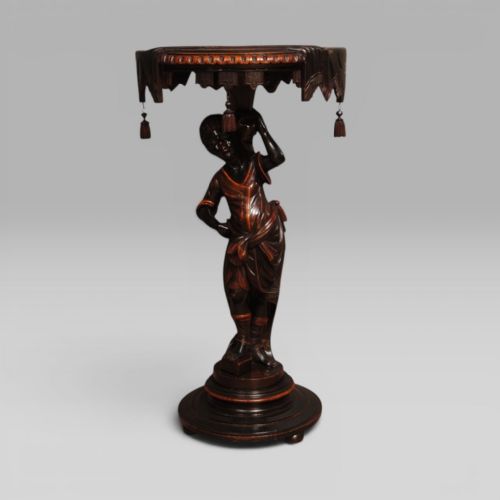


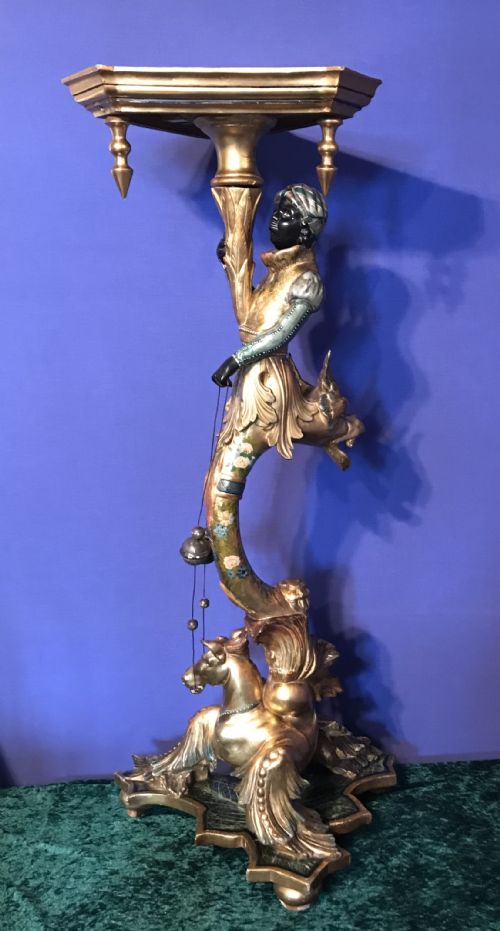
Carved Wood Blackamoor
These carved wood blackamoor figures and functional stands bring dramatic Venetian artistry and rich historic presence into a room.
Carved Wood Blackamoor
A carved wood blackamoor encompasses sculptural figures, torchere stands, side tables, and standard lamps originating predominantly from nineteenth-century Italy. These pieces frequently take the form of standing attendants holding trays, candelabras, or torchere columns designed to illuminate or furnish historic interiors.
The version most commonly encountered on this page dates from the nineteenth century and the early twentieth century, often reflecting Venetian Baroque or Rococo revival styles. They appear as single figures or matched pairs, functioning as sculptural furnishings or practical table bases.
Makers and artisans situated these figures in domestic and public spaces to display exoticism and theatrical craftsmanship. Surviving examples demonstrate distinct regional Italian characteristics rooted in Venetian workshop traditions.
Materials and construction methods
Carvers shaped these figures from solid timber, applying gesso layers to smooth surfaces before executing fine sculptural details. The underlying carved wood provides a sturdy structural foundation for complex forms such as torchere stands and candelabras.
Listings feature items dated from the mid-nineteenth century through the Edwardian period, up to around 1920.
Assessing quality in carved pieces
The preservation of original polychrome paint and gold leaf significantly influences the merit of an object. Pieces retaining their untouched nineteenth-century surface finish demonstrate greater historical integrity than those with later overpainting or heavy restoration.
The Carved Wood Blackamoor Glossary
- Torchere
- A tall ornamental stand designed to support a light fixture or candle holder. These sculptural supports frequently take human form in Venetian decorative arts.
- Gesso
- A plaster-like mixture applied to wood as a smooth base for gilding and paint. It allows carvers to achieve crisp surface details before applying gold leaf.
- Giltwood
- Wood that has been coated with gold leaf or gold paint. This finish provides a reflective, opulent quality suited to revival interior styles.
- Parcel-gilt
- Partially gilded, leaving portions of the underlying painted wood or natural timber exposed. This technique highlights specific decorative elements of a carving.
Carved Wood Blackamoor: Frequently Asked Questions
What is a blackamoor?
A blackamoor is a decorative sculptural figure depicted in traditional European art, often serving a functional role as a stand, table base, or light bearer.
These pieces draw heavily on Venetian decorative traditions from the nineteenth century and reflect historical European tastes for exoticised figures.
Where were these figures made?
The majority of these pieces originate from Italy, specifically Venice, where workshops specialised in elaborate carved wood furniture and decorative sculptures.
Venetian artisans produced these works across the nineteenth century and into the early twentieth century, drawing on baroque and rococo revival styles.
How do I care for original paint?
Original polychrome and gilt surfaces require gentle dusting with a dry, soft cloth to protect fragile nineteenth-century finishes.
Avoid liquid cleaners, moisture, and direct sunlight, which can destabilise historical gesso and cause painted details to flake over time.
Are these pieces functional?
Many examples serve practical purposes alongside their sculptural presence, functioning as side tables, torcheres, plant stands, or lamp bases.
Standard lamps and candelabras are often adapted for modern electrical use while retaining their original carved wooden structures.