
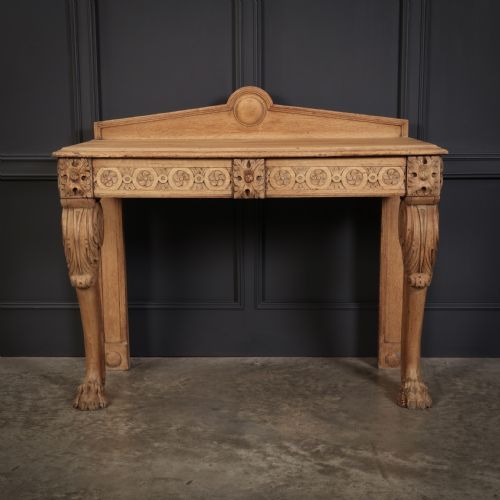


Carved Timber Hallway Console
These carved timber hallway console tables bring architectural weight and rich grain into an entrance, offering a surface for letters, lamps and keys.
Carved Timber Hallway Console
A carved timber hallway console sits flush against a wall, serving as a primary focal point in narrow entrance spaces and reception halls. The pieces appearing here span the eighteenth, nineteenth and early twentieth centuries, reflecting diverse global workshops and revival movements.
The most frequent examples on this page date from the nineteenth century, constructed from timbers such as mahogany, oak, elm, pine and padouk. Alongside standard console tables, the inventory includes related forms like pier tables, altar tables, serving tables and painted commodes suited to hallway placement.
Geographic origins vary widely across the selection, ranging from English and Irish designs through to French provincial work, Italian painted pieces, Chinese traditional forms and Anglo-Indian productions. This variety means buyers encounter everything from austere pitch pine to richly lacquered hardwoods and marble-topped variants.
Materials and construction methods
Makers utilised dense timbers like mahogany, oak, rosewood and elm to build stable frames capable of supporting heavy marble or solid wood tops. Hand-carving defines the ornamentation, whether applied as crisp Corinthian capitals on pine or intricate traditional motifs on Chinese altar tables.
Surface treatments range from bleached or polished natural grain to painted finishes, lacquering and specific regional treatments such as the padouk construction seen in Anglo-Indian pieces. Joinery relied on traditional framing and pegging to ensure longevity in busy hallway environments.
Listings feature timbers including mahogany, elm, brass, hardwood, marble, painted wood, oak and rosewood across various nineteenth-century styles.
Distinctions in craftsmanship and design
Quality rests primarily in the depth and clarity of the timber carving, where confident hand-chiselling distinguishes superior furniture from mechanical or later replication. The selection of the wood itself matters greatly, with well-figured mahogany, dense oak and clean-grained pine showing deliberate material choice.
Proportion and structural integrity separate robust pieces from the rest, ensuring that narrow console depths remain stable against the wall without excessive wobble. Original surface patination, whether aged polish, early paint or natural wax accumulation, preserves the visual integrity of the period.
The Carved Timber Hallway Console Glossary
- Console table
- A table designed to stand against a wall, frequently fixed or supported by brackets, and used in hallways or reception rooms.
- Pier table
- A low table specifically designed to sit beneath a wall mirror, usually sharing stylistic traits with the frame above it.
- Altar table
- A traditional Chinese form featuring an elongated rectangular top, often with upturned flange ends and carved apron spandrels.
- Padouk
- A heavy, durable tropical hardwood displaying a reddish-brown colour, frequently utilised in Anglo-Indian furniture production.
- Commode
- A low chest of drawers or cabinet originating in France, functioning as a decorative storage piece in entrance halls or living spaces.
Carved Timber Hallway Console: Frequently Asked Questions
Where should I place a hallway console?
These tables are designed to stand directly against an entrance wall where floor space is at a premium. They provide an immediate surface for dropping keys or post while establishing the decorative tone of the interior.
Because console depths vary, measure your hallway clearance carefully to ensure doors and foot traffic pass unhindered. Placing a mirror above the table creates a classic arrangement for checking appearance before leaving the house.
Are marble tops original to these tables?
Many nineteenth-century console and pier tables incorporated marble slabs to provide a durable, heat-resistant surface for lamps and decorative objects. Original marble tops fit snugly within the timber frame and show matching edge profiles.
When assessing a piece with stone, look for consistent thickness and appropriate weathering underneath that matches the age of the wooden base. Replacement tops usually reveal modern cutting marks or mismatched stone varieties.
How do I maintain a timber console?
Regular dusting with a soft, dry cloth prevents particulate accumulation in deep hand-carved recesses. Occasional application of quality beeswax feeds the timber and preserves the natural lustre of the grain.
Keep wooden consoles away from direct heat sources and radiators to prevent timber shrinkage and splitting. Avoid chemical silicone sprays, which build up over time and dull the original finish.