






Carved Teak Lamp Table
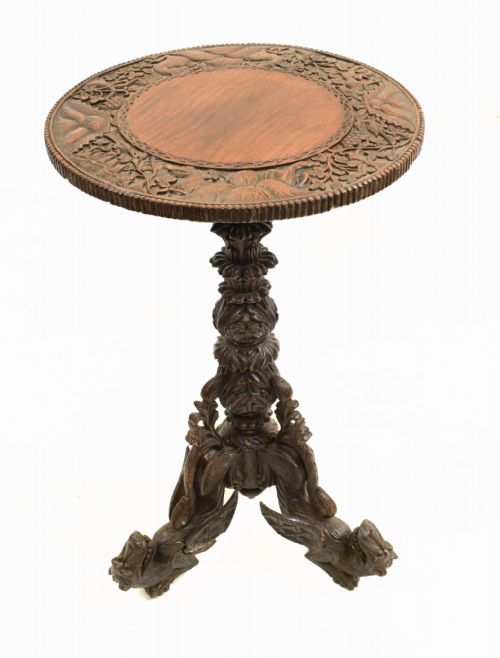
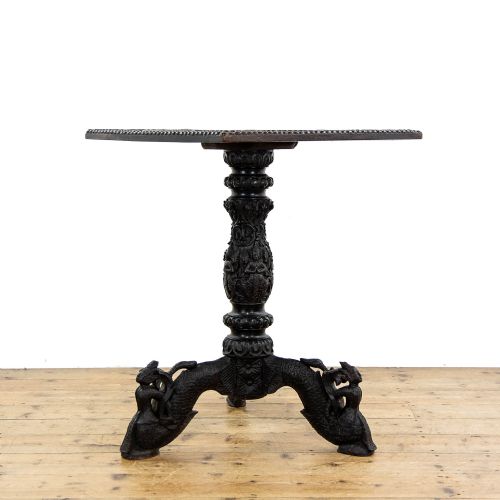
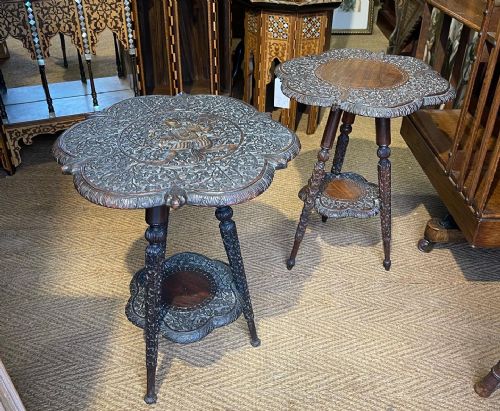
These carved teak lamp table examples bring rich colonial character and intricate woodwork into a room.
Carved Teak Lamp Table
A carved teak lamp table is a compact surface designed for illumination and display, rooted in nineteenth and early twentieth century international trade and colonial craftsmanship. Buyers seek these pieces for their dense timber and elaborate hand-carved surfaces that transform a simple corner into a focal point.
The pieces appearing on this page span several decades, reaching from mid-nineteenth century Victorian examples up to the 1930s. Forms include folding frames, tilt-top mechanisms, and fixed occasional tables originating from Indian, Burmese, and broader oriental workshops.
Anglo-Indian and Burmese styles dominate the selection, bringing deep relief carving, foliage motifs, and occasional bone inlay to standard domestic furniture. Most function as small side or occasional tables, easily adapted for modern lamps despite their historic origins.
Materials and Construction
Makers utilised dense tropical timbers, primarily teak, padouk, and general hardwoods, which provided a stable base for deep chisel work. Teak offered exceptional durability and a rich natural oil content that aged gracefully under regular handling.
Artisans applied hand-carving techniques directly to the solid wood, often combining pierced fretwork with high-relief floral and zoomorphic motifs. Folding mechanisms and tilt-top operations relied on clever wooden hinges and sturdy central pedestals rather than modern metal fixings.
Several tables appear ready to fold away instantly, proving that Victorian travellers appreciated flat-pack convenience just as much as modern decorators.
Factors That Separate the Best
Quality rests entirely on the crispness and depth of the hand-carving, where sharper chisel work and undercut details distinguish master workshops from hurried production. Timber selection also matters, as tightly grained teak takes a finer finish and resists splitting over decades of use.
Structural integrity sets apart superior tables, particularly in folding frames and tilt-top mechanisms that must operate smoothly without loose joints. The presence of secondary materials, such as precise bone inlay or integrated marble tops, elevates a standard occasional table into a more distinguished piece.
The Carved Teak Lamp Table Glossary
- Anglo-Indian
- A style describing furniture made in India during the British colonial period, often combining British furniture forms with traditional Indian carving techniques. This aesthetic produced distinctive occasional and side tables.
- Padouk
- A heavy, durable tropical hardwood with a reddish hue used in mid-nineteenth century furniture. It provides a dense base for intricate turning and relief work.
- Tilt-top
- A tabletop mechanism featuring a catch that allows the surface to rotate vertically for storage. This clever engineering was common on nineteenth-century occasional and tea tables.
- Bone inlay
- A decorative technique where small pieces of bone are set into carved recesses within the wood. It creates striking contrast against dark teak surfaces.
Carved Teak Lamp Table: Frequently Asked Questions
How do I date a carved teak lamp table?
Dating relies on examining construction methods, timber choice, and stylistic cues within the carving. Mid-nineteenth century pieces often feature heavier padouk or solid teak with deep, hand-chiseled botanical motifs.
Later examples from the early twentieth century may incorporate folding frames or simpler export designs. Comparing the piece to documented regional styles helps narrow down the decade of production.
Can these tables support heavy modern lamps?
Solid teak and hardwood construction makes these tables remarkably sturdy for everyday domestic use. Most were originally built to hold oil lamps, heavy tea services, or decorative objects.
Care should be taken with folding or tilt-top versions to ensure the locking mechanisms are secure before placing a heavy base on top.
How do I care for antique teak furniture?
Teak requires minimal maintenance due to its natural oils, needing only an occasional dusting with a dry, soft cloth. Avoid placing the table in direct sunlight or near heat sources that could dry out the wood.
Applying a neutral beeswax sparingly helps maintain the natural lustre of the carved surface without building up residue.
What is the difference between Anglo-Indian and Burmese pieces?
Anglo-Indian furniture typically reflects British domestic forms decorated with dense Indian foliage and scrollwork. Burmese pieces often feature even deeper relief carving and distinct figures or mythical animals.
Both styles utilise durable tropical hardwoods and share a history of production for export during the colonial era.