


Carved Oak Kneehole Desk
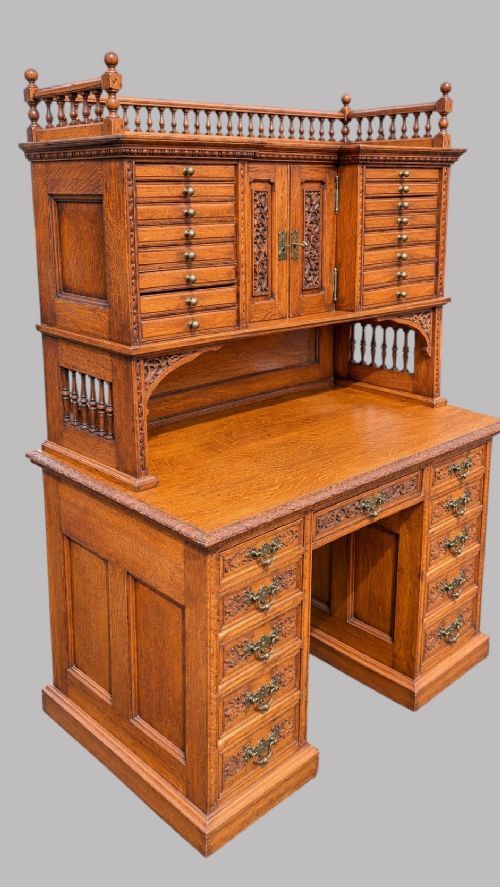
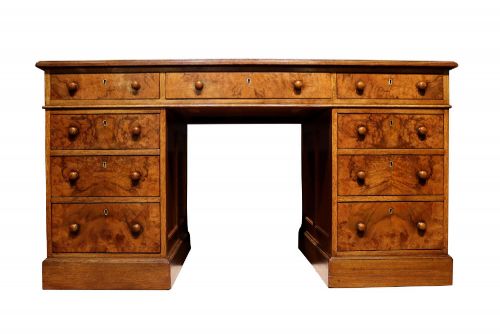
A carved oak kneehole desk is a sturdy pedestal workspace with central drawers, offering substantial storage and a distinctively textured wooden surface.

Carved Oak Kneehole Desk
A carved oak kneehole desk provides a compact writing workspace flanked by pedestals containing drawers and cupboards. These pieces appear most frequently from the Victorian period, though examples span from the eighteenth century into the early twentieth century.
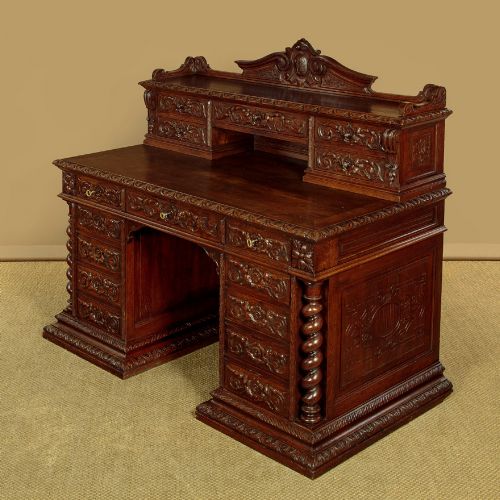
Makers often embellished these pedestal desks with deep relief carving, including Green Man motifs and lion heads. The central recess underneath the writing surface gives the form its name, separating the flanking banks of drawers.
Beyond standard pedestal layouts, variations include dressing tables and lowboys sharing the same kneehole configuration. Oak forms the primary structural timber, occasionally paired with walnut or mahogany in secondary elements.
Materials and construction
Cabinetmakers utilised solid oak for the primary carcass and framing, applying deep hand-carving directly to the drawer fronts, cupboard doors and pedestals. Secondary timbers such as mahogany or walnut sometimes appear in internal drawer linings and smaller panels.
Hardware typically consists of brass handles and escutcheons, occasionally cast as lions' masks or shaped drops. Writing surfaces frequently incorporate inset panels of leather, providing a contrasting texture to the surrounding carved timber.
Many a Victorian writer found themselves watched over by carved wooden lions and leafy Green Men glaring out from the drawer fronts.
Assessing quality
Quality rests upon the crispness of the hand-carving and the thickness of the oak boards used in construction. Finer examples display deeply undercut foliage and figures rather than shallow machine milling.
The integration of original brass hardware and working locks with keys elevates a desk's standing. Proportion and the careful matching of timber grain across the pedestals and drawers also distinguish superior cabinetmaking.
Shapland and Petter·Gillow and Co·Thomas Turner·Howard and Son
The Carved Oak Kneehole Desk Glossary
- Kneehole
- A recessed space beneath the central desk surface designed to accommodate the user's legs. This arrangement allows banks of drawers to sit on either side.
- Pedestal desk
- A heavy freestanding writing table supported by two vertical columns of drawers. The top rests directly upon these two pedestals.
- Green Man
- A sculptural architectural ornament depicting a human face carved from or entwined with leaves and vines. It appears frequently on nineteenth-century carved oak furniture.
- Lowboy
- A small seventeenth or eighteenth-century dressing table or writing desk standing on relatively tall legs. These often feature a single row of drawers above the kneehole space.
- Pollard oak
- Timber taken from trees that have been repeatedly cut back at the trunk, producing a dense cluster of shoots. This creates a highly figured, mottled grain pattern.
Carved Oak Kneehole Desk: Frequently Asked Questions
What is a kneehole desk?
A kneehole desk is a pedestal writing table featuring a central recessed space for the user's legs, flanked by columns of drawers or cupboards.
This compact layout provides substantial storage beneath the writing surface without sacrificing legroom.
How do I date a carved oak desk?
Dating relies on stylistic clues, hardware types, and construction methods. Victorian examples often display heavy relief carving and brass hardware.
Earlier eighteenth-century pieces tend to feature simpler lines and pegged joints, whereas twentieth-century items incorporate different internal framing techniques.
Where were these desks placed?
These desks served in private libraries, studies, and drawing rooms of large houses. Their finished backs sometimes allowed them to sit in the middle of a room rather than against a wall.
They provided a private workstation for correspondence and household administration.
Are writing surfaces always leather?
Writing surfaces frequently incorporate inset leather panels, though many examples consist entirely of solid carved oak. Leather provided a smooth, durable medium for writing with ink.
When present, the leather is often tooled with gilt borders.