


Carved Oak Credence
These carved oak credence pieces bring deep timber and historical character to a room, spanning the seventeenth century up through revival eras.
Carved Oak Credence
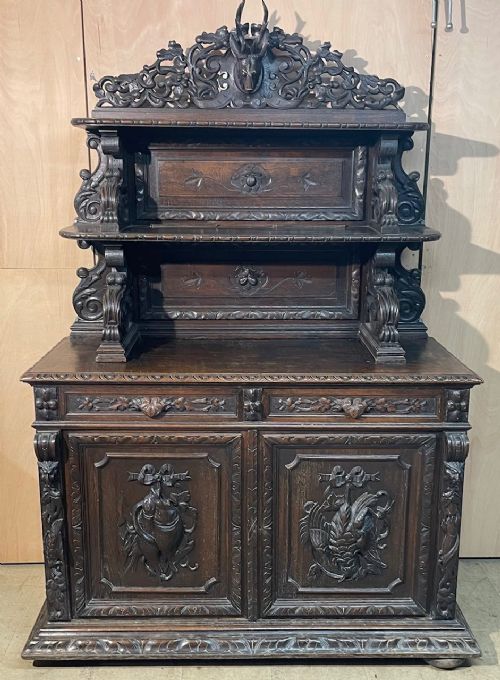
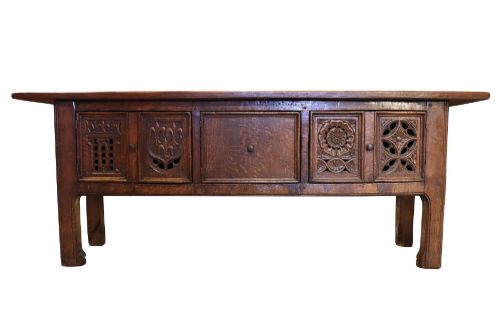
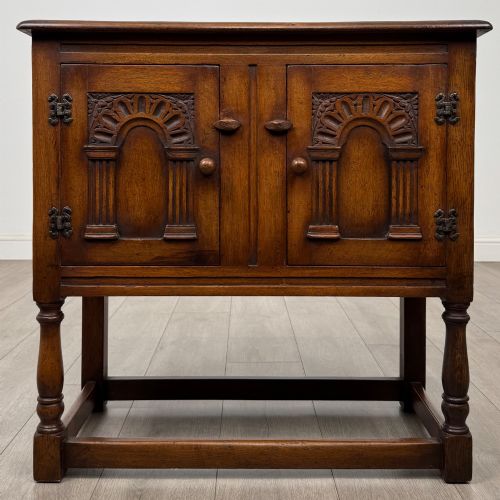
When you search for carved oak credence, you encounter a distinct group of historical and revival furniture built from solid timber. These items range from genuine seventeenth-century tables and cupboards to late nineteenth-century Gothic revival adaptations and early twentieth-century reproductions.
The forms vary across this selection, taking shape as side tables, console tables, court cupboards, and sideboards. Credence tables and cabinets often feature folding tops or canted sides that reveal concealed storage spaces beneath heavy timber construction.
You meet pieces originating from English workshops as well as French provincial traditions, showcasing regional interpretations of Jacobean and Gothic styles. The survivals include early pieces with later additions alongside purpose-built nineteenth-century revival items.
What varies in quality
The depth and crispness of the hand carving separate standard examples from finer works. Crisp undercut relief and well-defined floral or geometric motifs indicate skilled execution by the carver.
The proportion of original seventeenth-century fabric versus later replacement timber influences the character of older pieces. Cohesion in the timber selection and the integrity of the original joints determine the overall structural success of the item.
Materials across these listings are strictly limited to solid oak timber and structural iron hardware.
The Carved Oak Credence Glossary
- Credence table
- A table featuring a folding top that opens to reveal a concealed surface, historically used for placing church sacraments or domestic items. These often stand on slender or columnar legs connected by stretchers.
- Court cupboard
- A heavy storage piece consisting of an upper cabinet recessed above a wider lower section, typically supported by robust carved posts. They provide substantial enclosed space behind panelled doors.
- Jacobean revival
- A nineteenth-century style that mimics the heavy, rectilinear forms and geometric strapwork carving of the early seventeenth century. Makers utilised this aesthetic to evoke older domestic architecture.
- Gothic revival
- A design movement drawing inspiration from medieval ecclesiastical architecture, featuring pointed arches, tracery, and dense relief carving. Pieces in this style often display narrow proportions and strong vertical lines.
Carved Oak Credence: Frequently Asked Questions
What is a credence table used for?
Historically, credence tables served utilitarian and ceremonial purposes in both ecclesiastical and domestic settings. The folding top design allowed extra surface area to be deployed when needed for serving or display.
In modern rooms, these tables function well as side tables or console surfaces in hallways and living spaces. Their compact depth makes them practical for placement against walls where floor space is limited.
How do I date an oak credence piece?
Dating relies on examining the construction methods, tool marks left on the timber, and the style of the carving. Seventeenth-century examples display hand-split or sawn boards and pegged joinery consistent with early hand tools.
Revival pieces from the nineteenth and twentieth centuries often reveal more uniform machining marks or machine-cut screws. Comparing the style of the linenfold or strapwork carving against known period exemplars also helps establish the era of manufacture.
Are these pieces made of solid oak?
The majority of pieces listed under this category utilise solid oak throughout their primary framework and panels. Oak was valued for its strength and ability to hold deep relief carving.
Some later revival examples or items with later additions might incorporate secondary timbers in concealed areas like drawer linings or backboards. Inspecting the grain and weight helps confirm the extent of solid timber construction.
How do I care for antique oak furniture?
Maintenance requires keeping timber away from direct heat sources and extreme humidity fluctuations to prevent splitting. Applying traditional beeswax periodically helps nourish the grain and maintain a soft sheen.
Avoid modern silicone polishes that build up a residue on the surface over time. Dusting with a dry, soft cloth is sufficient for routine upkeep.