



Carved Oak Church Pew
These carved oak church pew examples bring solid timber ecclesiastical craft directly into domestic hallways, libraries and kitchens.
Carved Oak Church Pew
A carved oak church pew is a substantial ecclesiastical bench designed for communal seating in religious buildings, repurposed for domestic and architectural settings. When searching for a carved oak church pew, you encounter long benches, settles, panelled hall seats and individual architectural fragments originating from periods spanning the eighteenth to the early twentieth century.
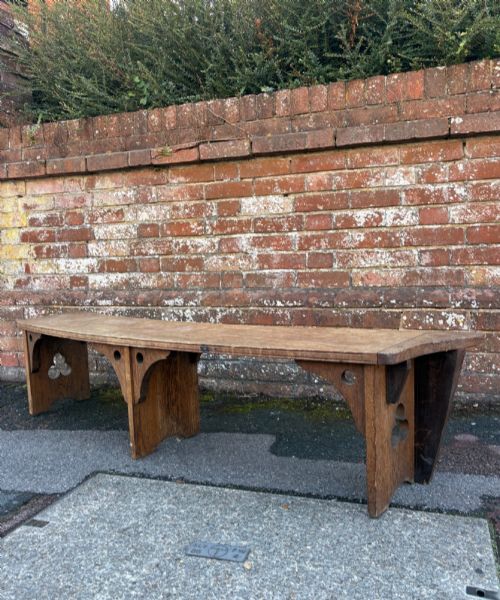
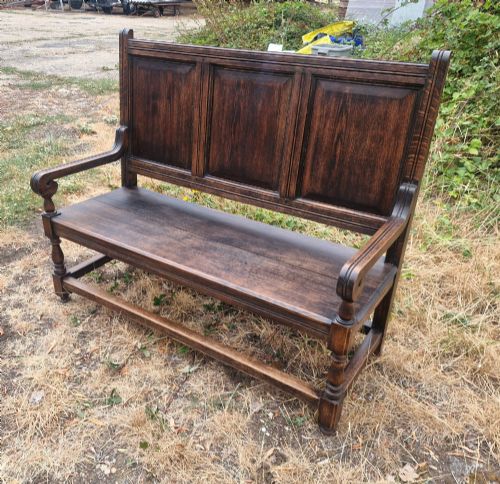
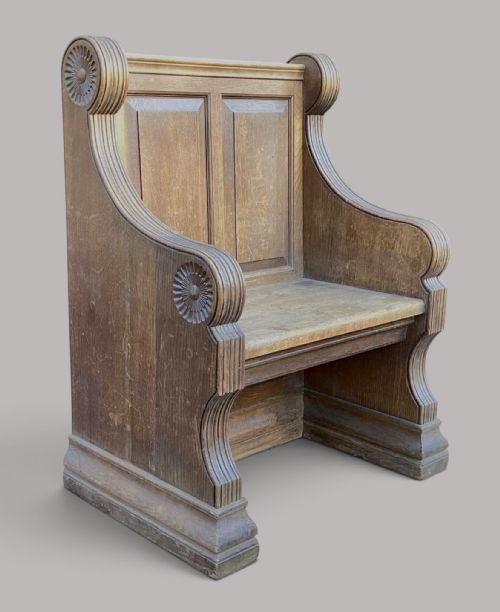
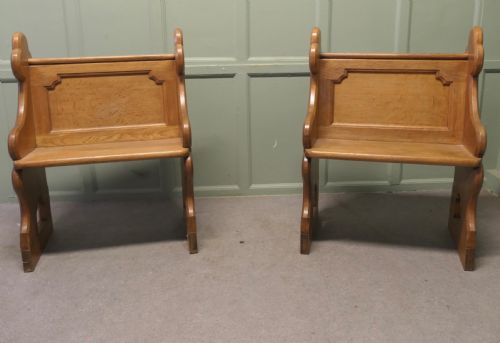
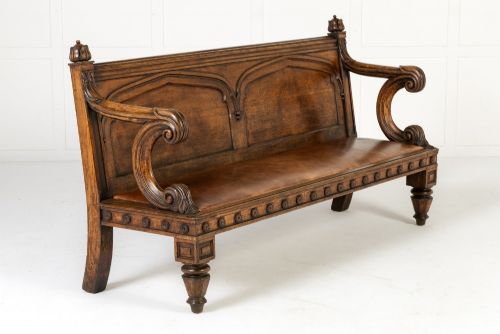
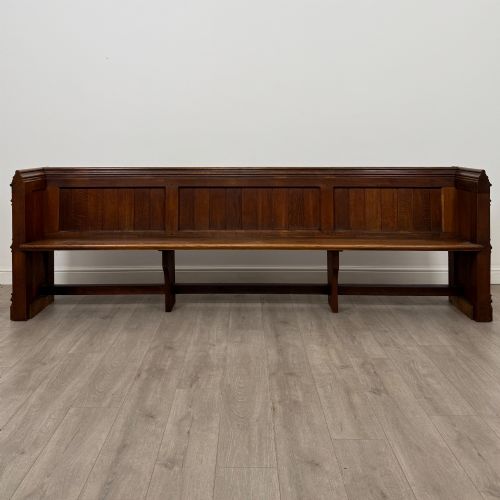
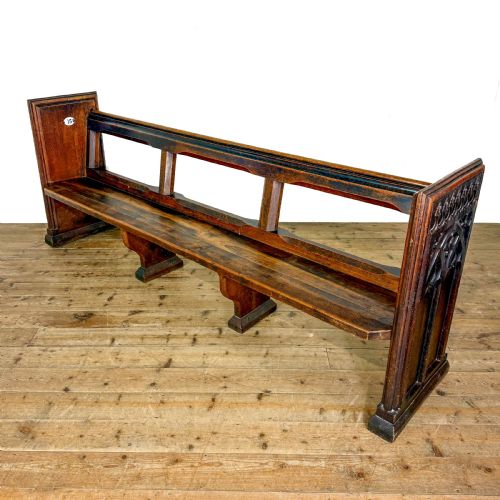
The specimens seen here range from plain nineteenth century country pews and Edwardian panelled hall seats to elaborate Gothic Revival forms displaying trefoil carved supports and poppy head finials. Many pieces carry clear provenance from specific ecclesiastical foundations or display regional country house characteristics.
Victorian Gothic Revival interpretations dominate the selection alongside Arts and Crafts variants and earlier eighteenth century country items. The forms vary from straight benches with high backs to curved iterations and modular architectural panels.
What varies in quality
Quality rests in the depth and crispness of the hand carving upon the poppy heads, bench ends and panels. Sharply chiselled figures and detailed tracery separate standard utilitarian seating from workshop pieces reflecting Pugin style design or specific architectural commissions.
The integrity of the solid timber and the preservation of original patination dictate the standing of a piece. Original provenance linking a pew to a named cathedral or parish church elevates the historical interest of the object.
Listings feature oak material predominantly, paired occasionally with leather or fabric elements across Victorian, Edwardian and eighteenth century periods.
The Carved Oak Church Pew Glossary
- Poppy head
- An ornamental finial carved on the top of a bench end, frequently shaped like a leaf, poppy seed head, or grotesque figure. These decorative terminations anchor the ends of ecclesiastical seating.
- Gothic Revival
- An architectural and decorative style drawing inspiration from medieval design forms, prominent during the Victorian era. This aesthetic manifests through pointed arches, trefoils and heavy tracery.
- Settle
- A wooden bench with a high back, solid arms and often a storage box beneath the seat. They shield occupants from draughts in domestic interiors.
- Architectural salvage
- Building elements rescued from structures slated for demolition or alteration. These fragments include panels, pew ends and carved sections.
- Trefoil
- A graphic ornament composed of three overlapping rings or lobes, resembling a clover leaf. You see this motif pierced through wooden bench supports and tracery.
Carved Oak Church Pew: Frequently Asked Questions
How do I place a church pew in a hallway?
A long bench fits flat against a narrow entrance wall, providing a firm seat for removing boots and shoes.
Ensure you measure the length of the space carefully, as these wooden benches often span generous proportions.
What is a poppy head finial?
A poppy head is the carved wooden ornament capping the vertical end panel of an ecclesiastical pew.
These decorative terminals often take the form of stylised foliage, animals or human figures.
Are these pews made from solid oak?
The listings show heavy construction using solid timber throughout the frames, panels and seats.
This robust material allows the benches to withstand heavy daily use over centuries.
How do I tell Victorian Gothic Revival apart from earlier work?
Victorian Gothic Revival pieces often display crisp, machine assisted uniformity and distinct nineteenth century stylistic interpretations.
Earlier eighteenth century items show the tool marks and simpler timber preparation typical of country joinery.