
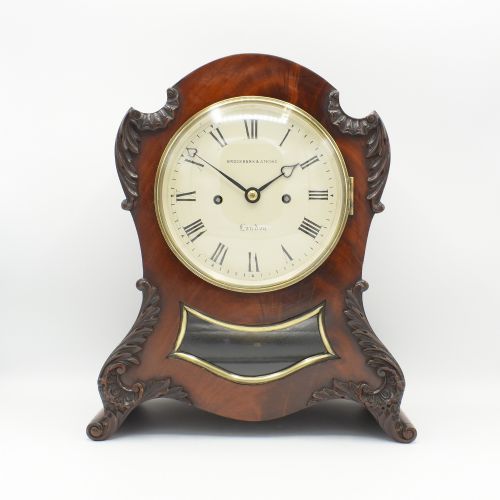
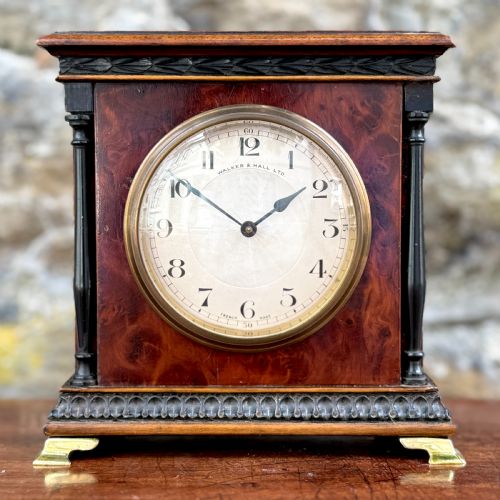
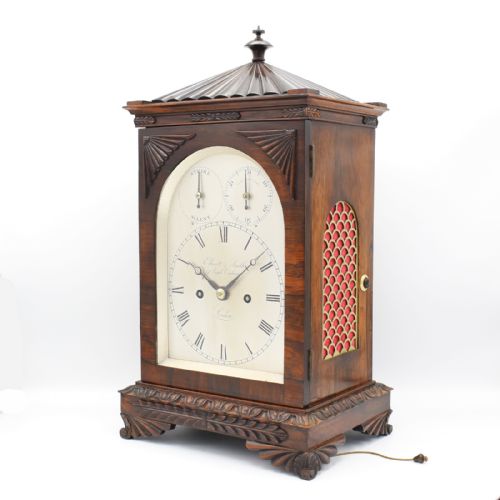
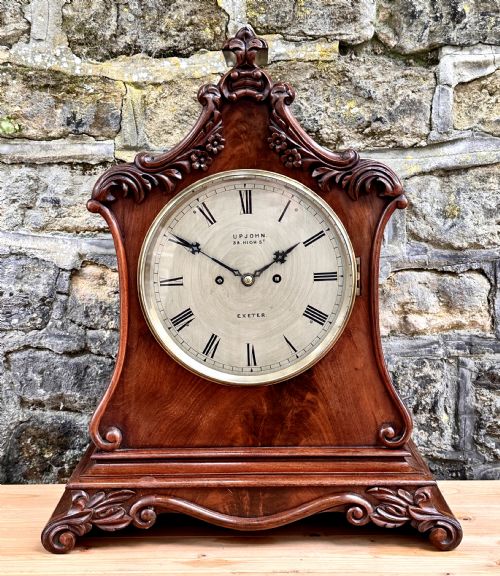


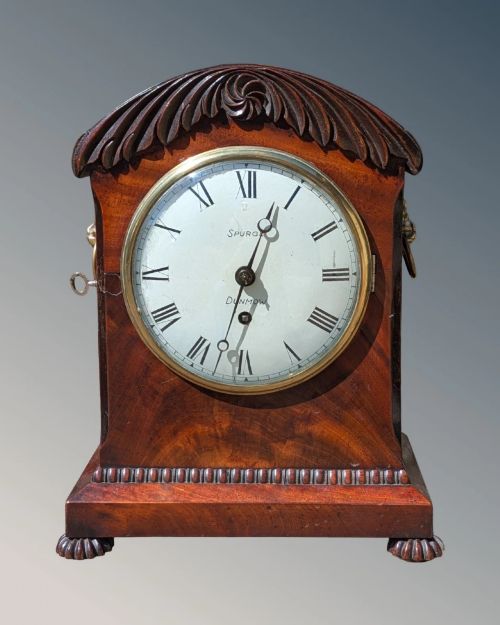
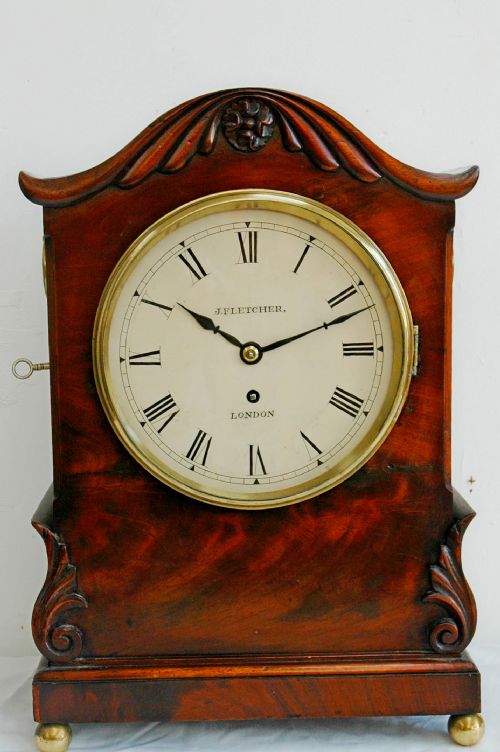


Carved Mahogany Bracket Clock
A carved mahogany bracket clock brings mechanical precision and rich timber warmth into a room, anchoring the space with traditional horological craft.
Carved Mahogany Bracket Clock
A carved mahogany bracket clock sits on a table, desk, or dedicated wall shelf to tell time through intricate mechanical gear trains. When you search for a carved mahogany bracket clock, you encounter pieces spanning the Georgian, Regency, William IV, and Victorian periods.
The objects on this page primarily take the form of mantel clocks, table clocks, and fusee bracket clocks housed in dark timber cases. Many examples incorporate carved details, architectural elements like pagoda or pad tops, and brass fittings.
Most entries originate from nineteenth-century workshops, ranging from provincial makers to prominent London watchmakers. These timepieces served as functional art in period homes, designed for both domestic utility and formal display.
Materials and Construction
Makers built the structural cases using dense, rich mahogany, occasionally accentuating surfaces with burr walnut, ebonised wood, or ormolu mounts. Glass panels protected the dial while brass components formed the intricate interior movements.
The mechanical heart relied upon fusee movements, driven by chains or cords that maintained even tension as the mainspring unwound. Enamel dials provided a crisp surface for painted numerals, paired with delicate metal hands.
Some models feature a pull-repeat mechanism, letting owners check the hour in the dark by pulling a small cord.
Distinctions in Quality
Quality reveals itself in the crispness of the timber carving and the complexity of the movement, such as double fusee systems or striking and repeating mechanisms. Superior examples feature well-proportioned architectural cases with balanced wood grain and signed brass dial plates.
Lesser pieces display simpler single fusee movements with plain cases and minimal decorative carving. The reputation of the maker, from London workshops to regional horologists, further elevates the standing of an individual clock.
Brockbanks and Atkins·Walker and Hall·Ellicott and Smith·Bush of London·Webster Cornhill London·Spurge Dunmow·Mappin and Webb·Piggin Norwich·Geo Carter Hackney·Barrett London·J Kingerley Manchester·Hampson and Son·J A Wheatley Carlisle·Funnell of Brighton·J W Benson·Purvis of London·Goldsmiths and Silversmiths London·Osborn of Bognor Regis·Edwards Of London
The Carved Mahogany Bracket Clock Glossary
- Fusee
- A conical pulley used in a clock movement to maintain constant power as the mainspring unwinds. This mechanism ensures accurate timekeeping throughout the duration of the wind.
- Bracket clock
- A portable timekeeper originally designed to sit on a wall bracket to allow better sound projection and visibility. Over time, the term came to describe larger table and mantel clocks of similar architectural form.
- Timepiece
- A clock that measures and indicates the time without including a striking mechanism for hours or quarters. These simpler movements focus entirely on the passage of hours and minutes.
- Pagoda top
- An Asian-inspired tiered roof style used on the upper portion of eighteenth and nineteenth-century clock cases. This decorative silhouette adds height and architectural drama to the timber housing.
- Dial
- The face of the clock where numerals are displayed and pointed to by hands. Enamel and painted metal versions provide a contrasting background for easy reading.
Carved Mahogany Bracket Clock: Frequently Asked Questions
What is the difference between single and double fusee movements?
A single fusee movement powers only the timekeeping train, meaning the clock simply tells the time. A double fusee movement adds a second train to drive a striking or chiming mechanism.
Clocks with double fusee systems generally require two separate winding holes on the dial face.
Where should I place a bracket clock in my home?
Position the clock on a sturdy, level mantelpiece, heavy sideboard, or a secure wall bracket away from direct sunlight and drafts. A stable foundation prevents vibrations that can disrupt the delicate pendulum or balance.
Ensure the location allows easy access for the weekly winding routine.
How can I tell a Victorian clock from a Regency one?
Regency clocks typically feature cleaner classical lines, brass inlay, and restrained mahogany veneers influenced by the Federal and Empire styles. Victorian examples often introduce heavier carvings, more ornate dial surrounds, and elaborate architectural silhouettes.
Examining the maker signature and interior movement construction helps confirm the period of manufacture.