
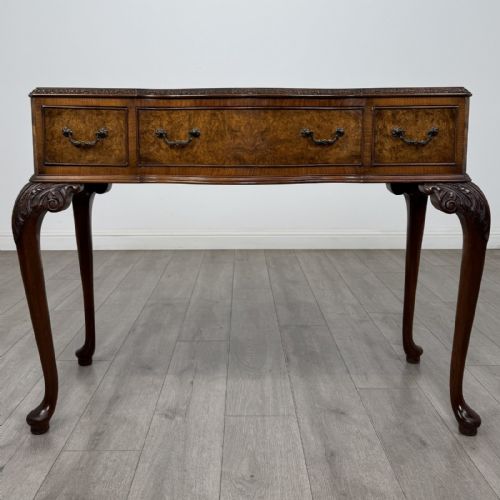
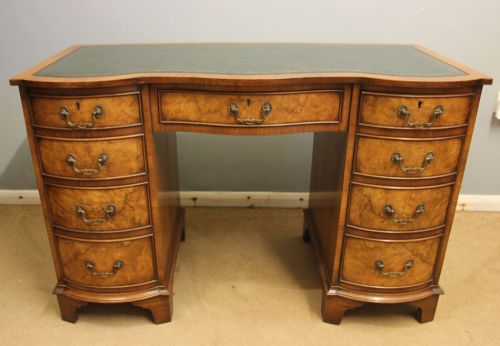


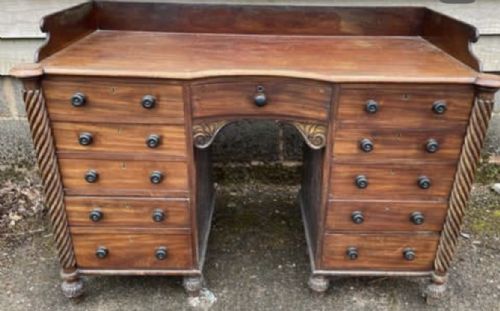


Carved Knee Writing Table
These carved knee writing table examples offer solid timber construction and distinct period character for your study.
Carved Knee Writing Table
A carved knee writing table is a dedicated piece of furniture designed for correspondence and paperwork, featuring a central recess for the legs. These desks appear in various forms, from compact 18th-century walnut pieces to larger Victorian and Edwardian iterations in mahogany and oak.
The most common examples you will encounter here date from the Victorian era and the early decades of the twentieth century. These later pieces often adopt earlier aesthetic revivals, such as Queen Anne style cabriole legs and Georgian revival proportions.
Makers utilised resilient hardwoods like mahogany and walnut, frequently incorporating burr veneers to add rich grain patterns to the writing surfaces and drawer fronts. Regional variations in proportion and hardware reflect the changing domestic requirements of their respective periods.
How they were made
Cabinet makers constructed these tables using dense timbers such as mahogany, oak, and walnut, often applying decorative burr walnut veneers to the primary facades. Structural framing frequently incorporated secondary woods like pine for internal components and drawer linings.
Surface ornamentation relied on hand carving, particularly around the knees and cabriole legs, alongside applied brass handles and escutcheons. Leather inserts were commonly fitted into the top surfaces to provide a suitable medium for writing.
Joinery methods involved traditional dovetailed drawers and mortise and tenon frames, ensuring the stability required for daily writing tasks. Finishes were typically built up using shellac-based polishes that highlighted the natural figure of the wood.
Secret compartments and hidden drawers often lurk behind the pedestals of these desks, waiting for future owners to discover them.
What varies in quality
The selection of timber significantly influences the overall grade of the piece, with figured burr walnut and well-matched mahogany veneers representing the higher end of craftsmanship. Lesser examples rely on plain native hardwoods with minimal decorative figure.
The crispness and depth of the hand carving on the knees and legs distinguish superior examples from simpler, more mechanical production. Finer tables maintain harmonious proportions across the pedestals and writing surface, while lower-tier pieces can appear blocky or heavy.
Internal construction details, such as hand-cut dovetails on the drawer boxes and the retention of original brass hardware, separate master-built pieces from later utility furniture.
Waring and Gillows
The Carved Knee Writing Table Glossary
- Cabriole leg
- A furniture leg that bends outward and then tapers inward, terminating in a foot. This form was popularised during the early eighteenth century and revived in later periods.
- Burr walnut
- A veneer sliced from the deformed growth or burl of a walnut tree. It yields highly figured, swirling grain patterns prized for decorative cabinet work.
- Dovetail
- A joint formed by interlocking wedge-shaped fingers, used primarily in drawer construction. It provides exceptional tensile strength against being pulled apart.
- Escutcheon
- A protective plate surrounding a keyhole. These fittings are commonly made of brass and serve both functional and decorative purposes.
- Pedestal
- A structural support base containing rows of drawers. Desks with two such supports flanking the central kneehole are often referred to as pedestal desks.
Carved Knee Writing Table: Frequently Asked Questions
How do I date a knee hole desk?
Dating relies on examining the secondary timbers, construction methods, and stylistic cues present in the piece. Earlier examples from the eighteenth century often feature solid walnut or mahogany with hand-cut dovetails, while 19th- and 20th-century versions may show machine-sawn elements and revival styling.
Hardware and drawer linings also provide chronological clues. Original brasses and oak or pine internal boards help confirm whether a desk belongs to the Georgian period or a later Edwardian revival.
Where were these desks placed?
These tables were traditionally positioned in studies, libraries, or private drawing rooms as functional writing stations. Their finished backs sometimes allowed them to stand freestanding within a room rather than pushed directly against a wall.
Pedestal variants offered the advantage of integrated storage without occupying a large floor footprint. This made them suitable for domestic administration and correspondence in period homes.
Are these desks suitable for daily work?
Many of these tables function well as modern workspaces, provided the height and knee clearance match your ergonomic needs. Their solid wood construction handles contemporary use efficiently.
Care should be taken with antique leather writing surfaces and polished wood finishes. Using desk pads or blotters helps protect the historical materials from daily wear.
How do I maintain the wood finish?
Maintenance involves regular dusting with a soft, dry cloth and avoiding placement near direct heat sources or strong sunlight. These precautions prevent the timber from drying out and the polish from fading.
Applying a traditional beeswax polish occasionally helps nourish the wood and maintain the lustre of the finish. Harsh chemical cleaners should be avoided entirely to preserve the original patina.