
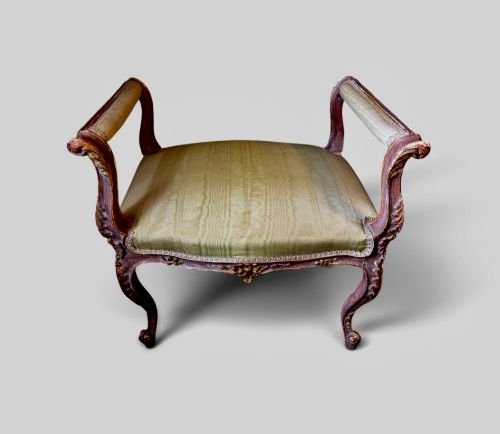
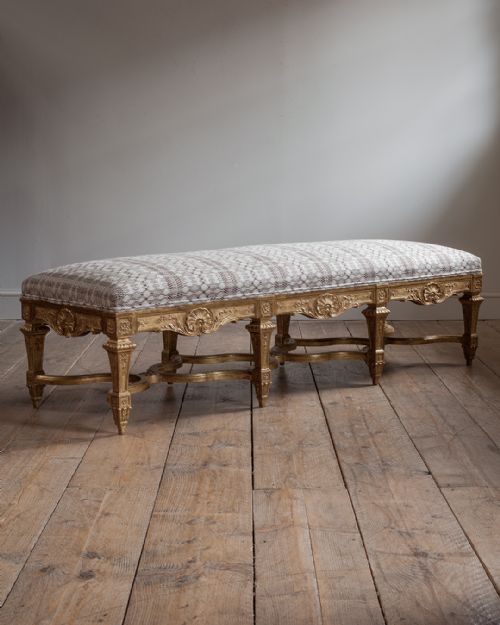
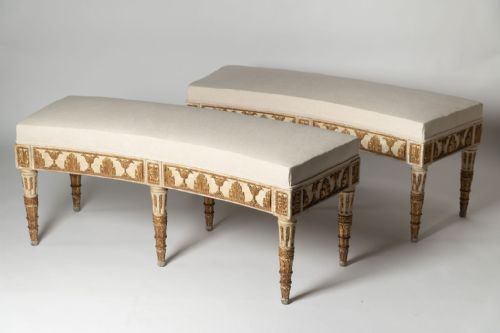


Carved Gold Window Seat
A carved gold window seat brings gilded refinement and architectural presence to a hall or alcove.
Carved Gold Window Seat
A carved gold window seat forms a compact form of seating designed for placement beneath a window or along a passageway wall, uniting utility with decorative display. When you search for this phrase, you encounter pieces spanning the eighteenth century through the early twentieth century, alongside Victorian interpretations.
The selections on this page lean heavily toward French and Italian aesthetic traditions, featuring Rococo Revival, Neoclassical, and Louis XVI styles. You will find forms ranging from single stools and curule benches to longer duet stools and two-seater window sofas.
Makers drew upon diverse regional idioms, producing items that balance formal grandeur with domestic scale. The physical evidence shows both dedicated window seats and versatile stools that serve the same spatial function.
Materials and construction
The primary structural material in the gilded examples is timber, specifically shaped as giltwood or prepared with gesso before application of the gold finish. Solid wood variants also appear in golden oak and mahogany across different regional workshops.
Upholstered elements rely on traditional textiles, incorporating fabric, silk, linen, and general textile coverings to pad the seat platform. Artisans carved the wooden frames by hand before applying the surface gilding that defines the visual character of the pieces.
The listings here combine nineteenth-century giltwood forms with eighteenth-century mahogany settees and Arts and Crafts golden oak variants.
What separates the finest examples
Quality rests upon the crispness of the hand-carved ornamentation and the depth of the gilding on the timber substrate. Superior pieces display fluid lines in styles like Louis XVI or Rococo Revival, where the carved motifs retain sharp definition rather than softening under layers of later finish.
The integrity of the underlying timber frame and the quality of the textile upholstery further distinguish the output of skilled workshops from utilitarian production. Harmonious proportions between the length of the seat and the height of the legs separate masterwork forms from simpler benches.
The Carved Gold Window Seat Glossary
- Giltwood
- Wood that has been coated with gold leaf or powder over a prepared ground such as gesso. This finish creates the luminous metallic surface characteristic of formal seating from the eighteenth and nineteenth centuries.
- Curule stool
- An ancient Roman magistrate seat form revived in later centuries, featuring intersecting curved legs that form an X-shape. It provides a distinct architectural silhouette compared to standard four-legged benches.
- Gesso
- A plaster-like mixture applied to wood surfaces to prepare them for gilding or painting. It allows carvers to achieve fine, sharp relief details before the gold leaf is laid down.
- Rococo Revival
- A nineteenth-century design movement inspired by the curves, asymmetry, and naturalistic motifs of the mid-eighteenth-century French court. It manifests in flowing frames with leaf and scroll carving.
- Neoclassical
- A style drawing on classical Greek and Roman art, prioritising symmetry, straight lines, and classical motifs such as urns, fluting, and laurel wreaths. It appears frequently in French and Italian pieces from this group.
Carved Gold Window Seat: Frequently Asked Questions
Where should I place a window seat?
These pieces suit narrow hallways, bedroom alcoves, and beneath large windows where low backs preserve the view.
Their compact proportions allow them to function as secondary seating without crowding a room.
How do I identify a Louis XVI style seat?
Louis XVI pieces typically display straight fluted legs, geometric symmetry, and classical motifs derived from ancient excavations.
In contrast to the flowing curves of earlier Rococo designs, these frames emphasise architectural order and restrained carving.
Are these seats comfortable for daily use?
Most of these forms were intended for formal reception rooms and transient seating rather than prolonged lounging.
The firm upholstery and supportive wooden frames are designed for upright posture in a hallway or drawing room.
What is a curule stool?
A curule stool uses an X-shaped frame derived from ancient Roman folding furniture.
This structural layout gives the seat a lighter visual footprint while maintaining robust load-bearing strength.