
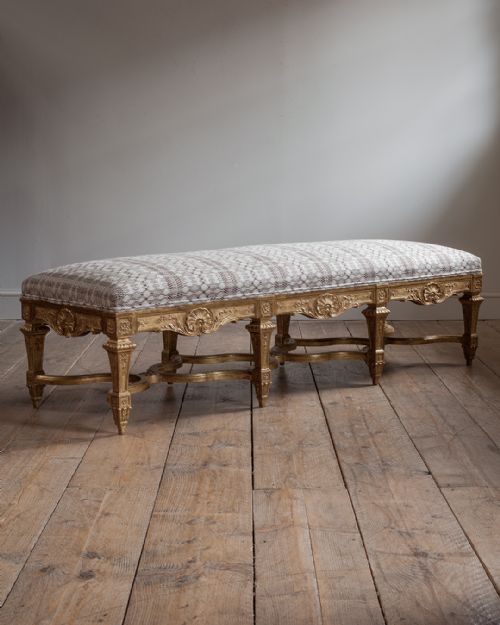
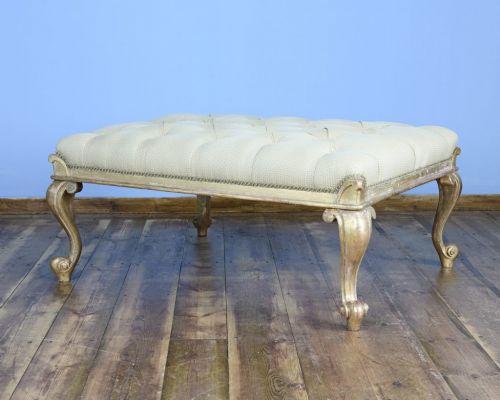

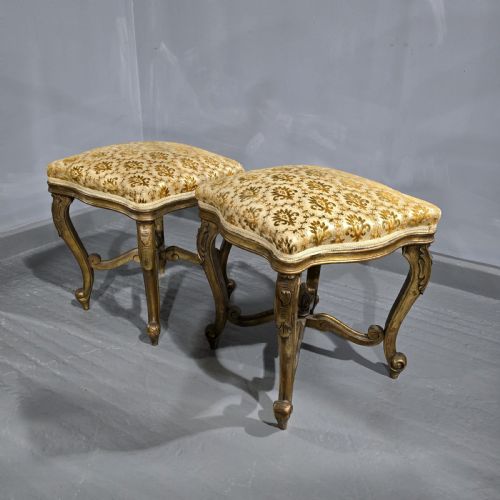
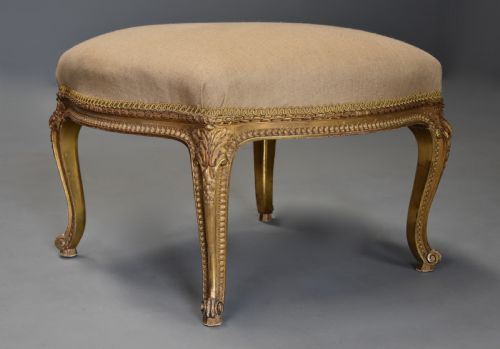


Carved Giltwood Footstool
A carved giltwood footstool offers a touch of opulent scale and textile warmth, bringing period French and English seating craft directly to the floor.
Carved Giltwood Footstool
A carved giltwood footstool brings formal seating traditions down to floor level, drawing from Georgian, Victorian, and various continental styles. When exploring a carved giltwood footstool, buyers most frequently encounter pieces spanning the nineteenth century, finished with carved wooden frames and soft textile upholstery.
The selection ranges from grand parcel gilt examples to low X-frame curule shapes and French revival designs. Makers and workshops from Paris and London produced these forms to complement larger parlour armchairs and formal drawing room suites.
How they were made
Makers shaped structural timber using traditional hand-carving methods before applying layers of gesso to prepare the surface for gilding. The exposed wood receives a gilt finish, highlighting the intricate scrollwork and floral motifs carved into the frame.
Upholstery completes each piece, utilising traditional textiles such as velvet, linen, and patterned fabrics fastened securely to the wooden base. Parcel gilt variants combine gilded highlights with exposed timber or paint to emphasise specific architectural details.
The documented periods stretch from Georgian and William IV eras through nineteenth-century French revival movements.
What varies in quality
The distinction between standard production and exceptional work lies in the crispness of the wood carving and the depth of the gesso preparation beneath the gold leaf. Superior examples display sharply defined relief work on the frame rather than soft or moulded ornamentation.
Integration between the structural timber and the upholstery foundation dictates the overall integrity of the piece. Master workshops invested greater care in joint construction and the durability of the textile covering.
Loidrault Freres Paris·Miles & Edwards·A.M.E. Fournier
The Carved Giltwood Footstool Glossary
- Giltwood
- Timber treated with a gold leaf or metallic powder finish applied over a prepared gesso ground. This surface treatment gives furniture a bright, reflective metallic appearance.
- Gesso
- A plaster mixture applied to wood frames to create a smooth surface for gilding and fine carving. It allows artisans to carve intricate details that hold sharp edges.
- Curule stool
- An ancient Roman magistrate's chair form featuring intersecting X-shaped legs. Nineteenth-century makers revived this classical design for portable or low seating.
- Parcel gilt
- A decoration method where only specific portions of a wooden object receive gilding while the rest remains exposed timber or painted. This technique creates visual contrast across the carved elements.
- Louis XVI style
- A neoclassical design vocabulary characterised by straight tapered legs, symmetry, and classical motifs. It provides a restrained contrast to earlier curved baroque forms.
Carved Giltwood Footstool: Frequently Asked Questions
What periods do these stools span?
The available selection primarily encompasses nineteenth-century production alongside later revival pieces from the early twentieth century.
Georgian and Victorian examples sit alongside French stylistic revivals such as Louis XV and Louis XVI designs.
Can I use these stools for daily sitting?
These decorative items function well as occasional seats or foot supports when placed in low-traffic areas of a room.
Heavier everyday seating demands careful consideration of the antique frame's structural integrity and the vintage upholstery's condition.
How do I identify French revival styles?
French revival pieces display characteristic scrollwork, cabriole legs, and asymmetrical floral carving inspired by royal court aesthetics.
Comparing the decorative motifs against documented nineteenth-century cabinetmaker outputs helps clarify the specific regional design influence.