


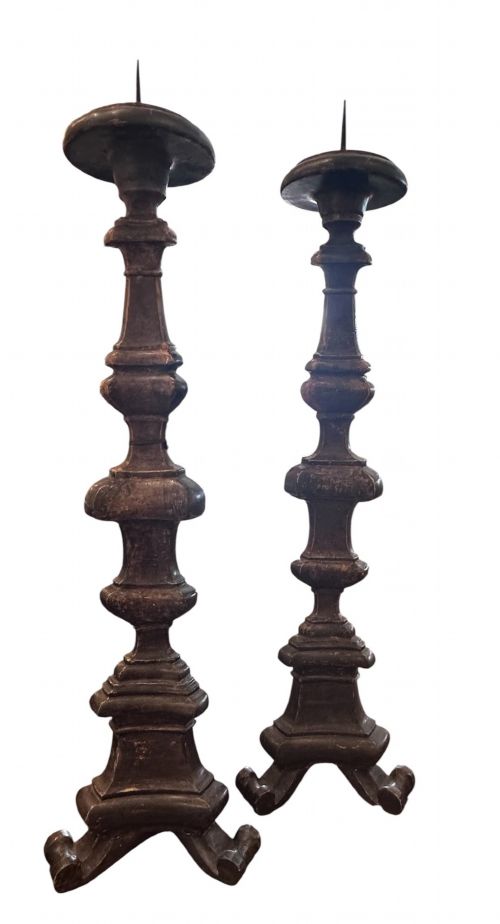


Carved French Candle Holders
These carved french candle holders bring distinct continental lighting to a room, spanning wall sconces, prickets and candelabra from the nineteenth century.
Carved French Candle Holders
Carved french candle holders encompass wall lights, candelabra, chandeliers and table lamps originating from various periods including the nineteenth century and the eighteen eighties. Collectors encounter items shaped as single candlesticks or multi-branch fixtures, often designed in French Neoclassical, Baroque, Louis XVI and Rococo styles.
The selection ranges from wooden prickets and treen to larger carved three-branch sconces and giltwood pairs. Pieces frequently display traditional continental forms, serving both practical illumination and decorative roles within a interior space.
How they were made
Materials span giltwood, gesso, carved wood, gold leaf, silver leaf, paint, brass, iron and silvered bronze. Artisans shaped these mediums by hand, applying decorative surface treatments such as gilding over gesso and wood.
Metal components in brass and iron were cast and worked into wall sconces and candlesticks, while wooden supports received detailed carving characteristic of French chateau and baroque aesthetics.
Materials documented across the inventory include giltwood, gesso, carved wood, gold leaf, paint, brass, iron and silvered bronze.
What varies in quality
Execution of the carved detail distinguishes standard items from finer examples, particularly in the precision of wooden foliage and figural elements like cherubs. The preservation of original giltwood, gold leaf and silver leaf surfaces heavily influences the overall character of a piece.
Subtlety in the application of paint and gesso under layers of gilding separates master craftsmanship from simpler production, alongside the structural integrity of multi-branch candelabra and prickets.
Ferdinand Barbedienne
The Carved French Candle Holders Glossary
- Pricket
- A candlestick featuring a central spike designed to impale the base of a candle, commonly seen on altar and church pieces. These often appear in nineteenth-century wood and gilt finishes.
- Giltwood
- Timber that has been coated with a thin layer of gold leaf or gold paint over a prepared gesso ground. This technique creates a rich metallic sheen on decorative carved items.
- Candelabra
- A branched decorative candlestick holder designed to support multiple candles simultaneously. Examples in this category often feature two, three or more lights.
- Wall Sconce
- A light fixture fixed to a wall that uses decorative brackets to hold candles or lamps. These range from single-light brass designs to large carved wooden multi-branch versions.
- Gesso
- A plaster mixture applied to wood surfaces as a smooth base before gilding or painting. It allows carvers to achieve crisp relief details under gold or silver leaf.
Carved French Candle Holders: Frequently Asked Questions
How do I clean giltwood candle holders?
Dust surfaces gently with a soft dry brush to protect the delicate gold leaf and gesso layers from damage.
Avoid using water, liquid cleaners or chemical polishes, as moisture lifts the historical gilding from the wood beneath.
What is a pricket candlestick?
A pricket candlestick uses an upright metal spike instead of a socket to hold the candle securely in place.
This traditional format appears frequently on nineteenth-century wooden altar sticks and continental church pieces.
How are wall sconces mounted?
Wall sconces feature integrated backplates or hanging loops designed to secure firmly onto wall fixings.
Heavier multi-branch wooden and brass versions require secure wall anchors to support their substantial weight safely.
Can I burn real candles on antique holders?
Real candles fit safely on sturdy metal prickets and wide cups, provided the flame remains monitored.
Wooden and gilt pieces benefit from drip protectors or glass shades to prevent wax and heat damage to antique surfaces.
How do I identify Louis XVI style?
Louis XVI style incorporates classical symmetry, straight tapered legs and restrained geometric ornamentation inspired by antiquity.
Carved wooden pieces in this aesthetic favor architectural proportions over the asymmetry of earlier Rococo designs.