



Classical Tapered Column Candlesticks
Classical tapered column candlesticks bring architectural symmetry to a table, pairing ancient proportion with the gleam of silver or brass.
Classical Tapered Column Candlesticks
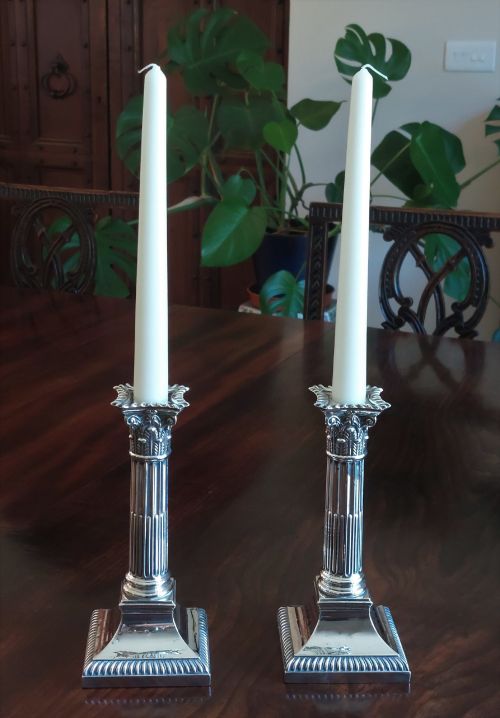
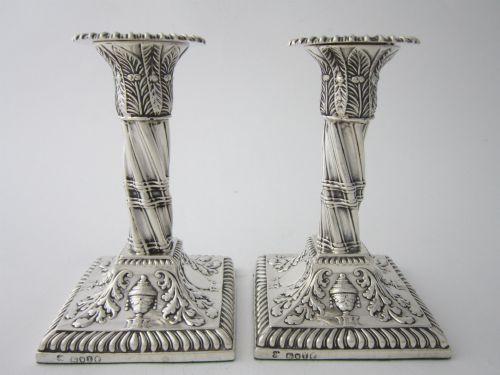
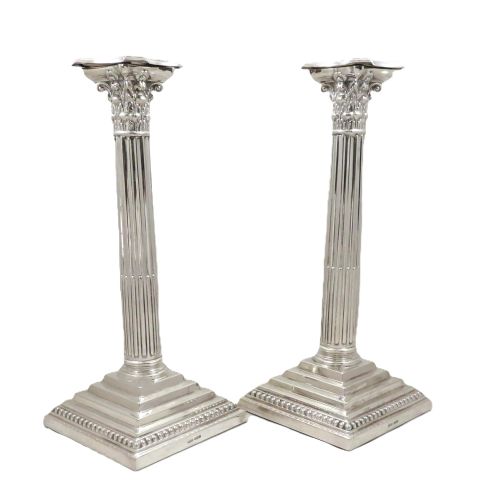
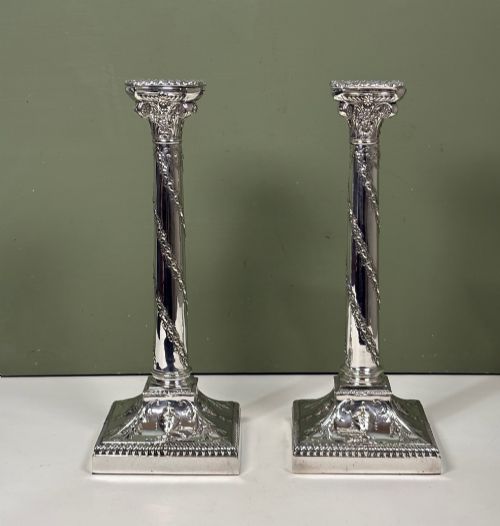
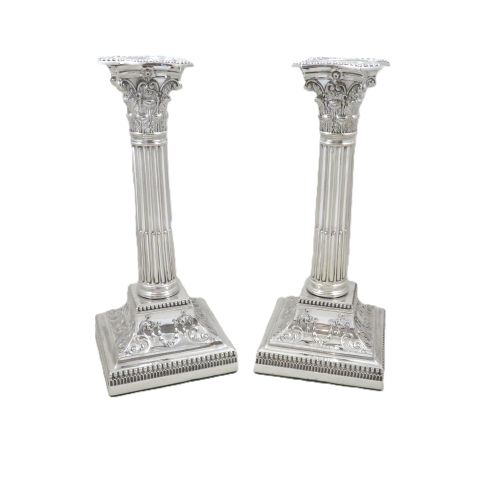
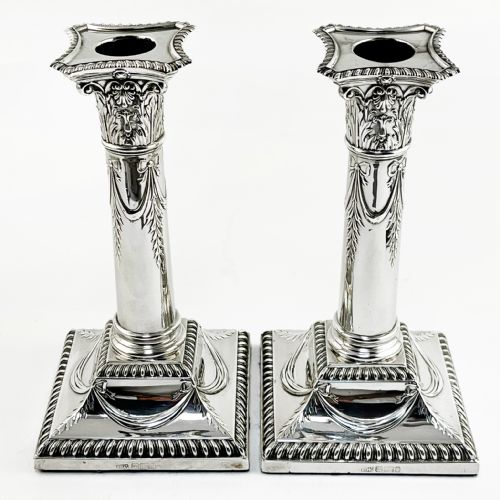
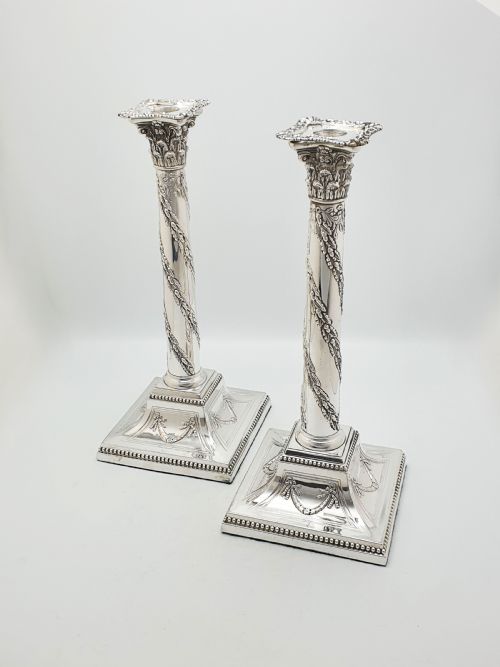
Classical tapered column candlesticks draw directly upon the architectural vocabulary of ancient Greece and Rome, translating stone pillars into domestic lighting. When searching for classical tapered column candlesticks, a buyer encounters forms that mimic the stately orders of architecture, often finished with Corinthian capitals of acanthus leaves.
The versions most commonly met on this page span the late eighteenth through to the early twentieth century. Pieces from the Georgian, Victorian, and Edwardian eras dominate the selection, appearing predominantly in matched pairs.
Makers adapted these architectural motifs for both formal dining tables and mantelpieces. Materials range from solid sterling silver and silver plate to cast brass, nickel silver, and stone.
How they were made
Makers constructed metal examples using casting techniques for the heavy bases and capitals, while the tapering shafts were often formed from rolled sheet metal or cast in sections. Silver pieces relied on weighted bases filled with resin or wood to provide stability for the tall upright column.
Brass and bronze elements frequently underwent turning on a lathe to achieve smooth, precise cylindrical profiles before hand-chasing and polishing. Silver-plated items involved fusing a thin layer of silver over a base metal such as copper or nickel silver, sometimes using the Old Sheffield plate method or later electroplating.
Listings span from the eighteenth century through to the 1940s, encompassing Georgian, Victorian, and Edwardian periods in silver, brass, and stone.
What varies in quality
The standard of a pair rests heavily upon the crispness of the casting in the capital and base ornament. Superior pieces retain sharp detail in the acanthus leaves and bead reels, whereas lesser examples show softened contours from worn production moulds.
Proportion and weight also dictate the tier of a piece. Heavier gauge metal, substantial weighted bases, and well-balanced shaft taperings separate the finer workshop productions from lighter, mass-produced domestic items.
Garrard & Co·J Miller·John Pound & Co·Ferdinand Barbedienne
The Classical Tapered Column Candlesticks Glossary
- Corinthian capital
- The uppermost member of a column, decorated with carved or cast acanthus leaves. This ornate style is frequently seen on classical tapered column candlesticks.
- Sterling silver
- An alloy containing ninety-two point five percent silver by mass, with the remainder being other metals, usually copper. Many nineteenth-century examples are struck with hallmarks indicating this standard.
- Silver plate
- A layer of silver applied to a base metal core such as brass, copper, or nickel silver. This technique offered the visual appeal of solid silver at a lower cost.
- Neoclassical
- A style spanning the eighteenth and nineteenth centuries that revived classical Roman and Greek motifs. Pieces in this aesthetic emphasise straight lines, symmetry, and architectural orders.
Classical Tapered Column Candlesticks: Frequently Asked Questions
Are these candlesticks always made of solid silver?
The inventory includes solid sterling silver alongside silver plate, brass, cast brass, nickel silver, stone, and silvered bronze. Many solid silver examples are weighted internally to provide stability.
Buyers should examine hallmarks or test the material to confirm whether a piece is solid precious metal or plated base metal.
How do I date a pair of brass candlesticks?
Dating relies on stylistic shifts, manufacturing marks, and the method of assembly. Georgian and nineteenth-century pieces often show distinct casting seams and hand-finished surfaces.
Comparing the decorative motifs against known periods helps narrow the decade of manufacture.
Why are most of these candlesticks offered as pairs?
Lighting a formal dining table traditionally required symmetrical arrangements of illumination at either end or along the length. Makers therefore produced columns in matched pairs to satisfy this requirement for domestic display.
Single survivors do appear, but matched pairs remain the standard format in the surviving record.