

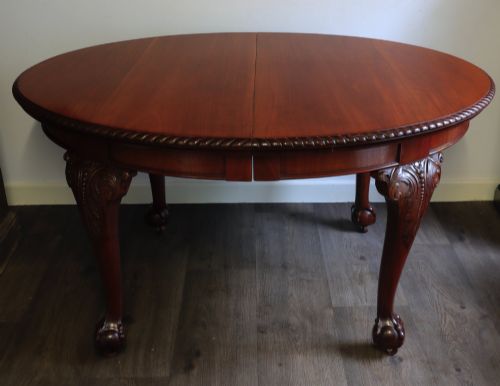
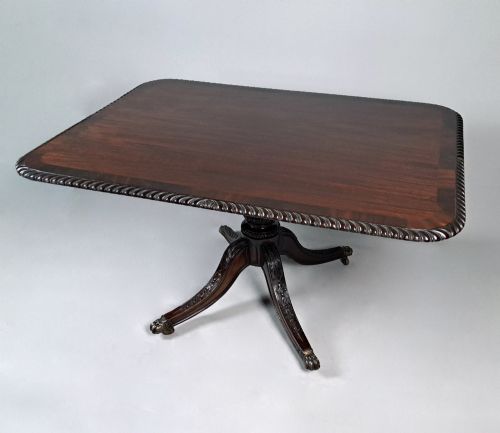
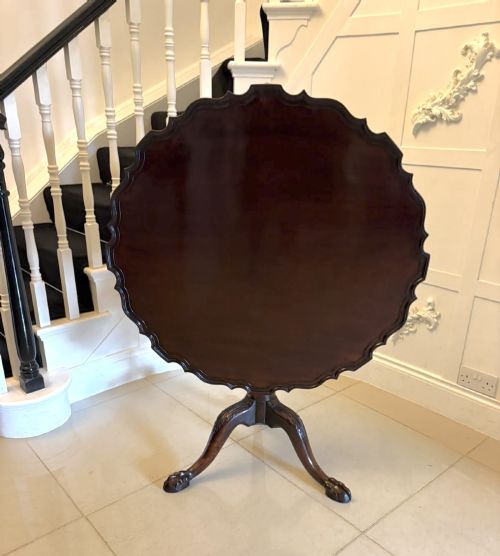
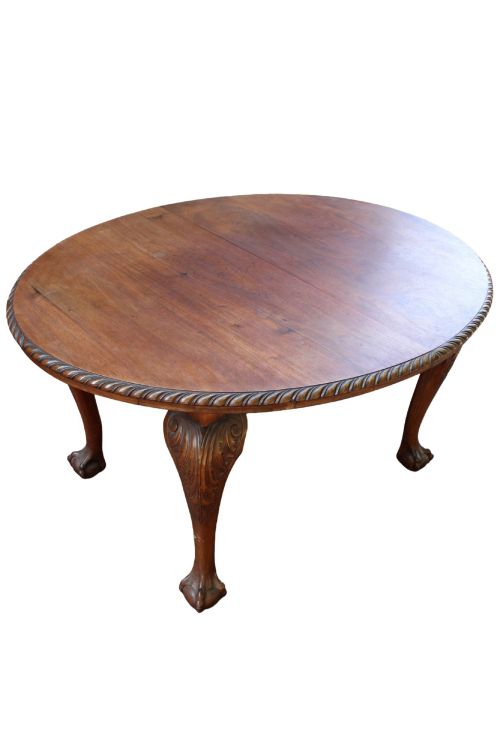
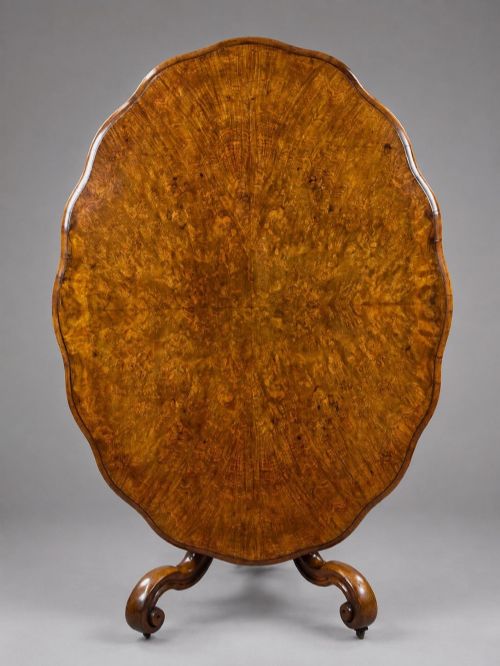

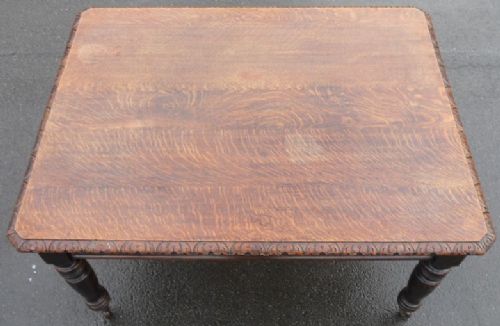
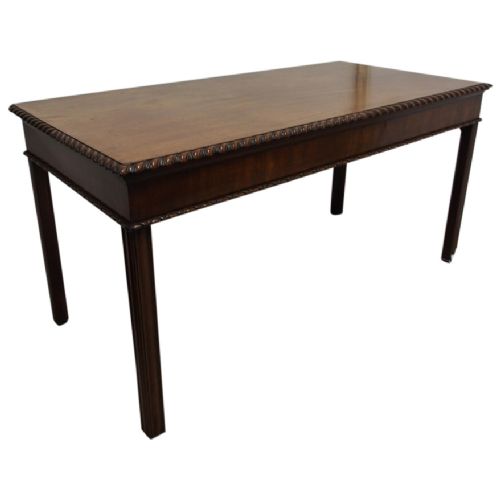


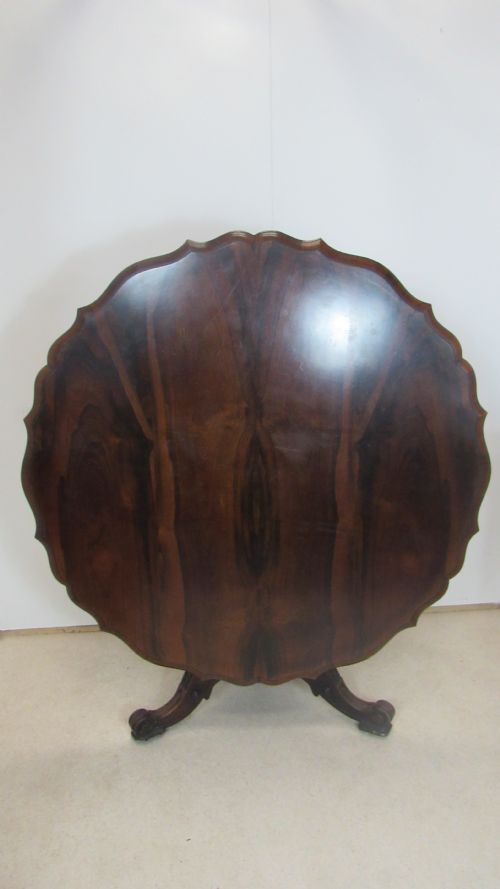


Carved Edge Dining Table
These carved edge dining table examples offer timber surfaces shaped by hand, bringing historical presence to everyday meals.
Carved Edge Dining Table
A carved edge dining table brings together formal dining pieces and smaller centre formats from periods spanning the eighteenth century to the early twentieth century. Buyers seeking a carved edge dining table encounter forms ranging from George III serving boards to Victorian tilt-top and pedestal designs, alongside Edwardian extending versions.
The selection encompasses round, circular, octagonal, and extending formats fashioned from dense timbers. Regional variations such as Anglo-Indian colonial pieces appear alongside standard British styles like Chippendale Revival and William IV.
Makers and workshops including Gillows and John Kendal contributed to this tradition, producing versatile tables that served as breakfast boards, loo tables, and primary dining surfaces. Each piece displays distinct edge detailing shaped by period woodworking conventions.
Materials and construction methods
Cabinet makers utilised dense hardwoods such as mahogany, rosewood, walnut, burr walnut, and macassar ebony to construct these surfaces. Solid timber and burr walnut veneers provided varied grain patterns, while brass hardware and castors added structural support and mobility.
Carpenters shaped the perimeters by hand, cutting crisp profiles, piecrust borders, and fret-carved friezes directly into the solid wood. Pedestal bases, quadruple columns, and tilt mechanisms required precise joinery to balance heavy tops.
Carved Edge Dining Table Retail Price Guide 2026
Typical asking prices for carved edge dining table among the pieces listed under this phrase on Sellingantiques today, from the lower quarter to the upper quarter. They describe what is for sale here now, not the wider market.
Listings feature mahogany, burr walnut, rosewood, and teak across Victorian, Regency, and eighteenth-century periods.
Judging execution and material depth
Quality rests upon the crispness of the perimeter carving and the depth of the timber grain. Finer examples display fluid hand-carved details along the edges and friezes, whereas simpler pieces rely on plain turned borders.
The choice of primary wood and veneer matching dictates the visual weight of the surface. Burr walnut figures and macassar ebony demand sophisticated matching, while standard mahogany offers a uniform finish.
Gillows·John Kendal
The Carved Edge Dining Table Glossary
- Piecrust edge
- A raised, scalloped perimeter carved directly from the solid timber top of a table. This detail appears frequently on tilt-top dining and centre formats.
- Tilt top
- A mechanism allowing the wooden surface to pivot vertically for storage when not in use. It is commonly found on round and octagonal tables.
- Burr walnut veneer
- Thin slices of decorative walnut cut from tree growths to reveal intricate swirling grain patterns. It is applied over a secondary wood base on Victorian tables.
- Pedestal base
- A central column supporting the dining surface, sometimes resting on branched feet or a quadruple base with castors. This construction frees legroom around the perimeter.
- Fret carved frieze
- Openwork ornamentation cut into the wooden band beneath the table top. It often incorporates geometric or mythical motifs.
Carved Edge Dining Table: Frequently Asked Questions
What is a carved edge dining table?
A carved edge dining table is a wooden dining or centre surface featuring decorative shaped borders executed by hand. These pieces originate from periods including the eighteenth century, the Regency era, and the Victorian epoch.
They encompass diverse formats from extending dining tables to compact tilt-top breakfast pieces. The defining characteristic lies in the sculpted perimeter detail rather than a uniform profile.
How do I identify a Victorian table?
Victorian tables often utilise burr walnut, rosewood, or oak with heavy pedestal bases and intricate marquetry. These pieces frequently feature rich grain patterns and dark finishes characteristic of nineteenth-century manufacturing.
Examining the construction methods beneath the top reveals period joinery techniques and hardware. The presence of brass castors and central columns is typical of this era.
What woods were used for these tables?
Cabinet makers relied primarily on mahogany, walnut, burr walnut, and rosewood for their durability and rich colour. Rarer examples incorporated macassar ebony or teak for distinctive visual impact.
Secondary woods supported the primary veneers on tabletops and friezes. Brass components were frequently integrated into bases and tilt mechanisms.
How do I care for a polished timber surface?
Polished wood surfaces require protection from excessive moisture, direct sunlight, and extreme temperature fluctuations. Using coasters and placemats helps preserve the original polish and timber grain.
Periodic dusting with a soft, dry cloth maintains the finish without stripping the historical patination. Wax can be applied sparingly to nourish dry hardwoods.
What is an extending dining table?
An extending dining table incorporates internal mechanisms or leaves to expand the surface area for larger gatherings. This practical design became widespread during the Edwardian period.
Such tables allow the dining surface to adapt in length while maintaining stable central supports. The extension system relies on wooden runners and removable leaves.