
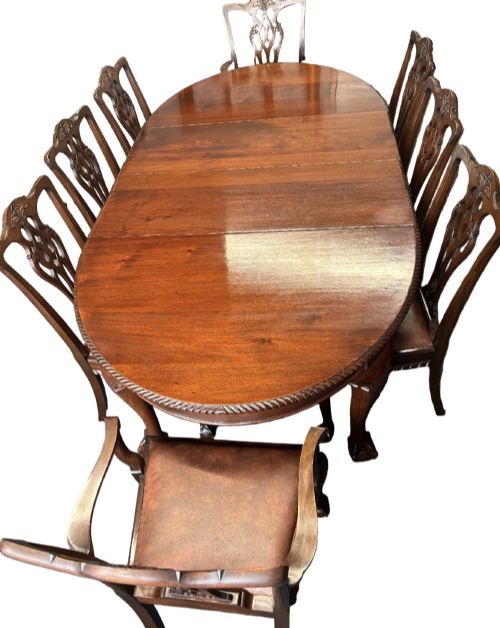
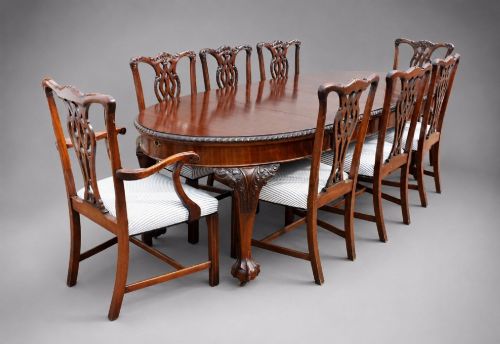


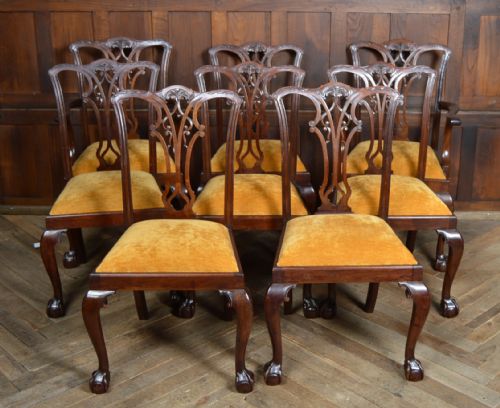


Chippendale Style Dining Table
A chippendale style dining table brings classic mahogany presence and carved cabriole legs to the dining room.
Identifying a chippendale style dining table
A chippendale style dining table is a dining table built in the manner of eighteenth-century cabinet maker Thomas Chippendale, typically featuring rich mahogany construction and detailed woodwork. When you browse this selection, you encounter pieces originating from the Victorian era, the Edwardian period, and the early twentieth century around 1920 and 1930. These gatherings of listings include extending dining tables, oval dining tables, console combinations, and dining sets complete with chairs.
Distinguishing quality levels
The top of the range is defined by the selection of figured mahogany timber and the crispness of the hand-carved details upon the legs. Tables featuring well-executed claw and ball feet demonstrate superior craftsmanship compared to simpler moulded edges and plain supports. Furthermore, the smoothness of the wind-out extending mechanism indicates the precision applied by the original maker.
Proportion and scale also separate standard commercial pieces from finer workshop productions. Larger eight-foot or ten-seater tables that retain their original matching leaves and stable frames represent higher execution standards. Maker attribution, such as pieces bearing the mark of Waring and Gillow, further elevates the standing of a table.
Retail Price Guide 2026
Typical UK retail prices for chippendale style dining table, calculated from the Sellingantiques database of over a million retail prices indexed since 2003. This retail price guide relies exclusively on Sellingantiques data; no external sources or auction records are used, so the figures do not describe the wider market.
Recorded materials across these listings include solid mahogany, leather, and metal mechanical components.
Waring and Gillow
The Chippendale Style Dining Table Glossary
- Cabriole leg
- A furniture leg that curves out in a convex shape at the knee and tapers inward in a concave shape to the foot. This form derives from ancient Chinese and Greek designs and became a defining feature of eighteenth-century and revival seating and table supports.
- Claw and ball foot
- A carved foot depicting an animal taloned foot gripping a spherical object. It appears frequently at the base of cabriole legs on quality mahogany furniture.
- Wind-out table
- An extending dining table operated by inserting a metal crank handle into a socket beneath the rim. Turning the handle drives internal wooden screws or gears to part or close the table top for extra leaves.
- Figured mahogany
- Timber cut from specific sections of a mahogany tree that display decorative grain patterns such as flame, fiddleback, or curl. Cabinet makers reserved these visually striking boards for prominent exterior surfaces.
- Extending dining table
- A table designed with a split top and internal runners to accept removable leaves. This allows the surface length to increase or decrease depending on dining requirements.
Frequently Asked Questions
What periods do these dining tables come from?
The listings span several distinct eras, encompassing Victorian production, the Edwardian period, and pieces dated around 1920 and 1930. Revival workshops continued to employ eighteenth-century aesthetic conventions long after the Georgian period ended.
Most surviving examples on this page reflect Edwardian and Victorian manufacturing dates, utilising solid mahogany and traditional extending mechanisms.
How do wind-out extending tables operate?
These tables rely on an internal mechanical screw system operated by a removable metal handle. Inserting the handle into the winding socket under the rim turns internal gears to separate the halves of the top.
Once the frame is parted to the required width, matching timber leaves drop into the central gap to extend the surface area for seating.
Are chairs usually included with these tables?
Some listings offer complete dining sets that pair the mahogany table with six or eight matching chairs. Other entries focus solely on the dining table or console combination itself.
When chairs are present, they frequently share the mahogany timber and carved stylistic details of the main table frame.
What wood types should I expect to find?
Mahogany is the primary timber used across the vast majority of these dining tables, often selected for its durability and deep reddish-brown colour. Figured mahogany surfaces exhibit decorative grain patterns across the main top panels.
Walnut also appears occasionally as an alternative hardwood material on specific oval and round extending table designs.