


Carved Ebony Box
A carved ebony box brings dense, dark timber and crisp colonial relief into a room, prized for intricate plant motifs and heavy grain.
Carved Ebony Box
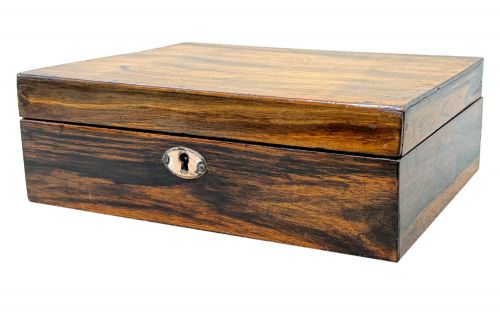
A carved ebony box usually takes the form of a writing slope, trinket box, or work box originating from nineteenth-century workshops. These items combine dense dark tropical hardwood with deep relief carving depicting foliage and geometric patterns.
Most examples seen here emerge from Victorian and Anglo-Indian contexts, reflecting trade and craftsmanship from regions such as Ceylon and broader British India. Interiors often feature fitted compartments in contrasting lighter woods, alongside velvet or paper linings.
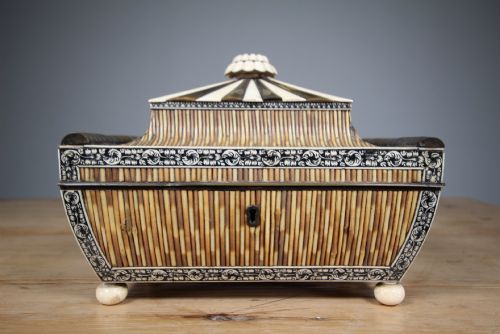
Buyers also encounter related containers including tea caddies and sarcophagus-shaped cases, alongside travelling chests built from camphor wood and ebony. The heavier pieces serve as table chests, while smaller trinket boxes sit neatly on dressing tables.
Judging Quality
Quality rests primarily on the crispness and depth of the carved surface relief, where sharper undercutting distinguishes superior craftsmanship from softer, shallower incision. The selection of the ebony itself also matters, with uniform deep black colour and minimal natural grain-splitting commanding greater regard.
Internal complexity elevates a piece, particularly where fitted writing slopes retain intact secret drawers, original felt or velvet linings, and well-fitted compartment lids. The integration of secondary woods, such as satinwood interiors within solid ebony carcases, marks out more ambitious commissions.
Some nineteenth-century travellers entrusted their most precious secrets to a box of spiky porcupine quills.
Jaques·Whitty·British Chess Company·F. H. Ayres·Calvert Pattern
The Carved Ebony Box Glossary
- Ebony
- A dense, hard black wood derived from various species of tropical trees, prized for its heavy weight and ability to hold fine carved detail. It forms the primary structural or decorative material for these boxes.
- Anglo-Indian
- A descriptive term for decorative arts produced in India during the period of British rule, often combining European furniture forms with traditional South Asian carving techniques. These objects frequently utilise local hardwoods.
- Sarcophagus
- A box shape featuring a domed or steep-sided profile tapering towards the top, echoing ancient stone coffins. Regency craftsmen frequently adopted this silhouette for tea caddies and work boxes.
- Writing Slope
- A portable desk featuring a hinged, sloping lid that opens to reveal a flat or angled writing surface, inkwell compartments, and storage space for stationery. Many examples incorporate secret drawers beneath the primary writing bed.
- Ceylonese
- Pertaining to Ceylon, the historical colonial name for Sri Lanka, known for distinct nineteenth-century carved woodwork involving ebony, satinwood, and porcupine quill decoration.
Carved Ebony Box: Frequently Asked Questions
How do I care for carved ebony?
Dust the deep recesses regularly with a soft, dry brush to prevent dirt accumulation in the carved channels. Avoid harsh chemical polishes and keep the wood away from direct heat sources to prevent splitting.
Apply a minimal amount of microcrystalline wax sparingly if the timber appears dry, buffing gently with a clean cloth. Stable room humidity preserves both the dense hardwood and any delicate internal linings.
What is an Anglo-Indian box?
An Anglo-Indian box is a container manufactured in nineteenth-century India for the European export or expatriate market. These pieces apply traditional South Asian deep-relief carving to familiar British forms like writing slopes and trinket chests.
They typically feature dense tropical timbers such as ebony or calamander, often enclosing secondary woods like satinwood or cedar within their fitted interiors.
How are these boxes dated?
Dating relies on stylistic clues, construction methods, and hardware such as brass locks, hinges, and escutcheons. Regency and early Victorian pieces often favour sarcophagus profiles and secret compartment mechanisms.
Later Victorian and Edwardian examples may show simpler rectangular outlines or incorporate alternative materials like porcupine quill alongside the carved ebony panels.
Where were these boxes used?
These boxes served as portable desks, dressing table containers, or secure repositories for jewellery, letters, and small valuables. Gentlemen and ladies utilised them in drawing rooms, studies, and during extended travel.
Their heavy construction and fitted compartments made them practical for organising correspondence while remaining decorative enough for prominent display on side tables.