



Carved Eagle Girandole Mirror
A carved eagle girandole mirror brings dramatic presence and historic British craftsmanship to a room.
Carved Eagle Girandole Mirror
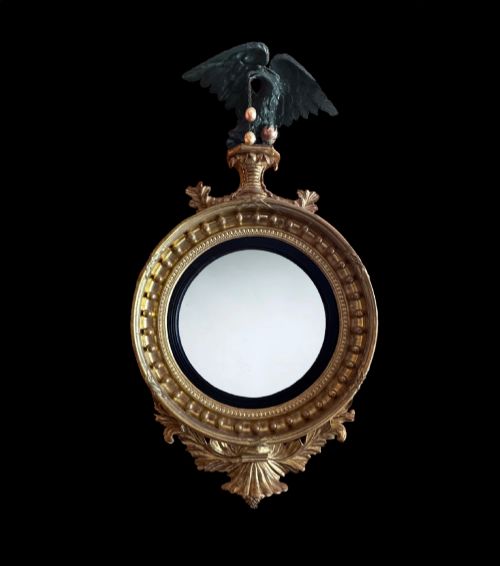
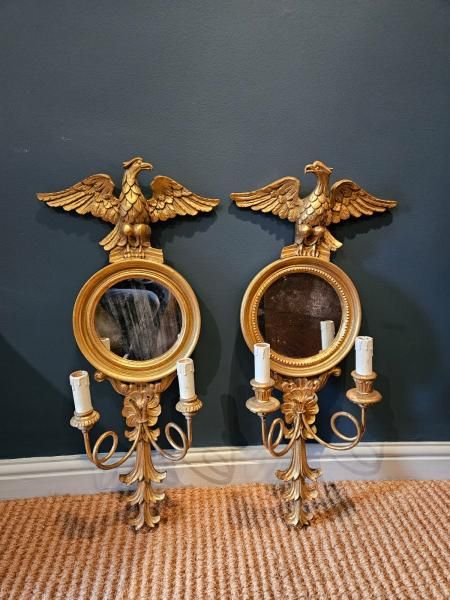
A carved eagle girandole mirror is a round convex wall glass housed in a decorative timber frame, frequently topped by a carved bird. These striking items reflect a wide curved field of vision while holding candle arms or sconces for illumination.
The versions met most frequently on this page date from the Regency period, though examples extend into the Georgian era, the nineteenth century, the Victorian age, and the early twentieth century. They are predominantly formed as wall mirrors and wall sconces.
The visual vocabulary spans Regency, Grand Regency, Regency Revival, George I, and Victorian styles. The defining element remains the round reflecting surface paired with gilded wooden frames.
How they were made
Makers shaped these frames primarily from giltwood and timber, applying layers of gesso to build up intricate carved details such as the prominent eagle surmounts and scrolling foliage. The wood was then gilded to achieve a bright metallic finish.
Mirrors utilise curved mirror glass and crystal elements to bounce light around domestic interiors. Additional touches incorporate ebonised wood details and brass or metal components on the candle arms.
Listings feature giltwood, glass, ebonised wood, brass, gesso, metal, mirror glass, and crystal.
What varies in quality
Quality rests in the crispness of the timber carving, particularly on the eagle crest and the surrounding frame ornamentation. Softer or shallower carving yields a less striking silhouette against the wall.
The depth and clarity of the original gilding and the preservation of the convex glass plate dictate the visual impact. Patina accumulated over the centuries adds depth that mechanical reproductions fail to replicate.
The Carved Eagle Girandole Mirror Glossary
- Girandole
- A branched wall sconce or candleholder attached to a mirror frame. It reflects candlelight across the room.
- Convex glass
- A curved round mirror plate that creates a wide-angle, distorted panoramic view of the interior. This form was especially popular during the Regency era.
- Giltwood
- Timber covered with a thin layer of gold leaf or gold paint. It provides a luminous surface that catches ambient light.
- Gesso
- A plaster-like mixture applied to wood frames to create a smooth surface for carving and gilding. It allows for sharp decorative relief.
- Ebonised wood
- Timber stained or treated to imitate ebony. It provides a dark contrast against bright gilt details.
Carved Eagle Girandole Mirror: Frequently Asked Questions
Where should I hang a convex mirror?
These mirrors function best on prominent focal walls in principal rooms such as reception halls, dining rooms, or living spaces. Because the curved glass captures a wide field of view, hanging it opposite a window or fireplace maximises the reflected light and sense of space.
Ensure the wall construction supports the weight of the timber and gesso frame securely. Positioning the mirror at eye level allows viewers to appreciate the carved details and the unique panoramic reflection.
How do I clean a giltwood frame?
Dust the carved surfaces gently with a soft, dry brush to remove particles without disturbing the fragile gold leaf. Avoid liquid cleaners or chemical sprays, which can strip historic gilding and damage the gesso beneath.
For the glass plate, apply a small amount of neutral glass cleaner to a cloth rather than spraying directly onto the surface. This prevents moisture from seeping behind the glass edges and tarnishing the backing.
What is the difference between a girandole and a standard wall mirror?
A girandole incorporates attached candle arms or sconces directly onto the frame structure. These arms held candles to supplement room lighting by reflecting the flame.
A standard wall mirror serves purely as a reflective decorative object without the integrated candle fittings. Both share similar circular frames and convex glass plates across historical periods.
How do I identify a Regency period mirror?
Regency mirrors often feature classical motifs such as reeded bezels, ball-stud ornaments, and the characteristic eagle surmount perched atop the frame. The timber construction and traditional gesso application reflect early nineteenth-century workshop practices.
Later revivals mimic these traits, but period pieces display genuine age in the timber shrinkage, the wear of the gilding, and the subtle imperfections within the historic glass plate.