
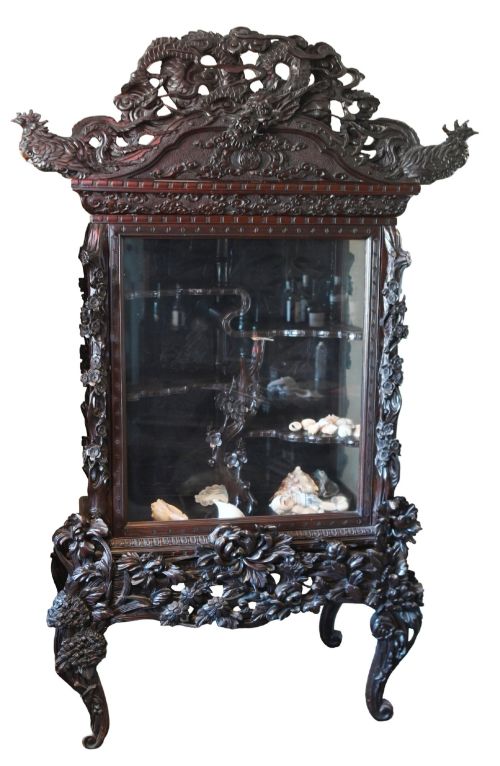


Carved Dragon Cabinet
These carved dragon cabinets bring fierce mythical presence into a room, blending intricate oriental woodwork with practical display space.
Carved Dragon Cabinet
A carved dragon cabinet is a substantial storage or display piece featuring elaborate dragon motifs across its wooden surfaces. Buyers seeking these items encounter forms ranging from Japanese shodana display units to Chinese hardwood cabinets and sideboards.
The pieces appearing on this page span the nineteenth century into the early twentieth century. They include examples from the Qing Dynasty, Meiji and Taisho periods, alongside European interpretations in the Japonisme and Chinoiserie styles.
Forms vary from compact music cabinets and small tabletop display units to large glazed cupboards and compound cabinet configurations. Many incorporate stands, open shelving stages, and glass panels designed for showing precious objects.
How they were made
Maker workshops utilised dense timbers such as hardwood, walnut, and ebonised hardwood as the structural foundation for these cabinets. Carvers worked directly into the wood to create high-relief dragon figures winding across doors, cornices, and panels.
Decoration often extended beyond bare timber through the application of lacquer, gilt bronze mounts, and inlaid bone or mother-of-pearl. Glazed compartments were integrated alongside open shelving tiers to balance enclosed storage with transparent display.
Listings feature pieces spanning the nineteenth century, Victorian era, and early twentieth century, incorporating hardwood, walnut, lacquer, and mother-of-pearl.
What varies in quality
Quality rests primarily in the depth, crispness, and vitality of the dragon carving itself. Master carvers achieved a sense of muscular movement and sharp detail in the scales and claws that lesser hands left flat and indistinct.
The choice of materials and the integration of delicate inlays such as mother-of-pearl or bone separate standard production from exceptional work. Structural integrity in the joinery of complex display tiers and glazed doors also determines the standing of a piece.
Gabriel Viardot
The Carved Dragon Cabinet Glossary
- Shodana
- A traditional Japanese multi-tiered display cabinet featuring staggered shelving, cupboards, and sliding doors. These pieces were designed to showcase ceramics and art objects.
- Japonisme
- A Western artistic movement of the late nineteenth century inspired by Japanese art and design. It heavily influenced European cabinet makers who adopted Eastern motifs.
- Zitan
- A dense, heavy Chinese hardwood prized for its dark colour and fine grain. It provides an ideal heavy base for intricate deep-relief carving.
- Chinoiserie
- European decorative style reflecting Chinese artistic influences. Makers applied these fanciful interpretations to furniture throughout the nineteenth century.
- Ebonised
- Wood treated with a finish to imitate expensive ebony. This dark surface treatment frequently highlighted gilded or carved details.
Carved Dragon Cabinet: Frequently Asked Questions
What is a shodana?
A shodana is a traditional Japanese display cabinet featuring asymmetrical shelving, small cupboards, and sliding panels. They were originally used in Japan to exhibit small scholarly objects and precious art.
On this page, you find Japanese examples alongside European pieces inspired by the form. They combine storage with complex multi-level display stages.
How do I style a carved cabinet?
These cabinets work best as statement focal points in rooms with neutral walls that allow the heavy timber and dragon carvings to stand out. Use the internal shelving or glass display areas for ceramics or glassware.
Keep surrounding furniture simple to avoid visual clutter around the intricate woodwork. Let the natural grain and carved details command attention on their own.
Where were these cabinets made?
The pieces originate from workshops in China and Japan, as well as European studios influenced by Eastern design. Asian export pieces date across the nineteenth and early twentieth centuries.
European makers working in Aesthetic Movement and Chinoiserie styles also produced similar furniture during the same period. Materials and construction methods typically point to the specific regional origin.
What is Zitan wood?
Zitan is an extremely dense and heavy Chinese hardwood valued for its deep dark colour and durability. It was traditionally reserved for high-status imperial furniture.
The heavy weight and tight grain made it an exceptional medium for sharp, detailed relief carving. Cabinets utilising this timber represent the higher end of Asian furniture production.