
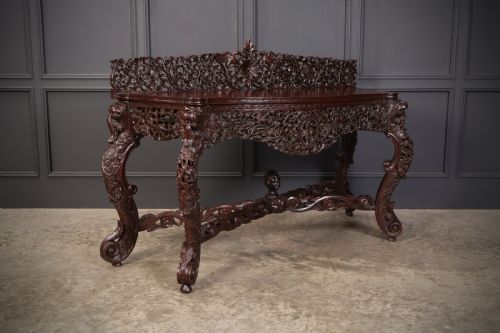
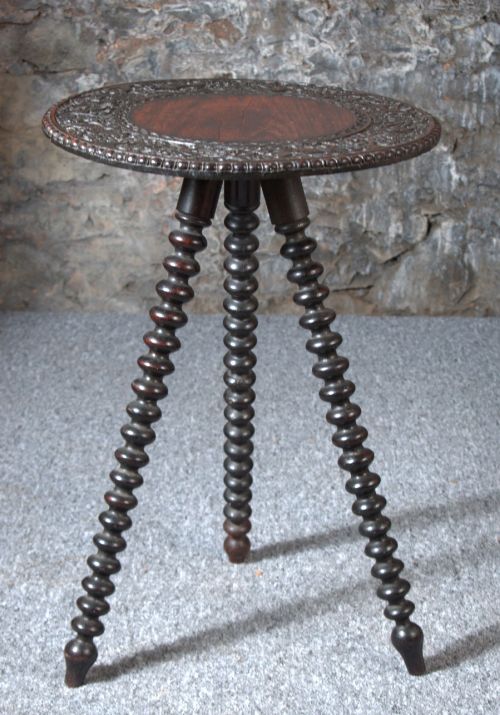


Carved Burmese Table
A carved burmese table brings deep relief work and dense tropical timber into a room, spanning side, occasional, and console forms from the nineteenth century.
Carved Burmese Table
A carved burmese table encompasses side tables, occasional tables, console tables, and multi-tiered buffets dating primarily from the nineteenth century, including Victorian examples. These pieces emerge from periods spanning the mid-nineteenth century through to the early twentieth century, reflecting Anglo-Burmese and colonial styles.
The occasional table and the side table appear most frequently on this page, often featuring round, tilt-top, or multi-tiered structures. Workshops also produced specialised forms such as centre tables, folding book stands, and console tables designed for hallway or lounge placement.
Materials and technique
Craftsmen utilised dense hardwoods, predominantly teak, padauk, and rosewood, to construct these heavy tables. These timbers provided a stable foundation capable of supporting deep, intricate relief carving without splitting or warping.
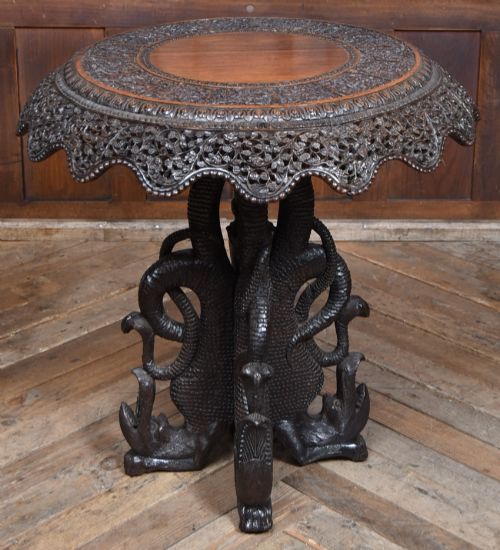
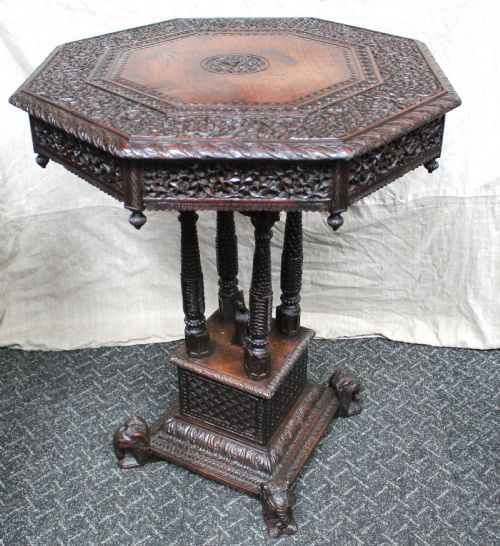
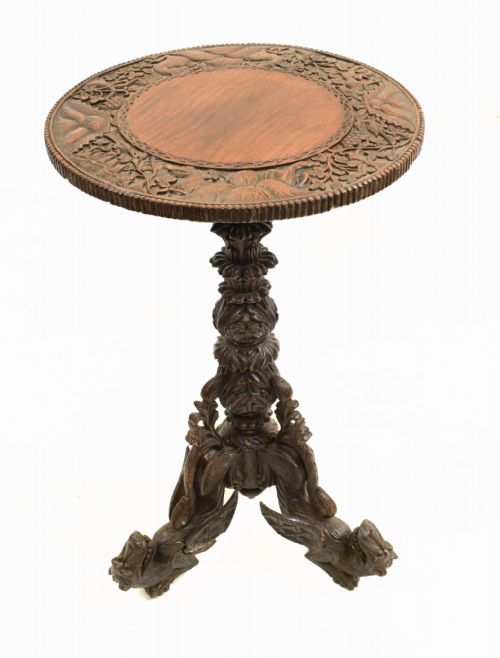
Artisans carved the wood by hand, producing elaborate surface decoration that often incorporated figurative elements such as elephants and dragons alongside dense foliage. Certain items integrated bone details or lacquer finishes to complement the carved wooden structure.
Listings demonstrate that padauk wood and teak served as the primary timbers for nineteenth-century occasional and side tables.
Craftsmanship and design
Depth and sharpness of the hand carving dictate the standing of an individual carved burmese table, separating restrained execution from profuse, deeply undercut relief work. The handling of anatomical details on figural supports, such as elephant or dragon legs, demonstrates the skill of the maker.
Selection of timber also marks distinction, with well-figured padauk or dense teak exhibiting superior grain and weight. Construction integrity, particularly in tilt-top mechanisms and multi-tiered joints, completes the measure of quality.
The Carved Burmese Table Glossary
- Padauk
- A heavy, durable tropical hardwood with a reddish-brown hue utilised extensively for nineteenth-century furniture. It takes a fine finish and supports intricate carving.
- Tilt-top table
- A table with a hinged top that folds into a vertical position when not in use. This mechanism allowed for compact storage against walls in period interiors.
- Anglo-Burmese
- A style combining traditional Burmese carving motifs with British furniture forms of the colonial era. These pieces reflect cross-cultural design influences during the nineteenth century.
- Tiered buffet
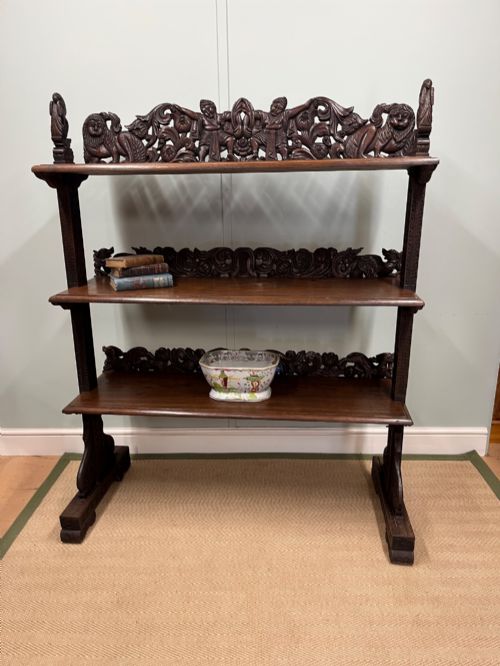
- A multi-layered standing piece used for display or service. Examples on record feature two or three graduated shelves supported by carved uprights.
Carved Burmese Table: Frequently Asked Questions
What periods do these tables date from?
The listings span the nineteenth century, with specific dates clustering around the 1870s, 1880s, and 1890s, alongside some early twentieth-century examples.
Victorian era production and colonial periods account for the majority of the surviving pieces seen today.
Which woods were used to make them?
Maker workshops relied primarily on dense tropical timbers such as teak and padauk wood. These heavy hardwoods provided the structural density required for deep relief carving.
Occasional pieces also incorporated rosewood, mahogany, or bone elements within the decorative scheme.
How were tilt top tables used?
A tilt-top table functioned as a versatile surface for lamps, books, or decorative items during daily use. The top folded down flat when needed and tipped upright against a wall to save floor space.
This practical design made them popular in nineteenth-century drawing rooms and parlours.