


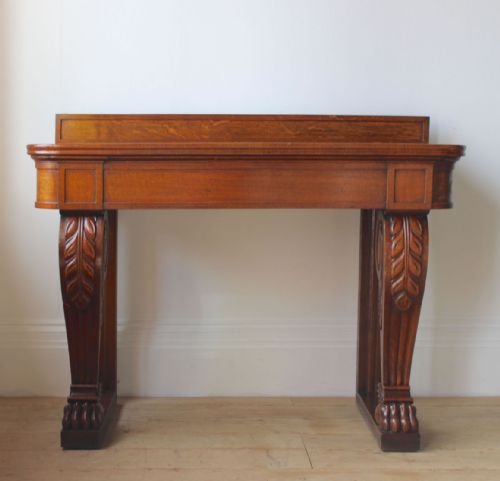


Carved Acanthus Console
These carved acanthus console pieces are substantial wall tables and brackets defined by rich sculptural leaf work that brings immediate presence to an interior.
Carved Acanthus Console
When you search for carved acanthus console, you are looking at items that range from console tables and serving tables to wall brackets, often paired with mirrors. These pieces span the eighteenth and nineteenth centuries, including Georgian, Regency, Victorian, and Baroque Revival styles.
The forms on this page include Italian and French Rococo designs alongside English mahogany tea tables and Scottish bleached oak consoles. Buyers frequently encounter wall brackets and console table sets originating from the eighteenth and nineteenth centuries.
Originating as architectural supports or decorative side tables, these objects often feature prominent leaf carving and gilded or painted surfaces. They are chosen to anchor a hallway or reception room with classical architectural weight.
Materials and construction
The pieces rely on carved wood such as mahogany, red walnut, and bleached oak as a structural base for detailed sculptural work. Cabinetmakers shaped the timber by hand before applying decorative surface treatments.
Giltwood, gold leaf, and gesso are frequently applied to create reflective, ornate finishes typical of Rococo and Baroque styles. Paint and marble are also utilised to complete the decorative scheme of the table tops and brackets.
Carved Acanthus Console Retail Price Guide 2026
Typical asking prices for carved acanthus console among the pieces listed under this phrase on Sellingantiques today, from the lower quarter to the upper quarter. They describe what is for sale here now, not the wider market.
Judging quality and execution
Quality rests primarily in the crispness and depth of the hand carving, particularly along the leaf scrolls and acanthus motifs. Finer examples display deep undercutting and fluid movement that show the hand of a skilled artisan rather than mechanical replication.
The integrity of the original surface finish, whether giltwood, paint, or polished mahogany, defines the visual impact of the piece. Superior execution is also evident in the structural joinery and the selection of timber used for the carcase and supports.
The Carved Acanthus Console Glossary
- Acanthus
- A classical decorative leaf motif derived from Mediterranean flora, widely used in carved woodwork and architectural capitals. It forms the defining sculptural ornamentation on these consoles and brackets.
- Console table
- A table designed to stand against a wall, traditionally supported by wall-fixed brackets or console legs rather than four independent floor legs. These tables often feature elaborate aprons and marble tops.
- Giltwood
- Timber that has been coated with a thin layer of gold leaf over a prepared ground such as gesso. This technique produces a luminous surface that catches candlelight and daylight.
- Corbel
- A structural bracket projecting from a wall to support a weight, often highly decorative in classical architecture. In these listings, it describes wall-mounted supports with carved detailing.
- Gesso
- A plaster-like material applied to wood surfaces to provide a smooth base for gilding and painting. Its buildup allows carvers to achieve sharp, refined edges beneath gold leaf.
Carved Acanthus Console: Frequently Asked Questions
What is a console table?
A console table is a narrow side table designed to stand flat against a wall, frequently anchored with brackets. They serve as decorative focal points in hallways and reception rooms.
Historically, many console tables were paired with matching wall mirrors to create a unified architectural display in formal interiors.
How do I hang a wall bracket?
Wall brackets require secure fixing to solid wall studs or masonry using appropriate weight-bearing screws. Because these wooden brackets often carry heavy ornaments or marble elements, professional installation is recommended.
Ensure the wall plate makes flush contact with the surface to prevent any shifting or strain on the antique timber joints.
Where should I place a console table?
Console tables sit naturally in entrance halls, living rooms, or dining spaces where floor space is limited. Their narrow profile allows them to provide a surface for lamps and objects without obstructing walkways.
Placing one beneath a large mirror or painting helps anchor the vertical space in a room.
How do I distinguish eighteenth-century pieces?
Eighteenth-century pieces typically exhibit hand-cut joinery, older timber patination, and organic tool marks left by the carver. The weight and density of the wood, such as early mahogany or walnut, also offer clues to the period.
Stylistic markers like asymmetrical Rococo scrolls or restrained Neoclassical symmetry help align a piece with its era of manufacture.