
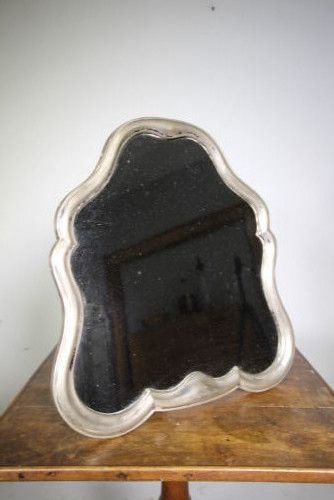
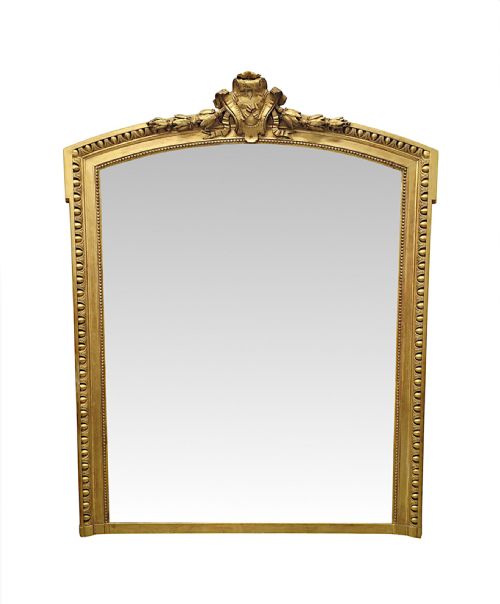


Cartouche Wall Mirror
A cartouche wall mirror brings sculptural scrollwork and organic symmetry to a room, offering an ornate focal point shaped like a scrolled shield or scroll-framed tablet.
Cartouche Wall Mirror
When you search for a cartouche wall mirror, you encounter pieces defined by their distinct scroll-framed, shield-like or ornamental tablet outlines. These decorative looking glasses draw heavily on Rococo and Neoclassical vocabularies, presenting asymmetrical or balanced flourishes that command attention in a hallway, over a mantel, or upon a principal salon wall.
The versions most commonly met on this page span the eighteenth and nineteenth centuries, alongside select early twentieth-century interpretations. You will find grand overmantel examples featuring prominent central cartouches, pairs of Italian and French giltwood pieces, and smaller wall-hanging formats executed in carved timber.
Makers and workshops from Italy, France, and Britain interpreted the cartouche form through regional stylistic lenses, ranging from exuberant Italian Rococo carving to restrained French Neoclassical symmetry. The resulting variety ensures that these mirrors suit both traditional period interiors and eclectic modern spaces requiring a strong historic anchor.
How they were made
The primary structural foundation relies on carved wood, gesso, and timber frameworks shaped into elaborate scrolls and crests. Artisans applied layers of gesso over carved wooden carcases to build up the crisp relief work necessary for intricate cartouche borders.
Giltwood and silver leaf finishes dominate the surface treatments, applied over a prepared bole to achieve deep metallic luminosity. Silver leaf and gold leaf catch the light, while mirrored glass plates - sometimes displaying age-related foxing - complete the optical assembly.
Listings feature eighteenth-century Italian rococo examples alongside nineteenth-century French revival and twentieth-century interpretations.
What varies in quality
The depth and crispness of the carving distinguish finer examples from simpler production. Master carvers achieved undercut scrolls and fluid asymmetrical rhythms that lesser workshops rendered in flat, mechanical relief.
Original gilding and untouched surface patination separate museum-grade survivals from heavily restored pieces. The integrity of the original gesso work beneath the gold leaf dictates how authentically the mirror reads its period origins.
Whytock and Reid
The Cartouche Wall Mirror Glossary
- Cartouche
- An ornamental tablet or scroll-framed shield motif with curved edges, serving as the defining shape or cresting feature of these mirrors.
- Giltwood
- Timber coated with gold leaf over a prepared gesso and bole ground, providing a rich metallic surface finish.
- Gesso
- A plaster-like mixture applied to wood frames and carved to create sharp decorative relief details before gilding.
- Foxed Plate
- Mirror glass displaying dark spots and age-related oxidation, indicating significant historic age.
- Overmantel Mirror
- A large horizontal or tall architectural looking glass designed specifically to hang above a fireplace mantel.
Cartouche Wall Mirror: Frequently Asked Questions
Where should I hang a cartouche wall mirror?
These pieces suit prominent locations where their sculptural frames can act as primary focal points. Common placements include above a drawing-room fireplace, centered in a grand hallway, or above a console table.
Because the ornate crests draw the eye upward, ensure adequate wall space above the frame so the cartouche shape is not crowded by adjacent cornices or pictures.
How do I date a cartouche wall mirror?
Dating relies on examining the construction methods of the wooden carcase, the composition of the gesso, and the style of the carving. Eighteenth-century examples typically feature hand-carved wooden foundations with organic asymmetry, whereas nineteenth-century revival pieces often employ more uniform gesso moulding.
Inspecting the mirror plate itself also helps, as original glass frequently exhibits bevels, thickness variations, or natural foxing consistent with historic manufacture.
Are these mirrors fragile?
The protruding scrolls and applied gesso ornaments require careful handling during movement and hanging. The delicate plaster work along the outer edges can chip if subjected to sharp impacts.
Secure wall fixings suited to the weight of the timber and gesso frame are essential for safe domestic display.
What is the difference between Italian and French styles?
Italian interpretations often showcase dramatic, highly sculptural Rococo carving with deep undercutting and energetic asymmetrical scrolls. French examples frequently balance ornamentation with architectural structure, incorporating refined Neoclassical symmetry or restrained chateau elegance.
Both regional traditions utilise giltwood surfaces, but the hand of the carver produces distinct national character in the scrollwork.