

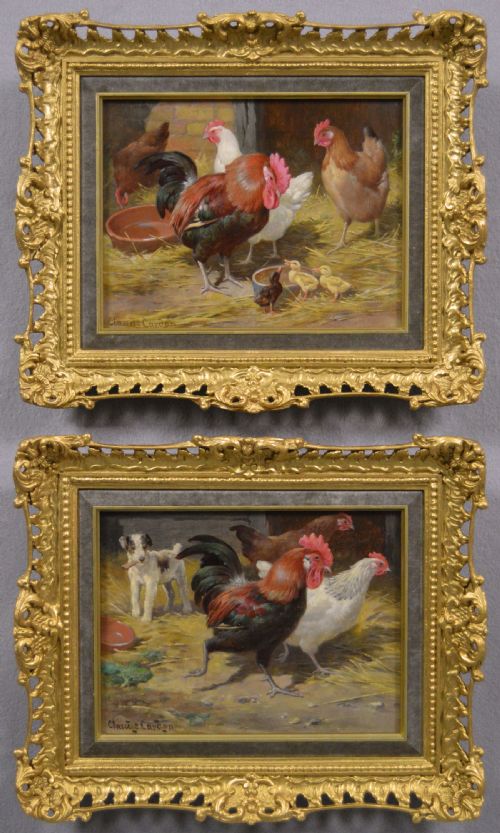


Canvas Farmyard Scene Painting
A canvas farmyard scene painting captures the daily rural labour and domestic animals of past centuries through oil on canvas.
Canvas Farmyard Scene Painting
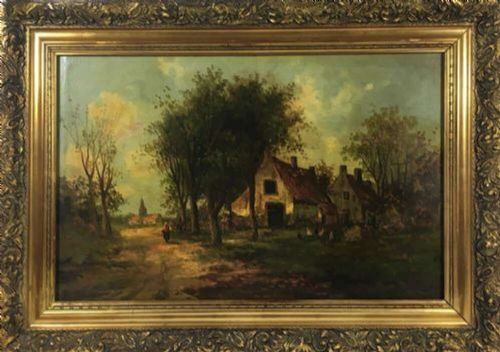
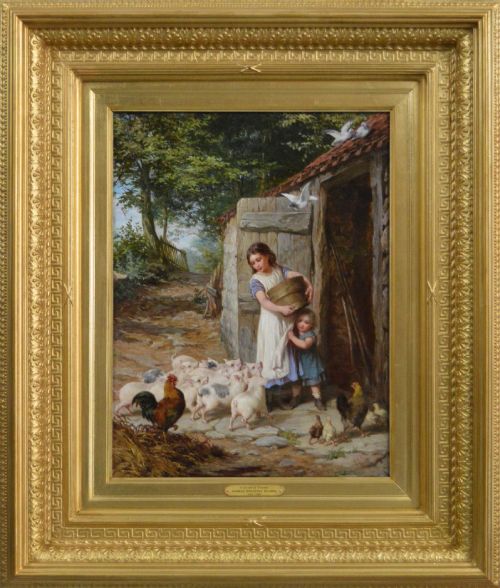
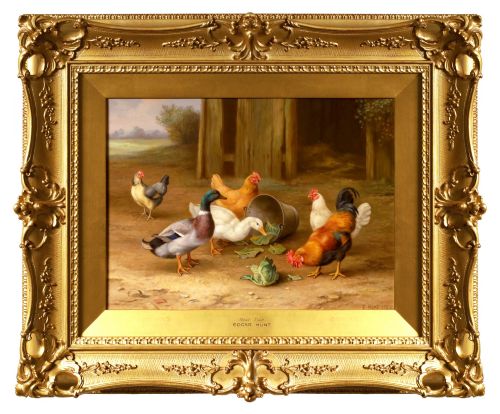
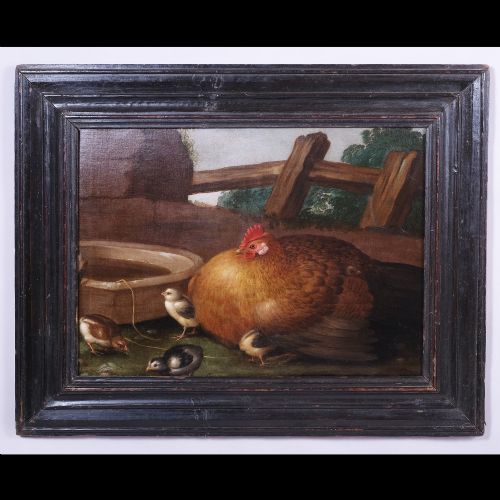
A canvas farmyard scene painting depicts rural life, agricultural work, and domestic animals such as horses, pigs, and poultry within pastoral landscapes. These works frequently record the daily rhythms of nineteenth-century agricultural life alongside eighteenth-century pastoral compositions.
Buyers encounter oil paintings executed on canvas stretched over wooden supports, often housed within original giltwood frames. The pieces range from intimate portrayals of poultry to larger landscapes featuring shire horses and farm labourers.
The selection includes examples from British animalier and Victorian realism traditions, alongside Barbizon school French landscapes and primitive folk art. Works span from the eighteenth century through to the early decades of the twentieth century.
Materials and technique
Artists built these compositions using oil paint applied to woven canvas supports, allowing for rich texture and subtle blending of earthy tones. The application ranges from smooth, detailed academic brushwork to more textured impasto.
Finished canvases were secured into wood structures and frequently set within ornamental giltwood frames embellished with gold leaf. These frames provide structural support and define the visual boundary of the rural landscape.
Periods represented span from the eighteenth century, through the Victorian era, up to the nineteen-thirties.
Quality variations
The skill in rendering anatomical details of farm animals and figures distinguishes finer works from simpler compositions. Artists who accurately capture the posture of horses, cattle, and poultry create more compelling pastoral narratives.
The depth of the landscape and the management of natural light determine the visual success of the piece. Superior examples integrate the animals seamlessly into the surrounding farmyard setting with considered atmospheric perspective.
George Augustus Holmes·Edgar Hunt·Claude Cardon·Herbert Royle·John Frederick Herring·John Linnell·Pierre Emmanuel Dielmans·Ralph Dorrance·John Frederick Herring Jnr·Julius Caesar Ibbetson·Arthur Charles Dodd·Robert Russell MacNee·Owen Bowen·Arthur Walker Redgate·Ernest Higgins Rigg·Georgina Lara·Thomas Blinks·James William Booth·Kershaw Schofield·John Percy Cooke
The Canvas Farmyard Scene Painting Glossary
- Oil on Canvas
- A painting medium where pigments are bound with drying oils and applied to a woven fabric surface stretched across a frame.
- Giltwood
- Wood that has been coated with a thin layer of gold leaf or gilt powder, commonly utilised for traditional picture frames.
- Barbizon School
- A nineteenth-century French movement focused on realist landscape painting inspired by direct observation of nature.
- British Animalier
- An artistic focus on the realistic portrayal of animals, particularly horses, farm livestock, and dogs, prominent in the nineteenth century.
- Victorian Realism
- An artistic approach that depicted everyday subjects and rural scenes with an emphasis on accuracy and unvarnished detail.
Canvas Farmyard Scene Painting: Frequently Asked Questions
What periods do these paintings date from?
The available works span from the eighteenth century through the Victorian era and into the early decades of the twentieth century. Specific dates recorded in the titles reach from seventeen-ninety-two up to nineteen-thirty.
Earlier examples often reflect eighteenth-century European sensibilities, while the majority represent nineteenth-century realism and British animalier traditions.
Which animals appear most frequently?
Horses, particularly shire and carthorses engaged in farm labour, appear across numerous rural landscapes. Pigs, piglets, cattle, goats, and poultry such as cockerels and chickens are also common subjects.
Artists frequently grouped these animals around farm buildings, barns, and feeding troughs to construct authentic pastoral scenes.
How are these paintings framed?
Many works are housed in their original giltwood frames, incorporating wood structures finished with gold leaf. These frames complement the oil paintings and reflect the period framing styles of the nineteenth and early twentieth centuries.
Some examples retain the original framing from the time of their creation, preserving the historical integrity of the piece.
What artistic styles are represented?
The selection encompasses British Impressionism, Victorian Realism, the Barbizon School, and British Animalier. Primitive folk art pieces also appear alongside traditional academic oil paintings.
Each style offers a distinct interpretation of the rural farmyard, ranging from precise animal portraiture to broader landscape compositions.