
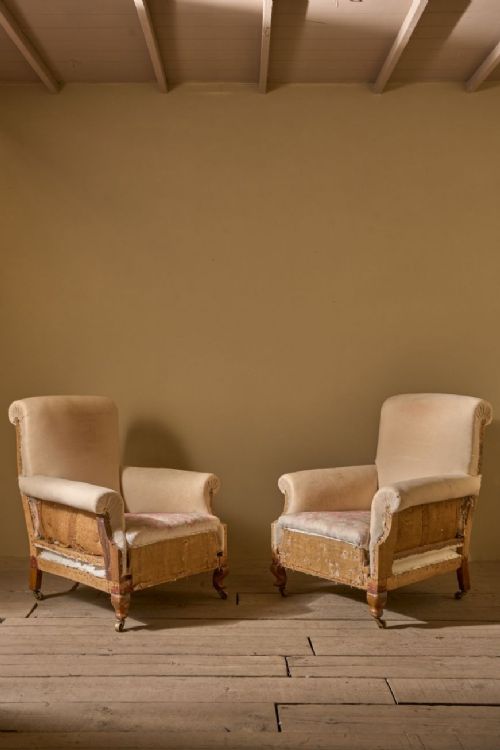

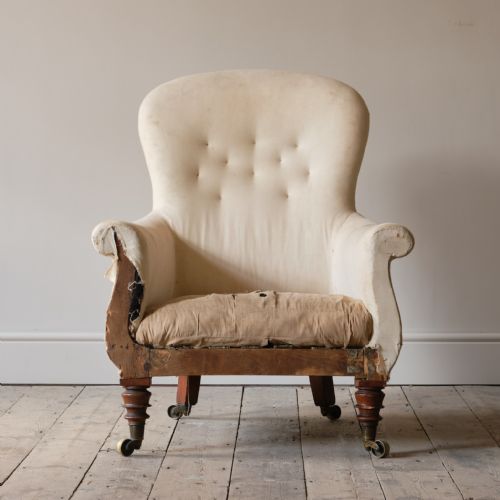
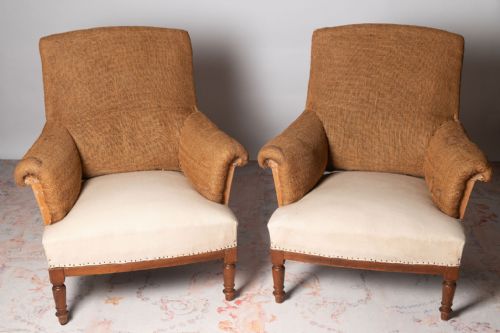
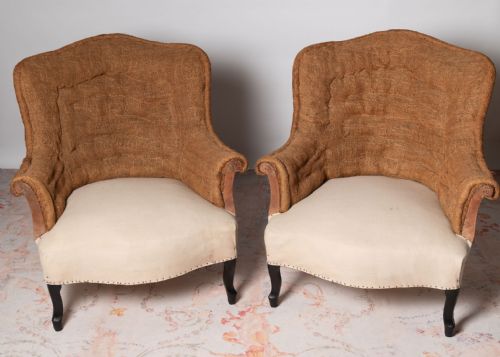
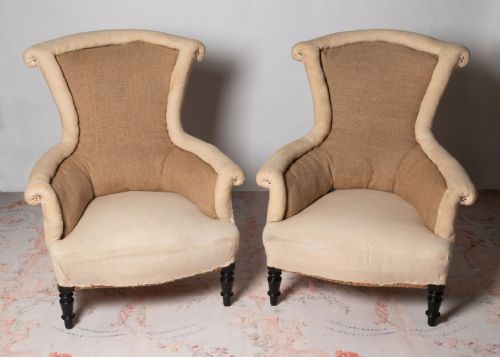


Calico Fabric Armchair
A calico fabric armchair offers a clean upholstered base for any room, bringing traditional comfort and versatility.
Calico Fabric Armchair
When you search for a calico fabric armchair, you are looking at seating covered in sturdy, unbleached cotton that serves as a neutral foundation or a finished rustic cover. The listings here span the nineteenth century, Regency, and nineteen hundred, showing distinct regional characters from English country house seating to French provincial forms.
You will meet various forms on this page, including scroll back armchairs, club styles, library chairs, and generous wingbacks. These pieces often arrive ready for custom upholstery or retain their crisp, plain cotton presentation.
The origins vary between English country house traditions and French Napoleon III or chateau aesthetics. Such chairs combine deep seating with robust timber frames designed for daily use.
How they were made
Frames utilise solid timbers such as mahogany, beech, and general wood to build a durable structural skeleton. Joinery methods support heavy buttoned backs and sprung interiors hidden beneath the outer covers.
Upholstery relies on layers of hessian and cotton calico pulled tight over stuffing. Details such as brass castors or tacks complete the lower framework of these pieces.
Listings feature nineteenth-century pieces incorporating timber, brass, mahogany, beech, hessian, and calico.
What varies in quality
The substance of the timber frame dictates the longevity and heft of the seating, moving from lighter beech structures to substantial mahogany. Proportion also plays a part, separating petite nineteenth-century examples from large, generous library or wingback forms.
The tightness of the calico application and the integrity of the underlying hessian and buttoning reveal the care taken by the maker. Maker attribution further distinguishes standard country house seating from documented workshop output.
Trollope and Sons·Hamptons and Sons·Howard and Sons·Thomas Sopwith
The Calico Fabric Armchair Glossary
- Calico
- A plain-woven, unbleached cotton textile used for upholstery covers and internal linings. It provides a durable and neutral surface.
- Hessian
- A coarse woven fabric made from jute fibres, utilised inside upholstered seating as a foundation for stuffing. It holds the internal padding firmly in place.
- Scroll back
- A chair design where the top rail or arms curve outward in a scroll shape. This style appears frequently in nineteenth-century English country house seating.
- Wingback
- An armchair with side panels or wings attached to the back, designed to shield the sitter from draughts. These pieces often feature generous proportions.
- Buttoned back
- An upholstery technique where depressions are created by pulling twine through the padding and securing it with buttons. This creates a tufted surface pattern.
Calico Fabric Armchair: Frequently Asked Questions
What is a calico fabric armchair?
A calico fabric armchair is a traditional seat upholstered in plain, unbleached cotton material. These pieces often serve as comfortable lounging chairs in libraries and country houses.
They appear in various nineteenth-century styles, ranging from French chateau forms to English scroll back designs.
Can I reupholster a calico armchair easily?
Calico is traditionally used as an interim covering or a clean, plain top layer on antique frames. The sturdy cotton base makes it straightforward to add decorative top fabrics or keep the minimalist look.
Upholstery work depends on the condition of the underlying hessian and internal padding.
How do I identify a Victorian armchair?
Victorian armchairs often show heavier proportions, dark timber frames like mahogany, and deep buttoned backrests. They reflect the comfort and solid construction favoured during the nineteenth century.
Details such as turned wooden legs and brass castors help date these pieces accurately.
Where were these armchairs placed originally?
These seating options originated in formal libraries, drawing rooms, and English country houses where comfort was paramount. Generous proportions allowed for long periods of reading or resting.
French provincial and chateau examples served similar domestic roles in continental reception rooms.