


Burr Walnut Document Box
A burr walnut document box brings rich timber grain and polished brass into a room, serving as a handsome home for correspondence.
Burr Walnut Document Box
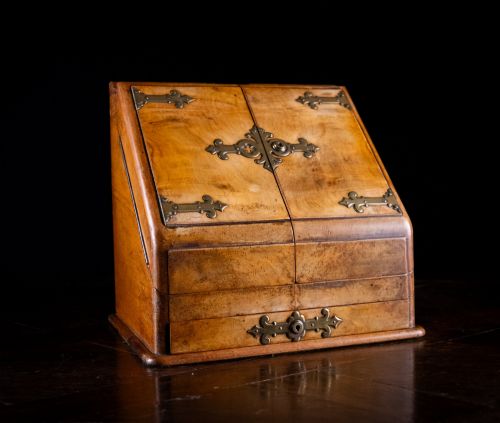
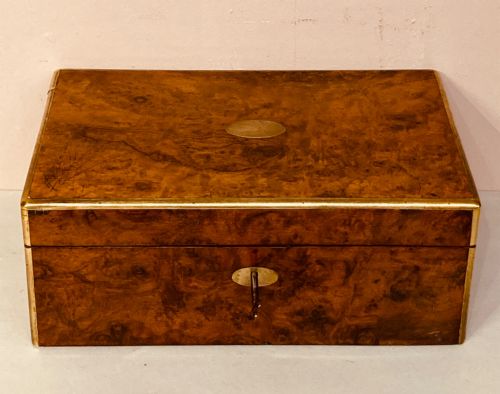
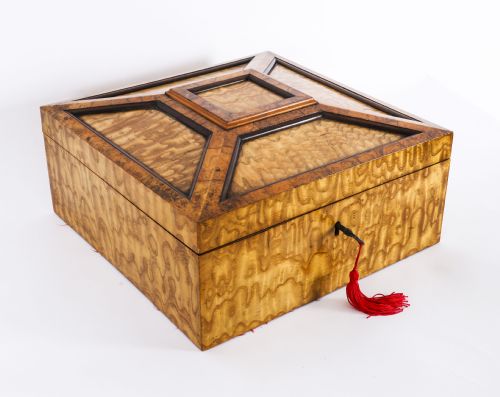
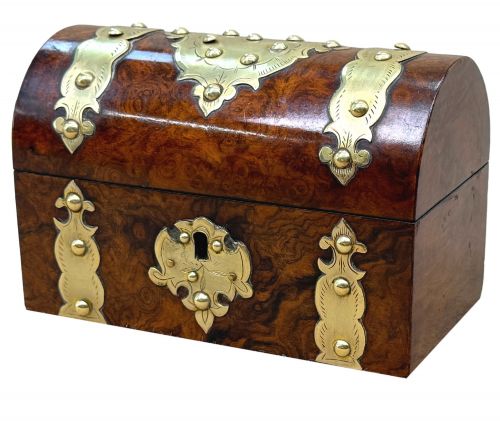
A burr walnut document box offers a compact repository for papers and letters, utilising striking timber figures shaped during the 19th Century. These boxes span several formats, including stationery cabinets, writing slopes, and domed caskets.
The Victorian era dominates the selections on this page, alongside occasional Late Georgian examples. Most pieces take the form of slopefront writing boxes or lidded stationery containers designed for desk use.
Makers integrated compartments, secret drawers, and brass mounts to render each burr walnut document box both decorative and practical. The wood's intricate vortex patterns mark out the distinct character of these desk accessories.
Materials and construction
Cabinet makers applied thin veneers of burr walnut, and occasionally burr maple, over solid secondary timbers to display the figured grain on every visible surface. They reinforced corners and edges with brass straps, escutcheons, and campaign mounts.
Interiors frequently incorporate fitted compartments, lined writing surfaces, and sophisticated locking mechanisms such as Bramah locks. Tunbridge ware inlay and marquetry occasionally decorate the exterior panels of these boxes.
Finding the secret drawers often requires removing a seemingly fixed pen tray to release a hidden spring.
Distinctions in quality
Superior quality shows in the depth and symmetry of the burr walnut veneer wrapping seamlessly around the box lid and sides. Finer examples retain their original fitted interiors, working keys, and branded or patented locks.
Execution of brass mounts and precision in secret drawer mechanisms separate standard production boxes from exceptional bespoke pieces. Secondary wood selection and the crispness of any inlaid marquetry further define the upper tier.
George Austin of Dublin·Mappin & Webb
The Burr Walnut Document Box Glossary
- Burr walnut
- A growth deformity on a walnut tree that produces intricate, swirling grain patterns when sliced into veneer. Cabinet makers prized this wood for high-status boxes and furniture.
- Writing slope
- A box with a hinged lid that opens to form an inclined writing surface, usually containing small compartments for inkwells and pens. Many feature fitted secret drawers beneath the internal stationery dividers.
- Stationery box
- An upright cabinet or box designed to hold envelopes and writing paper in vertical slots. These pieces often feature domed or sloping tops with brass mounts.
- Bramah lock
- A high-security barrel lock invented by Joseph Bramah in the late eighteenth century, commonly found on better quality Victorian boxes. They required a specialised cylindrical key to operate.
- Tunbridge ware
- A form of decorative woodwork featuring intricate mosaic patterns made from tiny wood blocks of various natural colours. It frequently decorates the lids of Victorian boxes and writing slopes.
Burr Walnut Document Box: Frequently Asked Questions
How do I use a writing slope?
Open the hinged lid and fold down the sloping writing surface to reveal the internal pen trays and letter compartments. The inclined plane provides a sturdy platform for writing letters by hand.
Store stationery, stamps, and small documents inside the compartment beneath the writing flap. Many boxes also conceal secret drawers behind these internal fittings.
What is the difference between a slope and a box?
A writing slope specifically incorporates a slanted folding lid designed to create a desk surface when opened. It usually contains specific slots for inkwells and nibs.
A document or stationery box generally sits flat on a table, holding papers in an upright or stacked position rather than providing a writing slant. Both utilise similar burr walnut veneers and brass hardware.
How do I care for burr walnut?
Keep the wood away from direct sunlight and strong heat sources to prevent the burr veneer from drying out and lifting. Dust the surface regularly with a soft, dry cloth.
Apply a microcrystalline wax sparingly if the finish needs nourishment, avoiding liquid polishes containing silicone. Handle brass mounts gently during cleaning to protect the surrounding timber.
Are keys usually included?
Some boxes retain their original working keys, particularly those fitted with secure Bramah mechanisms. Others survive without keys while the locks themselves remain intact.
A specialist locksmith can often fit a replacement key if the original has been lost over the decades.