
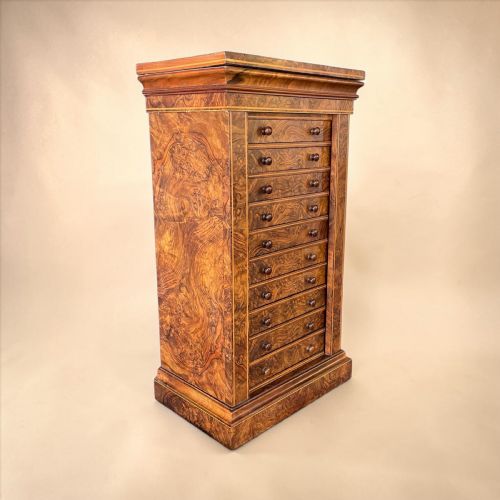


Burr Walnut Collectors Cabinet
A burr walnut collectors cabinet brings extraordinary timber figuring and disciplined interior drawer storage into a room.

Burr Walnut Collectors Cabinet
A burr walnut collectors cabinet is typically encountered as a tabletop piece, a Wellington chest, or a cabinet on stand dating from the eighteenth to the late nineteenth century. These pieces serve to store small specimens, jewellery, cigars, or dental instruments behind secure lockable doors and fitted drawers.
Victorian examples dominate the selection, often taking the form of Wellington chests or compact table cabinets with multiple internal drawers. Earlier pieces from the eighteenth century or the Regency and William and Mary periods appear less frequently as cabinets on stands or escritoires.
The primary function revolves around methodical organisation, housing numerous shallow drawers lined in materials like mahogany or oak. Exterior forms rely on rich walnut veneers that display complex natural grain patterns across the front.
Materials and construction
Makers utilised burr walnut veneers applied over secondary structural timbers such as oak and mahogany to create richly patterned exterior surfaces. Brass hardware, including drop handles, escutcheons, and locking mechanisms, provides functional contrast against the dark timber.
Glass panels appear in display cabinets and pier cabinets, while internal drawer construction frequently relies on solid mahogany or oak joined with traditional dovetails. Timber selection prioritised highly figured burr sections for the visible exterior facades while keeping structural carcases stable.
Listings span periods from seventeen-hundred through the late Victorian era, utilising burr walnut, mahogany, oak, and brass.
Judging quality
Quality rests on the density and symmetry of the burr walnut figuring across the primary facades, with superior examples displaying balanced grain patterns without heavy patching. The precision of the internal drawer construction and the original condition of brass locks and handles also distinguish finer pieces from standard production.
Subtleties in proportion and the retention of original interior linings or specialised fittings separate utilitarian dentist or specimen chests from high-status drawing room show cabinets.
The Burr Walnut Collectors Cabinet Glossary
- Burr walnut
- A veneer sliced from the deformed growth or knot of a walnut tree, yielding complex, swirling grain patterns. This material was favoured by cabinetmakers for high-status furniture fronts.
- Wellington chest
- A tall, narrow chest of drawers secured by a hinged vertical locking stile on one side. This mechanism fastens over the drawer edges to lock all drawers simultaneously with a single key.
- Cabinet on stand
- A two-part form consisting of a main storage cabinet resting upon a separate supporting table base with legs. This configuration elevates the storage section for easier access.
- Humidor
- A specialised box or cabinet designed to store cigars in controlled humidity. Many surviving examples share forms with small tabletop collectors cabinets.
- Escritoire
- A small writing cabinet featuring a fall-front desk flap or internal compartments. Some versions incorporate revolving tabernacles or small drawers.
Burr Walnut Collectors Cabinet: Frequently Asked Questions
What were burr walnut collectors cabinets originally used for?
These cabinets were designed to store orderly collections of small objects such as geological specimens, coins, shells, or jewellery. Owners valued them for keeping delicate items protected and catalogued.
Over time, many similar forms were adapted for specialised uses, including holding dental instruments, cigars, or writing materials.
How can I tell a Victorian cabinet from an earlier piece?
Victorian examples, particularly those from the mid to late nineteenth century, often display machine-sawn drawer linings in mahogany and heavy brass locking mechanisms. They frequently take the form of Wellington chests or tabletop specimen drawers.
Earlier pieces from the eighteenth century or the William and Mary period typically appear as cabinets on stands with distinct base constructions and different secondary timbers like oak.
Are the drawer interiors usually made of solid walnut?
Drawer interiors are rarely made from solid burr walnut, which was reserved for decorative exterior veneers. Makers instead constructed drawer carcases from stable timbers like mahogany or oak.
This method prevented warping while keeping the drawers strong enough to hold heavy collections of specimens or coins.
How do I care for burr walnut veneer?
Burr walnut requires stable room humidity and protection from direct sunlight to prevent the thin veneer from drying or cracking. Gentle dusting with a dry cloth is sufficient for routine maintenance.
Avoid placing these cabinets near heat sources or damp areas, as fluctuating conditions can cause the veneer to lift from the secondary timber.