




Burgundy Leather Desk
A burgundy leather desk brings depth to a study through polished mahogany and rich, dark red hides.
Burgundy Leather Desk
A burgundy leather desk typically combines a timber writing surface with a dark red or burgundy hide insert, often accompanied by matching seating.
Buyers seeking a burgundy leather desk encounter pedestal desks with inset leather writing panels alongside companion desk chairs upholstered in matching red leather.
The selection spans periods from the Georgian and Victorian eras through to the Edwardian period, built in mahogany, oak, and walnut.
How they were made
Carpenters constructed the underlying frames in solid timbers such as mahogany, oak, and walnut, often applying polished finishes to highlight the grain.
Hides were stretched over padding for seats and desk inserts, frequently complemented by brass hardware and gilt tooling around the borders.
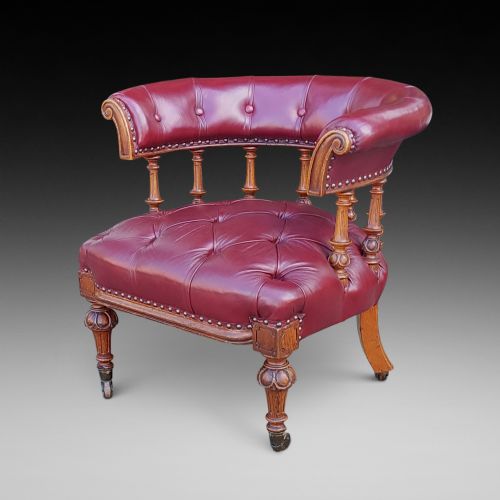
Certain stout oak chairs designed for traditional pastimes now serve comfortably at modern writing tables.
What varies in quality
The choice of primary timber and the selection of hide dictate the standing of a piece, with dense mahogany and thick leather occupying the upper tier.
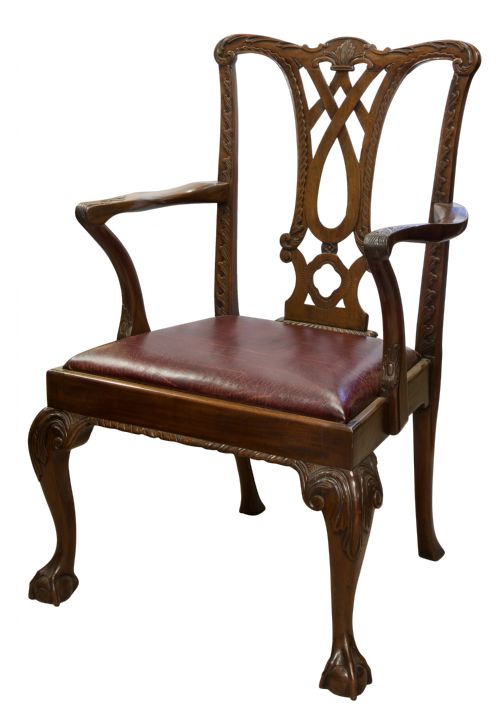
Execution of period styles, from Chippendale to Queen Anne, and the crispness of any gilt tooling on the leather surface distinguish finer examples from standard workshop output.
Phillips And Sons Of Bristol·Maple And Co
The Burgundy Leather Desk Glossary
- Pedestal desk
- A writing table built with two separate pedestals of drawers supporting the main top. This form provides substantial storage beneath the burgundy leather writing surface.
- Gilt
- Gold leaf or gold pigment applied to decorate surfaces. It frequently appears as decorative tooling around the perimeter of leather desk inserts.
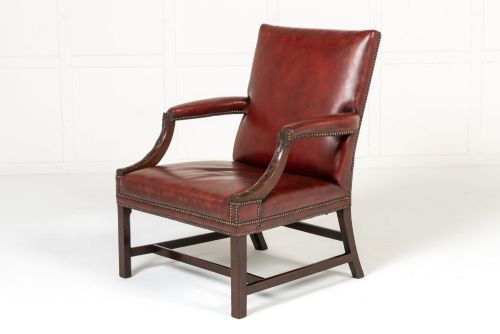
- Gainsborough chair
- A wide, open-armed armchair with a padded seat and back, designed in the 18th century. Examples often appear in mahogany with leather upholstery.
- Cockfighting chair
- A low timber chair with a padded armrest designed to straddle facing forwards. These pieces often feature dark red leather upholstery.
Burgundy Leather Desk: Frequently Asked Questions
What periods do these desks come from?
The pieces span several eras, including Georgian, Victorian, and Edwardian periods.
Craftsmen built them across the 18th, 19th, and early 20th centuries using traditional timber framing methods.
How do I match a chair to a desk?
Matching a chair involves looking at the timber species, such as mahogany or oak, and the shade of the leather.
Many pairings coordinate pedestal desks with revolving armchairs or library chairs finished in matching burgundy hide.
Are pedestal desks practical for daily work?
Pedestal desks offer large writing surfaces paired with multiple drawers built into the support columns below.
The stable timber construction and durable leather writing pads suit regular daily use in a study.
How do I identify a Victorian desk?
Victorian pieces often utilise dense mahogany or oak and frequently feature turnings or pedestal configurations.
Makers of this era commonly combined dark red leather inserts with heavy timber frames and brass castors.