




Buff Pottery Pitcher
A buff pottery pitcher brings tactile warmth to any room, offering the earthy tones and robust forms that collectors prize in early ceramic vessels.
Buff Pottery Pitcher
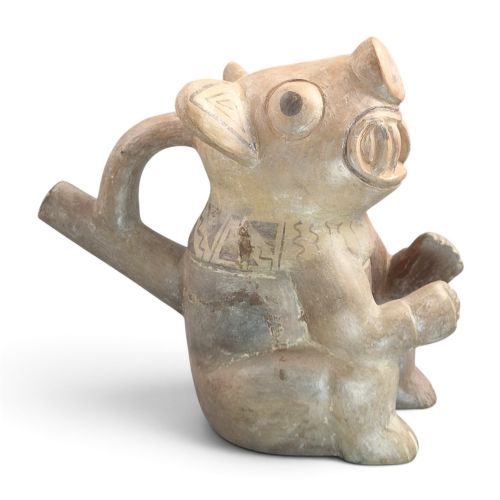
A buff pottery pitcher is a versatile vessel encompassing diverse historical forms, from early Pre-Columbian terracotta zoomorphic pieces to Victorian salt-glazed stoneware jugs. These items function primarily as utilitarian containers or decorative objects, utilising light-coloured clay bodies that vary from pale yellow ware to warm grey tones.
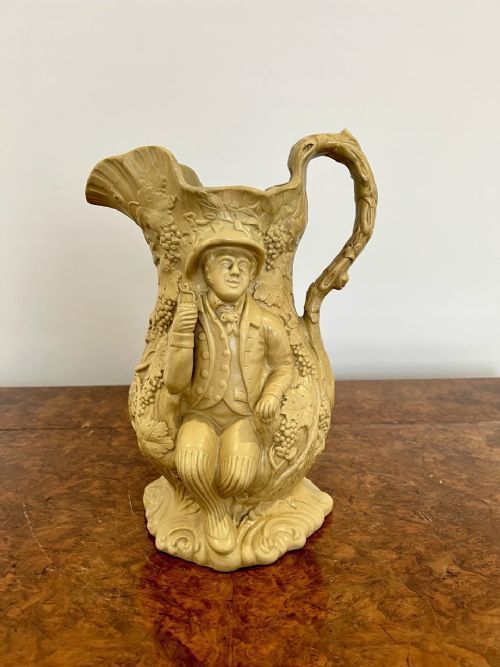
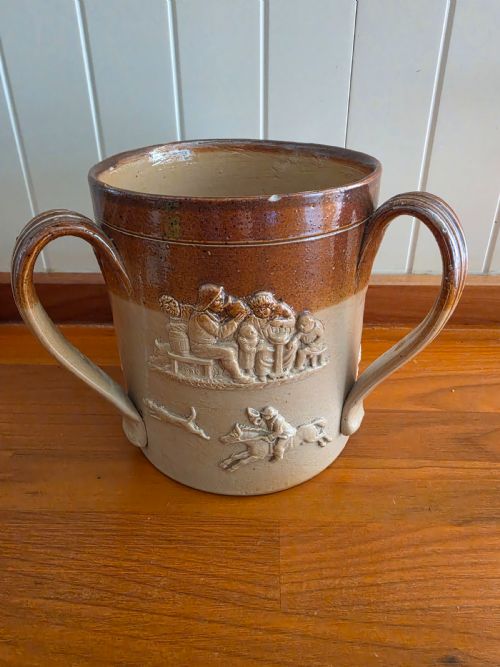
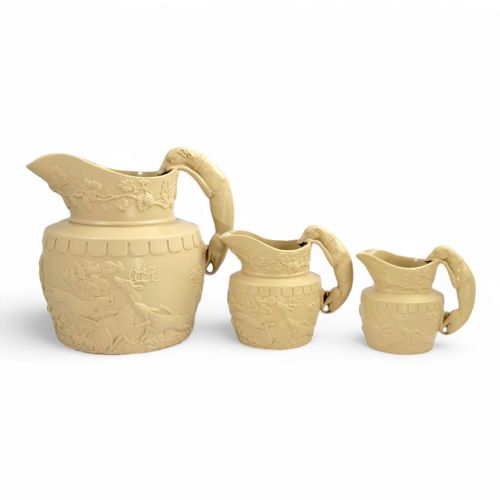
Buyers frequently encounter nineteenth-century English examples on this page, including relief-moulded ale jugs, puzzle jugs, and sporting vessels originating from notable potteries like Doulton Lambeth. Earlier periods are also represented by ancient earthenware and robust Georgian salt-glazed stoneware.
The assortment spans multiple decorative traditions, incorporating English Country Pottery alongside refined Art Nouveau and Victorian Arts & Crafts designs. Handles range from simple single loops to elaborate hound figures and multi-handled tygs.
Materials and construction
Potters shaped these pitchers using fundamental earthen materials, primarily relying on clay, stoneware, and terracotta to form the foundational body. Pigments were frequently applied to enhance surface detail, while glazes provided both decorative sheen and practical waterproofing.
Moulding and salt-glazing defined many nineteenth-century pieces, where salt thrown into the kiln during firing produced a distinctive textured surface. Relief moulding allowed makers to achieve crisp, three-dimensional decorative scenes across the body of the jug.
Assessing craftsmanship and execution
Quality in these pitchers rests upon the crispness of the moulding and the intentional application of decorative elements like cream sprigging or applied pigment. Superior examples display balanced proportions and sharp relief work that remains clear beneath the glaze.
The sophistication of the design and the execution of intricate details, such as sculpted handles or figural elements, distinguish standard utilitarian wares from exhibition-grade pieces produced by skilled makers.
Doulton Lambeth·Phillips and Bagster·Emma Shute·Copeland Spode
The Buff Pottery Pitcher Glossary
- Buff pottery
- Earthenware or stoneware featuring a pale, warm yellowish-brown or biscuit-coloured body. This clay serves as the neutral base for various glazes and decorative slips.
- Salt glaze
- A ceramic finish created by throwing common salt into the kiln at high temperatures, producing a pitted, orange-peel texture on stoneware. It provides a durable, impermeable surface prized on nineteenth-century jugs.
- Relief moulded
- A technique where vessels are formed in moulds featuring depressed designs, causing the clay to take on raised decorative patterns. This method allowed makers to produce consistent pictorial scenes and ornamentation.
- Tyg
- A traditional multi-handled drinking vessel designed for communal passing around a table. Early examples often feature three or more loop handles spaced evenly around the body.
- Sprigging
- The process of applying separately moulded clay ornaments onto the unfired surface of a vessel. These raised motifs are typically lighter in colour than the main body for contrast.
Buff Pottery Pitcher: Frequently Asked Questions
What is a salt glaze?
A salt glaze is a glossy, slightly textured finish created when salt vaporises inside a hot kiln. It bonds with the clay body to form a hard, durable surface.
This technique protects the stoneware vessel from moisture and wear while giving the exterior its characteristic pitted finish.
How do I identify a Victorian jug?
Victorian jugs often feature distinct relief-moulded ornamentation, botanical motifs, or sporting scenes. They frequently utilise salt-glazed stoneware or refined earthenware bodies.
Makers' marks, registration diamonds, or specific factory stamps from establishments like Doulton Lambeth can also confirm the nineteenth-century period.
Can I use these pitchers for serving?
Many antique pitchers are designed for display, historical study, or collection rather than daily dining use. Older earthenware and porous terracotta can be sensitive to modern liquids and rigorous washing.
Sturdier salt-glazed stoneware jugs are structurally robust, but checking for hairline cracks or historical repairs is essential before introducing any liquid.
What is cream sprigging?
Cream sprigging involves applying pale, pre-moulded clay motifs onto the contrasting darker body of a stoneware jug. These decorative reliefs are glued on with slip before firing.
The resulting designs stand out in sharp relief against the background, adding texture and visual depth to exhibition pieces.