
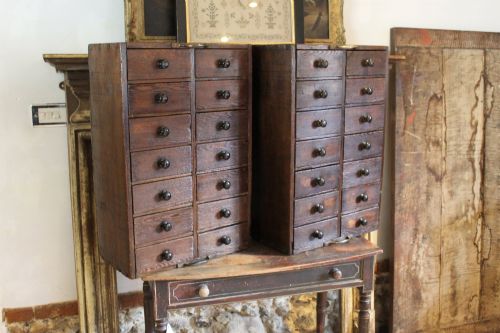
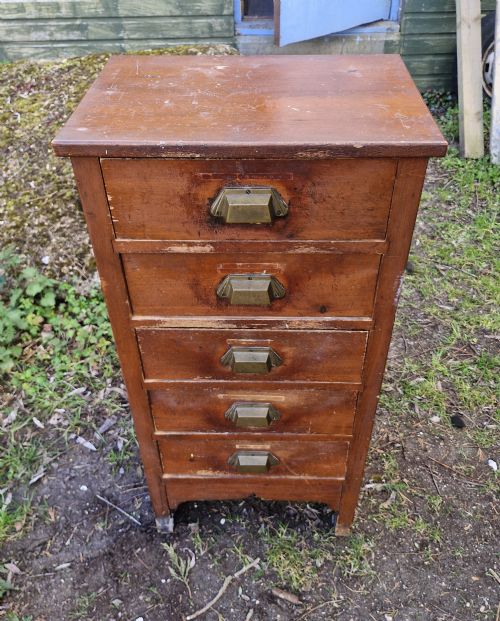


Brown Wooden Index Chest
These brown wooden index chest examples offer practical storage with period character, prized by collectors and organisers alike.
Brown Wooden Index Chest
A brown wooden index chest provides compartmentalised storage for documents, cards, or small items, appearing in forms such as filing cabinets, banks of drawers, and desktop filing drawers. Buyers seeking a brown wooden index chest will most commonly encounter pieces originating from the Victorian era, the Edwardian period, and the early decades of the twentieth century.
The selection ranges from tall watchmakers' banks of drawers and multi-drawer collectors' cabinets to compact office units and patent letter files. These items reflect utilitarian and commercial origins, designed originally for offices, workshops, and studies.
Makers and inventors such as Shannon, Amberg, and D Napier & Sons contributed to this category, producing functional furniture that now serves domestic and workspace storage needs. The variety spans styles including Arts and Crafts, Industrial, and Art Deco alongside straightforward Victorian and Edwardian utilitarian designs.
How they were made
Construction relies upon traditional timber framing utilising solid woods such as oak, mahogany, walnut, pine, and beech. These durable timbers form the main carcass and drawer structures, providing the necessary strength for frequent daily use.
Metal components play an essential structural and functional role, particularly brass handles, label holders, and patent mechanism parts. Glass panels occasionally feature in specialised display or collectors' pieces.
A sixty-six drawer office cabinet provides enough tiny compartments to misplace your sanity sixty-six times over.
What varies in quality
The standard of timber selection and cabinetmaking craftsmanship dictates the durability and visual appeal of each unit. Well-executed dovetail joints and substantial drawer thickness distinguish robust workshop pieces from lighter domestic items.
Original hardware, including marked brass pulls and functional patent locking systems, adds significant character and historical integrity. The complexity of the drawer arrangement, from simple five-drawer office units to extensive forty-drawer systems, influences the scale and utility of the piece.
D Napier & Sons·Amberg·Shannon·Brady
The Brown Wooden Index Chest Glossary
- Bank of drawers
- A tall or wide cabinet containing multiple shallow drawers stacked vertically or horizontally. These units were standard in trade workshops and offices for sorting small components or documents.
- Patent letter file
- A filing system incorporating proprietary mechanical elements, such as Amberg's designs, to secure and organise correspondence. These mechanisms often bear maker stamps and metal naming plates.
- Collectors cabinet
- A specialised piece of furniture designed to house specimens, watches, or small objects in numerous shallow drawers. They often feature tightly fitted panelled or glazed doors protecting the contents.
- Dovetail joint
- A traditional interlocking woodworking joint used at drawer corners for maximum tensile strength. Fine, numerous pins indicate attentive hand construction.
- Index filing drawers
- Small-scale drawer units engineered specifically for holding index cards or standardised paper records. They frequently include brass label holders on the drawer fronts for categorisation.
Brown Wooden Index Chest: Frequently Asked Questions
What were index chests used for?
These chests served primarily in offices, libraries, and workshops for organising business correspondence, index cards, and trade specimens. Their numerous shallow drawers allowed clerks and craftspeople to maintain orderly filing systems before modern digital archiving.
Over time, businesses upgraded their record-keeping methods, rendering these wooden units redundant for corporate use. Today, they transition smoothly into domestic environments for sorting stationery, craft supplies, and small household collections.
How do I date a wooden index chest?
Dating relies upon observing the combination of timber types, construction methods, and hardware styles present on the piece. Victorian and Edwardian examples often display heavier oak or walnut builds with traditional hand-cut joinery and period brass pulls.
Later pieces from the 1920s and 1930s tend towards simpler industrial utility designs or streamlined Art Deco influences. Patent stamps and maker plaques provide definitive chronological markers when present.
Are these cabinets suitable for modern filing?
Many index chests accommodate smaller card formats, index records, and modern stationery items rather than standard hanging folders. Their shallow drawer depths suit the storage of notes, craft materials, and desk accessories rather than bulky files.
Buyers should verify internal drawer dimensions against their intended storage requirements before purchase. Desktop versions offer convenient access to everyday paperwork while occupying minimal surface area.
How do I care for antique wood furniture?
Maintenance involves keeping wooden surfaces away from direct heat sources and strong sunlight to prevent timber warping and finish fading. Occasional dusting with a soft, dry cloth preserves the patina without introducing moisture.
Applying a suitable microcrystalline wax periodically helps nourish the wood and protect the original finish. Avoid silicone-based sprays, which can penetrate the grain and damage older polished surfaces.