
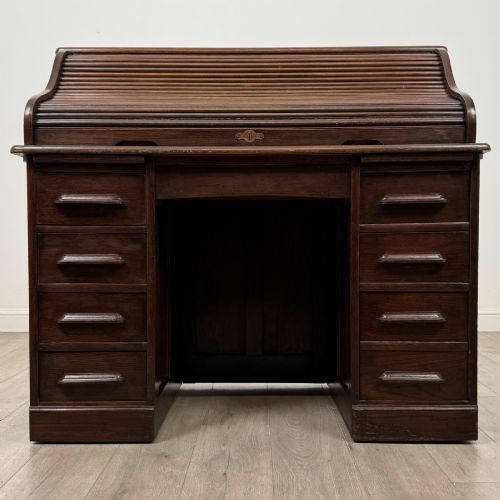
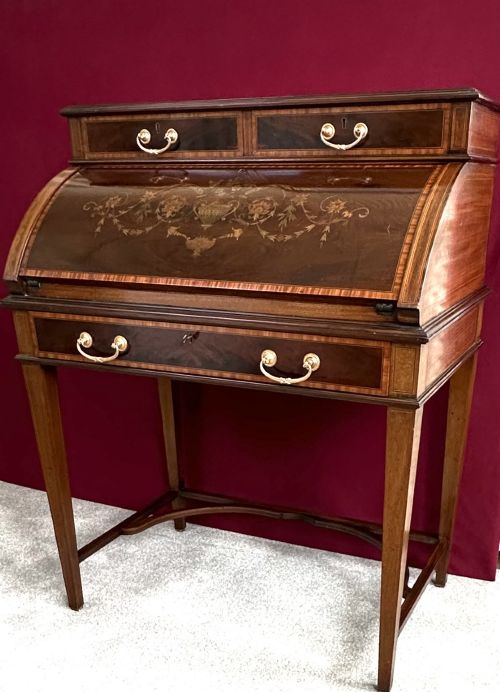
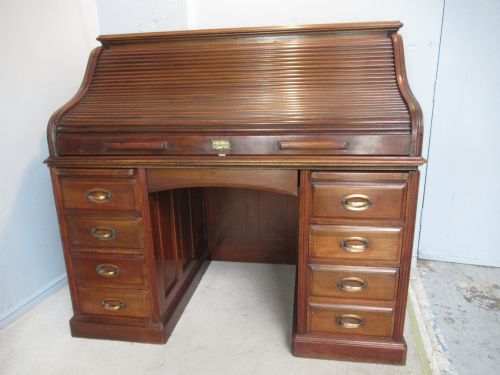
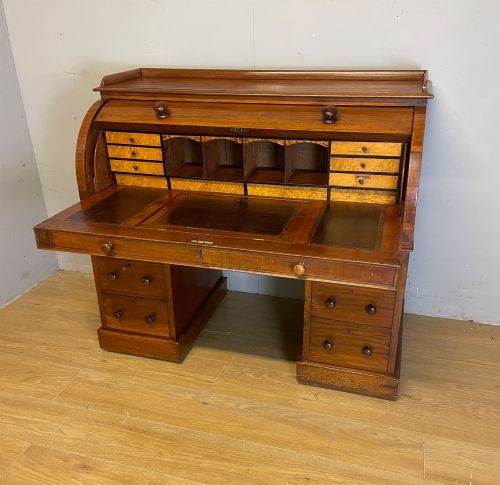
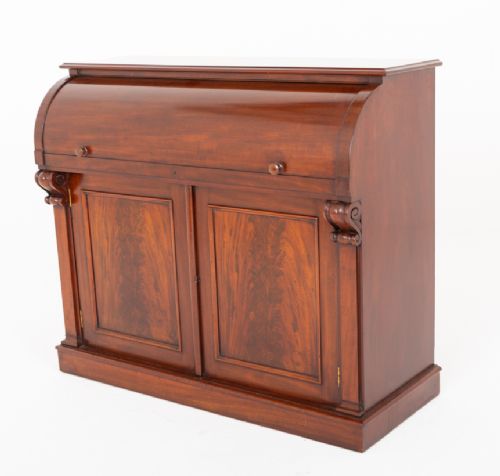
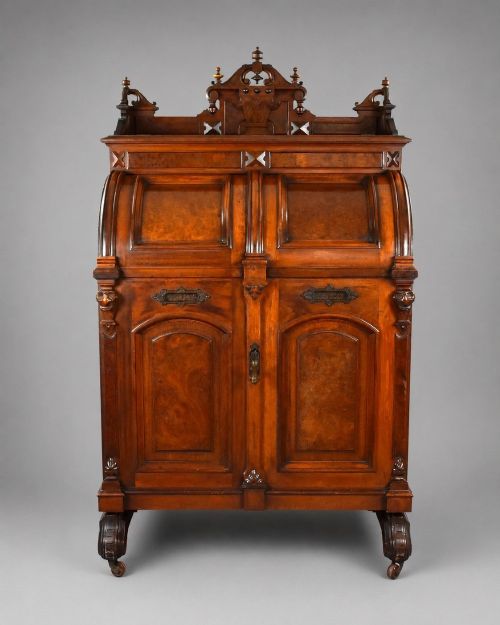
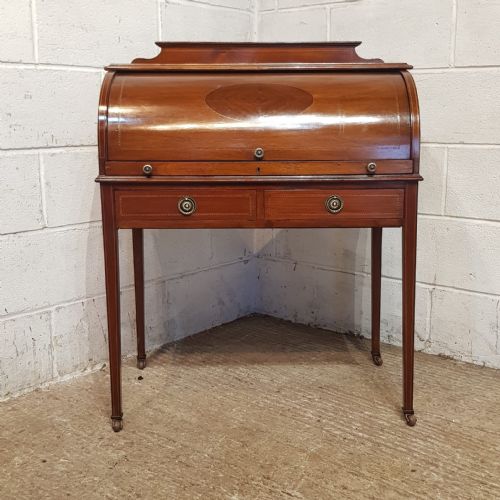


Brown Wooden Cylinder Desk
These brown wooden cylinder desk pieces combine enclosed writing surfaces with rich timber grains, offering a practical workspace that conceals daily papers behind a curved sliding lid.
Brown Wooden Cylinder Desk
When you search for a brown wooden cylinder desk, you encounter sophisticated writing furniture designed to keep correspondence and documents neatly hidden from view. These pieces range from compact Edwardian examples to grand Victorian pedestals and elaborate continental variations.
The versions you are most likely to meet on this page hail primarily from the Victorian and Edwardian eras, constructed in substantial timber forms like mahogany, walnut, and oak. Alongside standard writing tables, you also find bureau cabinets and roll-top variants designed for efficient daily use.
Geographic origins and stylistic influences vary considerably across the selection, encompassing British workshop traditions alongside Dutch marquetry, Japanese Yosegi woodwork, and Chinese carved elements. Each piece demonstrates how different periods adapted the fundamental curved-lid mechanism to suit contemporary tastes.
How they were made
The primary construction relies on solid and veneered timbers such as mahogany, walnut, oak, and maple, often enhanced by contrasting decorative inlays like satinwood. Cabinetmakers formed the characteristic curved cylinder or tambour mechanism from thin slats or flexible wooden segments running in precise tracks.
Many examples incorporate secondary materials including brass hardware for handles and fittings, alongside glass panes in associated upper bookcase sections. Advanced iterations utilise complex marquetry techniques or intricate mosaic Yosegi work to pattern the exterior surfaces.
Listings feature items spanning the Georgian, Victorian, and Edwardian periods, constructed in timber varieties including mahogany, walnut, oak, maple, and satinwood.
What varies in quality
The smoothness and precision of the sliding cylinder or tambour action dictate the mechanical calibre of each desk. Superior pieces feature well-aligned tracks and seasoned timbers that resist warping, ensuring the curved shutter glides effortlessly without binding.
Material selection and decorative execution further separate standard utility furniture from exhibition pieces. Finer desks display carefully chosen burr walnut veneers, meticulous string inlay, and substantial secondary woods rather than simple plain panels.
Wiggers
The Brown Wooden Cylinder Desk Glossary
- Cylinder desk
- A writing desk featuring a quarter-circle or half-cylinder wooden shutter that rolls back to reveal the writing surface and pigeonholes. This mechanical lid allows the user to leave correspondence undisturbed while closing the desk.
- Tambour
- A flexible sliding shutter formed from narrow vertical strips of wood glued to a fabric backing. It operates within a grooved track to cover storage compartments.
- Marquetry
- The art of applying decorative veneer pieces in various timbers to form pictorial or geometric patterns on furniture surfaces. It requires high skill to fit each wood segment precisely into the base.
- Yosegi
- A traditional Japanese mosaic woodworking technique using natural coloured woods to create intricate geometric patterns. Pieces utilising this method demonstrate exceptional precision in miniature wood assembly.
- Pedestal desk
- A heavy freestanding desk supported by two separate stacks of drawers or cupboards. The central writing space sits bridged between these two structural bases.
Brown Wooden Cylinder Desk: Frequently Asked Questions
How do you use a cylinder desk?
To use the desk, you slide the curved wooden cylinder upward into the body of the cabinet, which exposes the internal writing surface, drawers, and pigeonholes. Pulling out an extendable writing flap provides additional knee room and workspace.
When finishing work for the day, you push the writing slide back in and pull the cylinder down to secure your papers without needing to clear the surface.
How do I date a Victorian cylinder desk?
Dating these desks involves examining the secondary timbers, construction methods, and hardware styles characteristic of the nineteenth century. Victorian pieces often employ solid mahogany or walnut with heavy pedestal configurations and hand-cut dovetails in the interior drawers.
Later Victorian and Edwardian examples may show machine-sawn elements, lighter oak or maple construction, and more restrained decorative inlays.
Where should I place a cylinder desk?
Because these desks are substantial items of furniture with finished backs in many cases, they work effectively both against a wall and freestanding in the centre of a study. Ensuring adequate clearance around the piece allows the user to operate the sliding cylinder and pull out the writing surface without obstruction.
Keeping them away from direct heat sources prevents the solid timbers and intricate veneer work from drying out or splitting.