

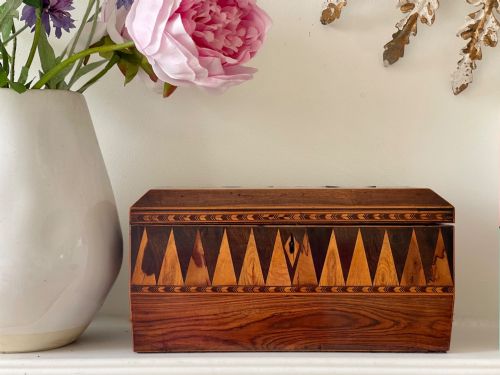


Brown Timber Tea Caddy
A brown timber tea caddy brings domestic history to hand, offering a sturdy wooden box once used to safeguard costly tea leaves under lock.
Brown Timber Tea Caddy
A brown timber tea caddy is a wooden receptacle designed for storing dry tea leaves in domestic rooms during past centuries. Buyers searching for a brown timber tea caddy will encounter various forms spanning the Georgian, Victorian, and Edwardian periods.
The selections on this page include mahogany, partridge wood, and rosewood examples shaped into octagonal bodies, pairs, and sarcophagus forms. Fitted interiors often remain inside these timber boxes to divide the space for different tea varieties.
Makers utilised contrasting woods such as boxwood for decorative banding alongside bone elements. Alongside standard caddies, related items like jewellery boxes and caddy spoons occasionally appear within the broader selection.
How they were made
Craftsmen built these containers from dense timbers including mahogany, rosewood, and partridge wood, sometimes applying amboyna veneer to the exterior surfaces. Boxwood strings and bone details provide decorative contrast against the darker brown wood.
Specialised techniques such as Tunbridge Ware surface decoration appear on Georgian examples, alongside carved hard wood oriental designs. Metal hinges, escutcheons, and brass elements secure the lids and form functional fixtures.
Brown Timber Tea Caddy Retail Price Guide 2026
Typical asking prices for brown timber tea caddy among the pieces listed under this phrase on Sellingantiques today, from the lower quarter to the upper quarter. They describe what is for sale here now, not the wider market.
Some wooden boxes survived primarily because tea was once so valuable that households kept the key on a chain around the neck.
What varies in quality
The standard of a brown timber tea caddy depends on the choice of timber and the precision of the veneer work, with figured grains commanding attention. Richly patterned partridge wood or burr yew displays greater decorative ambition than plain mahogany boards.
Internal arrangements differentiate standard boxes from superior pieces, particularly when fitted interiors retain their original partitions and matching caddy spoons. The complexity of external shapes, such as eight-sided octagonal geometries or sarcophagus curves, reflects higher workmanship.
The Brown Timber Tea Caddy Glossary
- Tunbridge Ware
- A type of woodwork featuring intricate mosaic patterns made from tiny wood triangles. This decorative technique appears on Georgian pieces.
- Sarcophagus-shaped
- A box design featuring a steep-sided, domed lid resembling an ancient stone coffin. Makers applied this monumental form during the Regency and William IV periods.
- Veneer
- A thin layer of decorative wood applied to a secondary timber base. Amboyna veneer provides a contrasting figured surface on mahogany bodies.
- Escutcheon
- A protective metal plate surrounding a keyhole on the front of a box. Brass serves as the primary metal for these functional fixtures.
Brown Timber Tea Caddy: Frequently Asked Questions
What is a brown timber tea caddy?
A brown timber tea caddy is a wooden storage box made to keep loose tea leaves dry and secure. These containers date primarily from the Georgian, Victorian, and Edwardian eras.
Craftsmen built them from dense woods like mahogany, rosewood, and partridge wood. Many examples feature hinged lids and internal compartments for different tea grades.
How were tea caddies used historically?
Tea was an expensive commodity in the 18th and 19th centuries, requiring secure storage away from dampness and servants. The mistress of the house kept the key to lock the leaves inside.
Inside the box, separate lidded canisters or foil-lined compartments held green and black teas. A caddy spoon served to measure out the leaves for each pot.
How do I date a wooden tea caddy?
Dating relies on observing the timber choice, cabinet-making techniques, and overall shape style. Georgian pieces often display straight sides or octagonal geometries with delicate inlay.
Later Victorian and William IV examples frequently adopt heavier sarcophagus shapes with rosewood veneers. Fitted interiors and metal hardware also offer clues to the period of manufacture.
How do I care for a antique tea caddy?
Keep wooden tea caddies away from direct sunlight and radiators to prevent the timber and veneer from splitting. Stable room temperatures protect the historic polish and natural grain.
Dust the surfaces gently with a dry, soft cloth rather than using modern liquid polishes. Check the brass hinges and locks infrequently to ensure they operate without strain.