



Brown Mahogany Music Chest
These brown mahogany music chests are tall, upright storage cabinets built for sheet music, carrying the refined joinery of the Victorian and Edwardian eras.
Brown Mahogany Music Chest
When you search for a brown mahogany music chest, you are looking at narrow, vertical furniture designed to hold sheet music, folios, and documents in domestic sitting rooms. The pieces appearing here span the Victorian and Edwardian periods, stretching from the late nineteenth century into the early twentieth century.
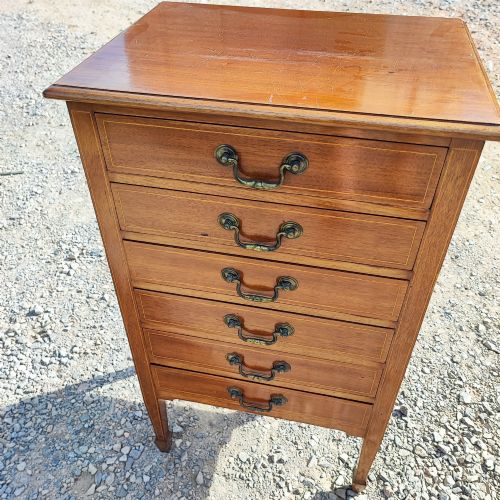
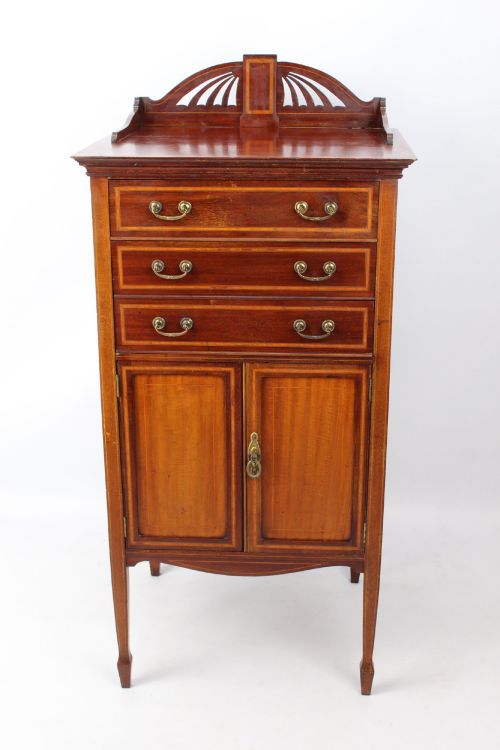
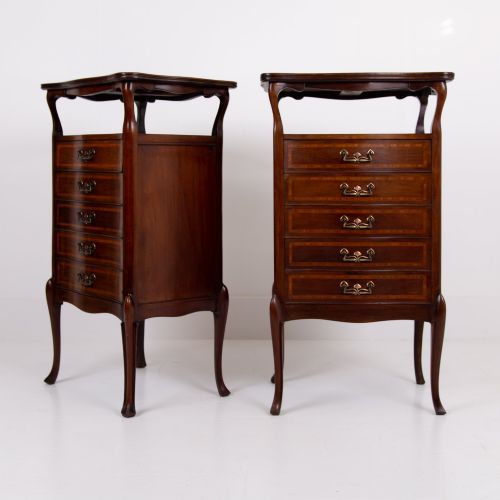
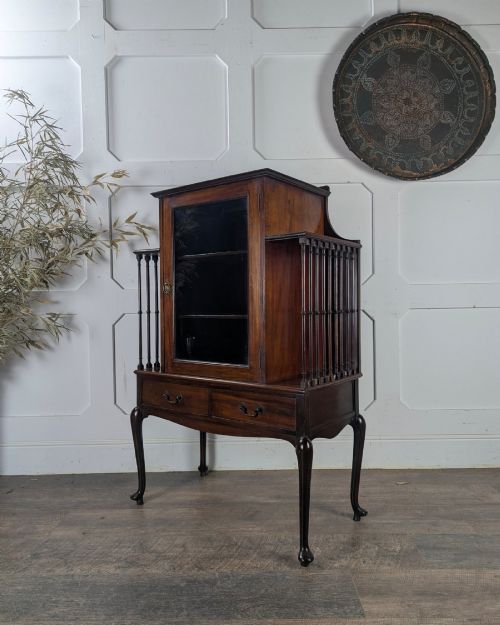
The versions you will most frequently meet are Edwardian floor-standing cabinets in mahogany, often featuring tiered drawers or drop-front compartments. Some examples bridge the gap between music storage and display, incorporating glass doors, side shelving, or lower undershelves for books.
Origins are distinctly British, with styles ranging from plain classical forms to more decorative expressions including Art Nouveau, Arts and Crafts, and Edwardian Chippendale revivals. Occasionally, the basic form doubles as a bedside cabinet or document filing chest.
How they were made
Cabinet makers built these pieces using solid mahogany and mahogany veneers over secondary timbers, shaping the vertical carcases to fit tight domestic corners. Many surfaces receive delicate contrasting details through satinwood and boxwood inlay or marquetry panels.
Functional metalwork plays a crucial role in construction, with cast brass drop handles, drawer pulls, and escutcheons fitted to secure drop fronts and shallow drawers. Glass panels are integrated into door frames on display-oriented hybrids, while specialised internal partitions keep paper sheets upright and sorted.
Brown Mahogany Music Chest Retail Price Guide 2026
Typical asking prices for brown mahogany music chest among the pieces listed under this phrase on Sellingantiques today, from the lower quarter to the upper quarter. They describe what is for sale here now, not the wider market.
Some Edwardian drop-front cabinets open to reveal internal partitions still bearing faint pencil marks from Victorian pianists.
What varies in quality
The standard of timber selection sets the baseline for quality, distinguishing plain mahogany boards from richly figured grain patterns framed by crisp boxwood and satinwood stringing. Finer cabinets show careful alignment of inlay work across multiple drawer fronts and door panels.
Structural refinement also separates workshop outputs, visible in the precision of the drawer dovetails, the smooth action of fall fronts, and the weight of the brass hardware. Maker attribution, such as signed Victorian work, elevates certain examples above standard domestic production.
Keeble London·Liberty
The Brown Mahogany Music Chest Glossary
- Music cabinet
- A tall, narrow piece of furniture fitted with shallow drawers or drop fronts specifically proportioned for storing sheet music. These cabinets became standard in middle-class Victorian and Edwardian parlours.
- Fall front
- A hinged door or panel that drops down to a horizontal position when opened, revealing internal slots or shelves. It allows easy access to stacked folios without pulling out individual drawers.
- Marquetry
- The art of applying pieces of veneer to a structure to form decorative patterns and pictures. Makers used various coloured woods to create floral or geometric motifs on the cabinet doors.
- Satinwood inlay
- A contrasting light-coloured ornamental wood inserted into recesses cut into the darker mahogany surface. This technique creates fine decorative borders and lines known as stringing.
- Canterbury
- A low, open-sectioned stand traditionally used for holding sheet music or loose folios near a piano. Some Victorian variants incorporate small drawers beneath the slatted divisions.
Brown Mahogany Music Chest: Frequently Asked Questions
What is a music chest used for?
These cabinets were originally designed to organise and protect sheet music, folios, and scores beside a piano or in a music room. The shallow drawers and vertical compartments kept fragile paper documents flat and free from dust.
Today, buyers repurpose them as jewellery chests, bedside tables, or narrow filing cabinets for modern paperwork in compact spaces.
How do I date a music cabinet?
Dating relies on stylistic clues and construction methods visible across the Victorian and Edwardian periods. Pieces from the late nineteenth century often feature heavier proportions, dark finishes, and elaborate marquetry.
Early twentieth-century Edwardian examples tend to be lighter in appearance, frequently combining inlaid satinwood stringing with cleaner lines inspired by revival styles.
What woods are used in these cabinets?
Mahogany serves as the primary timber for the main carcase, door frames, and drawer fronts. This was chosen for its rich brown tone and stable grain.
Decorative elements frequently incorporate contrasting lighter woods like satinwood and boxwood for inlay work, while secondary timbers such as pine or oak appear inside drawer linings.
Are music cabinets suitable for small rooms?
Their tall, narrow footprint makes them exceptionally well-suited for tight corners and spaces where floor area is limited. They provide generous vertical storage without dominating a room.
This compact proportion explains why they easily transition into modern homes as bedside tables or hallway storage.