
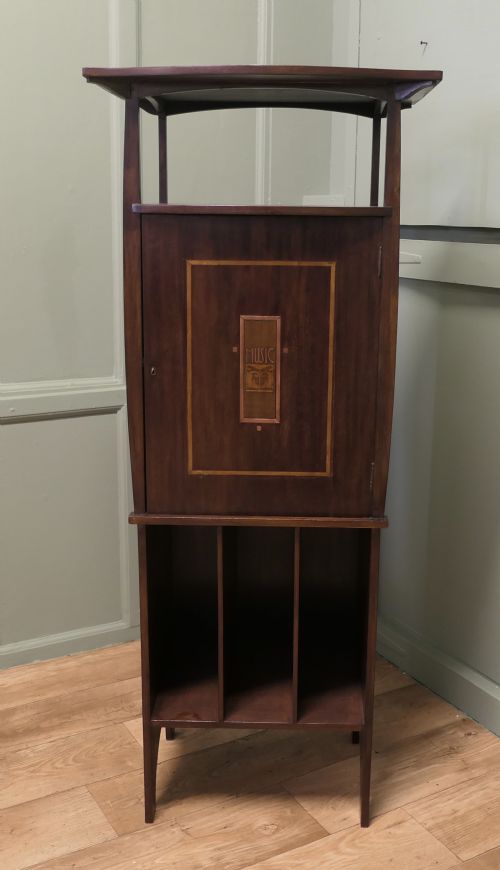


Sheet Music Organiser Cabinet
A sheet music organiser cabinet is a purpose-built home for your scores and folios, keeping paper tidy with drop-down fronts or vertical tiers.
Sheet Music Organiser Cabinet
A sheet music organiser cabinet brings order to loose folios and scores, appearing mostly in Edwardian and Victorian forms across this selection. You will frequently meet Edwardian mahogany pieces alongside late Victorian examples and occasional Art Nouveau or Arts and Crafts variants.
Most items function as music cabinets or music canterbys, while later iterations stretch into record cabinets for LP storage. These pieces were designed for the Victorian and Edwardian parlour, offering specific interior divisions to sort paper by size and composer.
How they were made
Construction relies heavily on mahogany and rosewood timbers, frequently enriched with boxwood and satinwood inlay to create delicate surface patterns. Brass hardware provides functional detailing for handles, hinges and fall-front mechanisms.
Cabinet makers utilised traditional joinery paired with decorative wood inlay styles characteristic of the Arts and Crafts and Art Nouveau movements. Glass panels and specialised fall-front drawers appear to manage the weight and fragility of paper collections.
Edwardian and Victorian periods account for the vast majority of the cabinets seen here.
What varies in quality
Quality reveals itself in the crispness of the wood inlay and the selection of figured mahogany or rosewood veneers. Finer examples display thoughtful design integration by named makers, whereas standard commercial pieces rely on simpler construction.
The sophistication of the internal divisions and the execution of distinct stylistic elements, such as French Art Nouveau curves or Arts and Crafts linearity, dictate the standing of an individual cabinet.
GM Elwood for JS Henry
The Sheet Music Organiser Cabinet Glossary
- Fall Front
- A hinged panel that drops forward to reveal internal storage compartments. This mechanism allows easy access to sheet music stored flat.
- Music Canterbury
- A low stand featuring vertical partitions for holding folios and sheet music off the floor. The Victorian version often includes small drawer units below the open tiers.
- Inlay
- A technique where contrasting woods like boxwood and satinwood are fitted into the primary mahogany or rosewood surface. It defines the decorative borders on Edwardian models.
- Art Nouveau
- A stylistic movement characterised by organic, flowing lines and natural motifs. Pieces from this period show distinct curvilinear woodworking.
Sheet Music Organiser Cabinet: Frequently Asked Questions
What is a sheet music organiser cabinet used for?
These cabinets house loose sheet music, folios, and small musical scores in an orderly fashion within a domestic setting. The interior compartments keep paper flat and separated by category.
They serve equally well today for organising modern documents, art papers, or vinyl records in living spaces.
How do I date a sheet music cabinet?
Dating relies on observing the primary wood, decorative style, and construction details present on the piece. Edwardian examples often feature mahogany with delicate boxwood inlay, while Victorian versions may show heavier rosewood construction.
Art Nouveau and Arts and Crafts pieces display specific design motifs linked to the turn of the twentieth century.
Can I store vinyl records in them?
Many of these cabinets accommodate modern vinyl records, particularly the later record cabinets and deep compartments of Edwardian models. The vertical tiers and drawer depths work well for standard LP storage.
Buyers should check internal dimensions before storing records, as sheet music formats varied significantly across the Victorian and Edwardian eras.