


Brown Leather Reclining Chair
A brown leather reclining chair brings adjustable comfort and rich period character to a room, offering clever mechanical ingenuity hidden inside traditional forms.
Brown Leather Reclining Chair
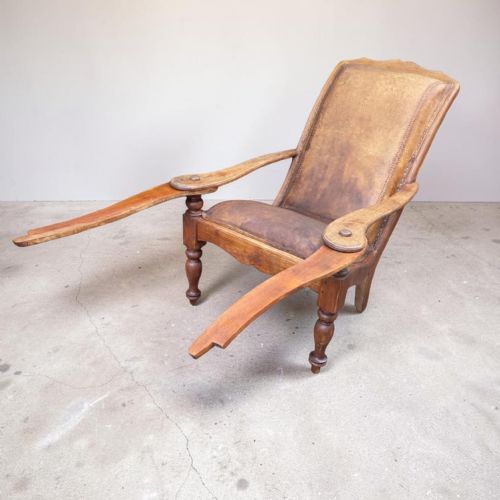
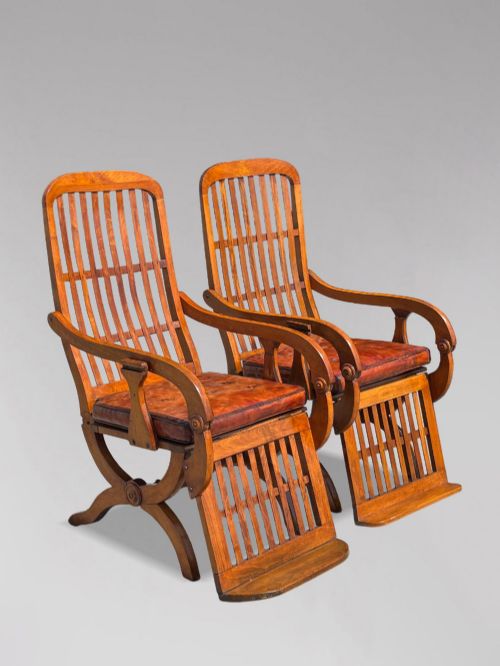
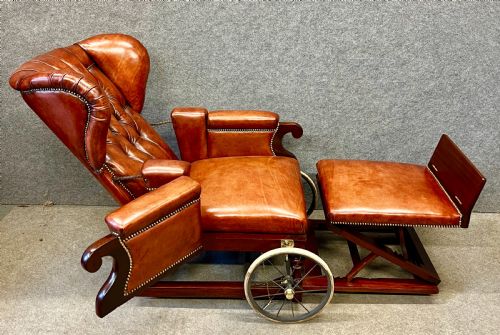
When searching for a brown leather reclining chair, you encounter a range of heavy timber seating designed for adjustable repose, spanning periods from the late seventeenth century through the Victorian era. These pieces appear in forms such as library armchairs, colonial planter's chairs with extending arms, and reclining chaise longues.
The selections represented here showcase diverse regional styles, including Anglo-Indian colonial pieces, French nineteenth-century designs, and Arts and Crafts oak armchairs. The most frequent examples trace back to the Victorian period, utilising rich woods and supple leather upholstery tailored for reading, convalescence, or relaxation.
How they were made
Frames rely on sturdy timbers including mahogany, walnut, oak, teak, and rosewood, chosen for structural strength to support pivoting and adjustable mechanisms. Hardwood and iron internal components provide the necessary leverage and support for the moving parts.
Upholstery combines stitched brown leather fastened with brass studs over padded foundations. Timber elements often feature carved details, particularly on arms and supports.
Brown Leather Reclining Chair Retail Price Guide 2026
Typical asking prices for brown leather reclining chair among the pieces listed under this phrase on Sellingantiques today, from the lower quarter to the upper quarter. They describe what is for sale here now, not the wider market.
Object forms on this page include standard armchairs, complex invalid wheel chairs, and extended chaise longues.
What varies in quality
The sophistication of the internal adjusting mechanism dictates much of the standing of an individual piece, ranging from simple manual props to complex metamorphic actions. Movement should be balanced and smooth.
The selection and treatment of the timber framing, alongside the depth of hand-carving and the character of the original leather, separate standard production from exceptional workshop output.
Heals of London·J Foot and Son·Robert Daws·John Ward
The Brown Leather Reclining Chair Glossary
- Metamorphic armchair
- A chair with mechanical parts that transform its shape, allowing the user to shift from an upright sitting position to a reclined posture.
- Planter's chair
- A form featuring long, extending arms designed for resting legs, frequently associated with colonial or Anglo-Indian contexts.
- Campaign chair
- Portable furniture constructed for travel, often incorporating folding or adjustable elements for ease of movement.
- Chaise longue
- An upholstered couch shaped like a chair with a long seat suited for reclining.
- Library chair
- A heavy, comfortable armchair intended for long periods of reading, often featuring adjustable backs or attached reading surfaces.
Brown Leather Reclining Chair: Frequently Asked Questions
How do adjustable mechanisms work on these chairs?
Most mechanisms rely on ratchets, pivoting backrests, or extendable foot supports concealed within the wooden frame. Users typically lift or shift the arms or back to lock the piece into a preferred angle.
More complex metamorphic designs allow the chair to alter its entire silhouette significantly, moving fluidly between a standard upright seat and a fully extended recliner.
What is a colonial planter chair?
A planter chair is a distinct seating form featuring exceptionally long, flat arms designed to support a person's legs when reclined. They were developed for warm climates to maximise airflow and comfort.
Many examples incorporate native hardwoods like teak and retain deep patination on both the timber frame and the leather sling seating.
How do I care for antique leather upholstery?
Antique leather requires gentle cleaning and regular nourishment using specialist balms to prevent the hide from drying and cracking over time. Avoiding direct sunlight and extreme temperature fluctuations preserves the natural suppleness of the material.
Preserving the original surface often involves maintaining the character built up over centuries rather than applying heavy modern finishes.
Are these chairs suitable for daily use?
Many of these sturdy hardwood and leather designs remain robust enough for regular sitting, provided their internal moving parts and frames are structurally sound. Their heavy timbers and durable leather were built to endure decades of practical use.
Testing the motion gently ensures the historical mechanisms function smoothly without putting undue strain on the antique joints.