




Brown Leather Recliner
A brown leather recliner offers deep, adjustable seating built for nineteenth-century comfort and library study.
Brown Leather Recliner
A brown leather recliner combines nineteenth-century seating comfort with mechanical adjustment for reading and convalescence. These armchairs, rocking chairs, and chaise longues originate from Victorian, Regency, and William IV periods.
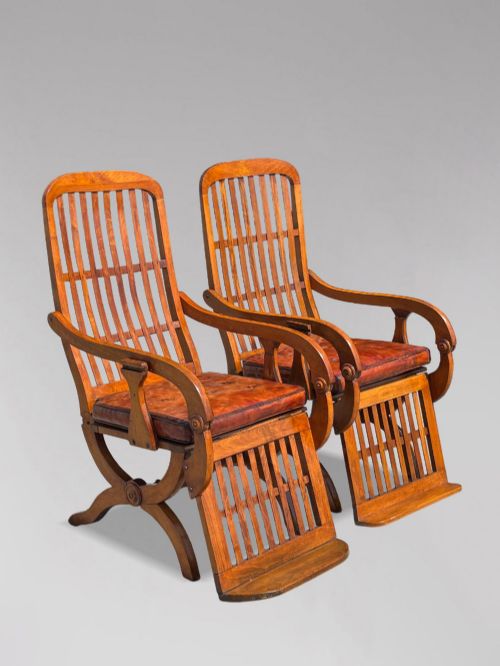
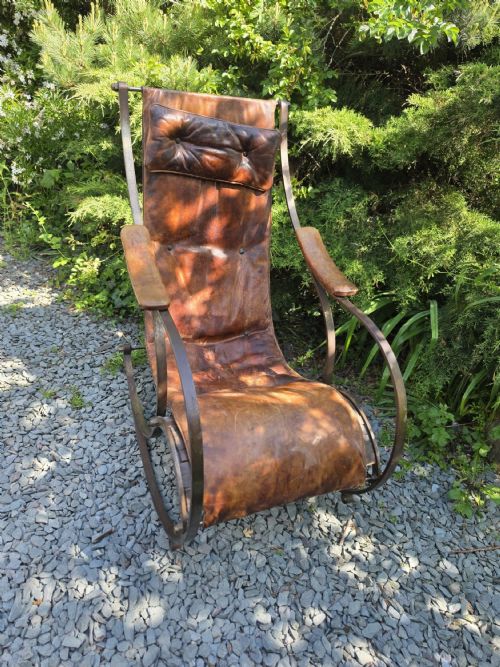
The versions met on this page include mahogany library chairs, oak rocking chairs, and walnut reclining armchairs. Makers and designers utilised timber frames fitted with adjustable mechanisms to alter the seat angle.
How they were made
Frames rely on dense timbers such as mahogany, walnut, oak, and rosewood, paired with iron mechanisms for movement. Brass details often accent the framework and adjustment points.
Upholstery consists of brown leather stretched over supportive padding, occasionally accompanied by cane panels or secondary fabric elements.
Listings feature nineteenth-century seating built from mahogany, walnut, oak, and rosewood, paired with iron and brass mechanisms.
What varies in quality
The sophistication of the mechanical adjustment separates standard seating from complex metamorphic library chairs. Pieces with smooth, integrated reclining actions represent higher tiers of nineteenth-century craftsmanship.
Timber selection and secondary materials dictate the calibre of the frame, moving from straightforward oak construction to finely figured mahogany and rosewood.
R W Wingfield·Heals of London·J Foot & Son·Robert Daws·John Ward
The Brown Leather Recliner Glossary
- Metamorphic armchair
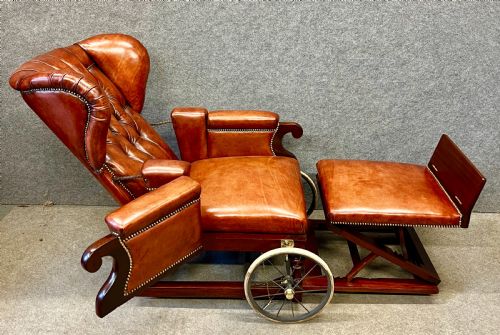
- An adjustable seat designed to transform from a standard upright chair into a reclining position. These forms often incorporate hidden ratchets and footrests.
- Library chair
- A heavy, substantial seat intended for study and reading rooms, frequently upholstered in dark leather. They prioritise long-term seating comfort.
- Chaise longue
- An elongated upholstered seat for reclining, combining the backrest of a chair with the footrest of a daybed. Nineteenth-century examples often feature carved timber frames.
- Plantation style
- A colonial design aesthetic adapted for warmer climates, frequently utilising cane and breathable materials alongside sturdy timber structures.
- Ratcheted mechanism
- The internal iron gearing that allows the back of the chair to lock at various angles. Quality depends on the smooth operation of this metalwork.
Brown Leather Recliner: Frequently Asked Questions
How do these recliners adjust?
These chairs use internal iron ratchets and mechanical linkages operated by levers or body weight. The backrest tilts backward while supporting footrests often rise simultaneously.
Such systems allowed nineteenth-century readers and invalids to find custom positions for rest and library work without leaving the seat.
Were brown leather recliners used in offices?
Primary placement occurred in libraries, studies, and private sitting rooms rather than commercial offices. Wealthy homeowners and scholars utilised them for reading heavy volumes.
Convalescing rooms also received these pieces because adjustable angles aided recovery from illness.
How do I identify a Victorian piece?
Victorian examples display heavy timber frames in walnut, mahogany, or oak, matched with buttoned brown leather upholstery. Mechanical sophistication increased notably during this era.
Stylistic cues draw on Gothic, Rococo, or colonial revivals popular between eighteen thirty and nineteen hundred.