


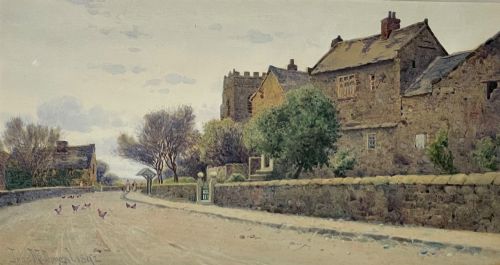


Brown Earthy Landscape Painting
A brown earthy landscape painting brings the quiet weight of rural fields, woodland streams and heavy skies straight into a room.
Brown Earthy Landscape Painting
A brown earthy landscape painting captures scenes of the countryside, farmyards, and coastal views through natural, subdued tones. These works focus on rural life, featuring working horses, cattle, and rustic cottages set against muted grounds.
The selections available here span from the Victorian era through the early twentieth century, including pieces from British, Scottish, and French provincial traditions. Most examples rely on the steady observation of nature common to nineteenth-century and early twentieth-century painters.
Buyers will find both oil paintings and watercolours depicting moorlands, rivers, and harvest scenes. These pieces offer a direct window into agricultural life and pastoral scenery from past centuries.
Materials and techniques
Artists built these compositions primarily using oil paint on canvas, wood panels, or watercolour paint on paper. The choice of medium dictated the depth of the earthy palette, with oils providing rich layers for shaded woodlands and watercolours capturing translucent light over coastal ruins.
Supports varied from stretched canvas and heavy paper to solid wood panels. Painters applied their pigments with careful brushwork to render the textures of soil, foliage, and stone.
Several canvas corners bear the quiet toothmarks of long-gone studio dogs who clearly preferred pasture scenes.
Assessing quality
Quality rests on the sureness of the brushwork and the artist's ability to balance light and shadow across a restrained palette. Stronger works demonstrate confident handling of form, particularly in the depiction of figures, animals, and natural terrain.
The relationship between the subject and the atmosphere determines the success of the piece. Superior examples hold the viewer's attention through a cohesive composition that makes the most of muted tones without losing clarity.
Tom Campbell·John McDougal·Raimond Louis Lecourt·James Orrock·John Atkinson·Herbert Royle·John Frederick Herring·Robert Finley McIntyre·Alfred Grey·Owen Bowen·William Traies·Ernest Higgins Rigg·Rowland Henry Hill·Tom Dudley·Frederick William Jackson·Kershaw Schofield·William Greaves·Francis William Topham·Charles Branwhite·Maurice Asselin·Fred C Jones·John D Walker·Benjamin Williams Leader·Edward J Cobbett·Edward John Niemann
The Brown Earthy Landscape Painting Glossary
- Oil paint
- A slow-drying paint made of pigment suspended in a drying oil, typically linseed oil. This medium allows for deep layering and rich tonal variation.
- Watercolour
- A paint consisting of colorants suspended in a water-soluble vehicle. It is typically applied to paper to create luminous, transparent washes.
- Wood panel
- A rigid flat wooden support used by artists instead of canvas. Panels provide a firm surface for detailed brushwork.
- Canvas
- Heavy woven fabric stretched across a wooden frame to form a foundation for oil painting. It remains the most common support for nineteenth-century works.
- Provincial style
- Art produced in regional areas outside the main metropolitan artistic centres. These works often reflect local traditions and immediate surroundings.
Brown Earthy Landscape Painting: Frequently Asked Questions
What periods do these paintings come from?
The works span the Victorian era and the early twentieth century. Most pieces date from the nineteenth century up through the nineteen-thirties.
This timeframe covers the shift from traditional British and French landscape painting towards early modern regional movements.
How should I care for an antique watercolour?
Watercolours require protection from direct sunlight to prevent the pigments from fading over time. Framing them behind conservation glass helps guard against moisture and environmental damage.
Keep these works in stable indoor conditions away from damp walls and extreme temperature shifts.
What subjects are common in these landscapes?
Common subjects include farmyards, cattle watering in rivers, horse-drawn ploughs, and quiet rural villages. Coastal scenes and Scottish highlands also appear frequently across the selection.
These motifs reflect a steady interest in agrarian life and the natural topography of Britain and France.
How can I tell an oil painting from a watercolour?
Oil paintings feature a heavier, textured surface where the paint sits proud of the canvas or wood panel. Watercolours present a flatter appearance on paper, often showing the texture of the sheet beneath translucent washes of pigment.
Examining the piece closely under good light reveals the distinct physical properties of each medium.