


Vintage Agricultural Landscape Art
Vintage agricultural landscape art captures the rhythm of rural life through working fields and farmyards.
Vintage Agricultural Landscape Art
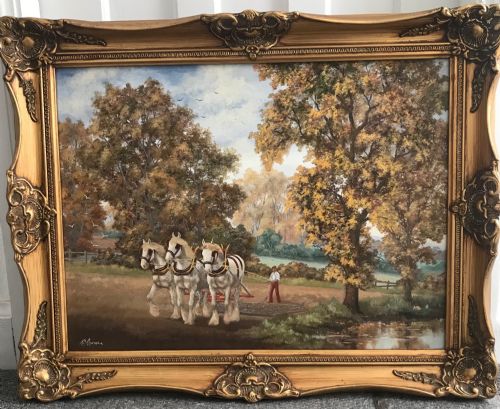
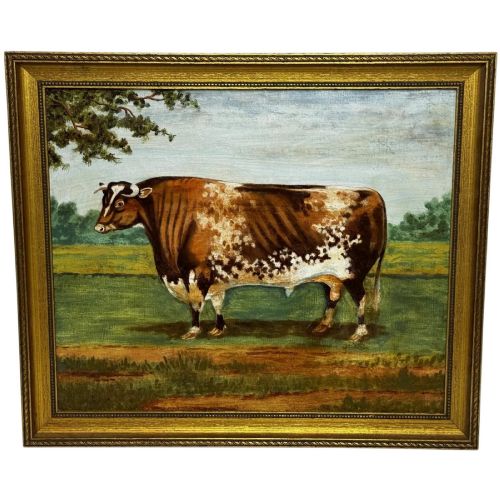
Vintage agricultural landscape art records the traditional methods of farming, harvesting, and rural labour across Britain during the nineteenth and twentieth centuries. These works document horse-drawn ploughs, haymaking scenes, and prize livestock within pastoral settings that formed the backbone of the countryside economy. A buyer browsing this selection encounters oil paintings and watercolours depicting farmyards, shire horses, and harvest fields rendered in various traditional styles.
The prevalent pieces on this page span from the Victorian era through the Edwardian period and into the mid-twentieth century. Works range from detailed depictions of Shorthorn bulls and working horses to sweeping watercolours of hay carts and stack yards. Traditional realism and British impressionism dominate the visual language, presenting scenes that celebrate rural toil and agrarian life with direct observation.
Materials and Techniques
Artists producing vintage agricultural landscape art typically utilised oil paint on canvas or watercolour applied to paper to capture rural subjects. Oil on canvas allows for rich textures and deep colour layering, frequently housed within traditional wood or ebonised frames. Watercolour works employ fluid washes on paper to render atmospheric skies, open fields, and soft countryside light.
Makers of these paintings relied on direct observation of rural subjects, often setting up outdoors or sketching working horses and farm labourers in motion. The combination of pigment, binder, and support defines the physical character of each piece, whether executed with the precise brushwork of traditional realism or the looser strokes of British impressionism.
Listings feature works spanning from the nineteenth century through the 1960s, executed in oil and watercolour.
Factors of Quality
Quality in vintage agricultural landscape art rests upon the artist's ability to render anatomy, movement, and atmospheric depth within the scene. Superior works display confident brushwork in the depiction of working animals and human figures, capturing the genuine weight of farm labour rather than stiff posing. The integration of light and shadow across the landscape separates accomplished compositions from more formulaic workshop productions.
The condition of the canvas or paper, along with the retention of original framing, influences the overall integrity of the piece. Works that maintain their original surface tension, stable pigment layers, and period frames offer a more complete historical record of the rural landscape.
James William Booth·Herbert Royle·George Soper·Frederick William Jackson·William Sidney Cooper
The Vintage Agricultural Landscape Art Glossary
- British Impressionism
- A painting style developed in Britain that incorporates loose brushwork and an emphasis on natural light, often applied to rural and coastal subjects.
- Traditional Realism
- An artistic approach aiming to represent subject matter truthfully and accurately without artificiality, frequently seen in detailed portrayals of farm animals and agricultural workers.
- Oil on Canvas
- A medium consisting of pigments suspended in a drying oil, applied to a stretched canvas support, which permits rich colour saturation and textured impasto.
- Watercolour Painting
- A method where water-soluble pigments are applied to paper, producing luminous washes and delicate tonal transitions suited to outdoor landscapes.
- Ebonised Frame
- A wooden picture frame treated with a finish that mimics ebony wood, commonly utilised during the Victorian and Edwardian periods to provide a dark, contrasting border.
Vintage Agricultural Landscape Art: Frequently Asked Questions
What periods do these paintings cover?
The available artworks span from the Victorian era through the Edwardian period, extending into the mid-twentieth century.
This timeline encompasses nineteenth-century realism alongside early twentieth-century British impressionist and traditional country depictions.
What mediums were used?
Artists primarily worked in oil paint on canvas and watercolour on paper to create these rural scenes.
Many pieces feature traditional wood frames, with some utilising period ebonised mouldings to complement the composition.
How should I display these works?
These paintings suit traditional and rustic interiors, pairing well with natural wood furniture and neutral wall colours.
Keeping them away from direct sunlight preserves the pigments on both canvas and paper supports.
How do I identify the subject matter?
Subjects focus on rural labour, including ploughing teams, haymaking, farmyards, and portraits of prize livestock.
Titles and signatures often reference specific British regions, farms, and coastal towns associated with the artist.