
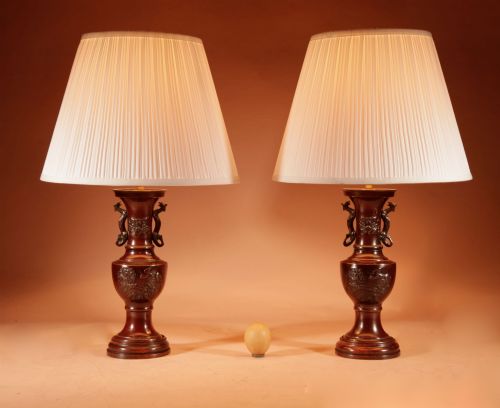
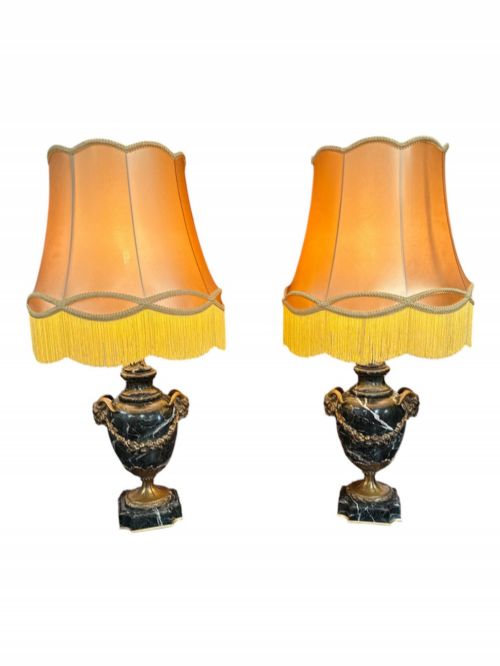


Bronze Urn Side Lamps
Bronze urn side lamps bring architectural form and warm illumination to a room, offering classical elegance for any interior.
Bronze Urn Side Lamps
Bronze urn side lamps take classical vessel shapes and adapt them for illumination, appearing frequently in nineteenth-century French and Victorian designs. These table lamps transform classical motifs into functional lighting suitable for living spaces and side tables.
The selections here showcase distinct forms influenced by Neoclassical, Louis XVI, and Victorian Neo-Classical Revival styles. Buyers encounter pieces that integrate historical vase shapes with period lighting elements.
Materials and construction
Maker construction combines cast bronze, brass, and ormolu mounts with natural stone bases such as marble and onyx. Metal components are shaped and patinated to emulate classical antiquity.
Many examples incorporate porcelain bodies, including Sevres style painted panels, paired with fabric shades. Ormolu detailing and gilt bronze applications highlight the classical ornamentation.
Some urns hide secret reversible lids that once held perfume.
Factors that determine quality
Quality rests in the crispness of the bronze casting and the precision of the ormolu chasing. Superior examples display sharply defined relief work and harmonious proportions between the urn body and its base.
The choice of materials also dictates standing, with dense marbles and heavy cast bronze marking the upper tier. Lesser pieces rely on lighter metal alloys like spelter or simpler surface treatments.
The Bronze Urn Side Lamps Glossary
- Ormolu
- Gilded bronze used for decorative mounts and furniture fittings. This technique gives metallic elements a rich, golden finish.
- Cassolette
- A decorative vase or urn designed with a removable lid that can be reversed to form a candlestick or burner. These pieces often serve as the basis for conversion into table lamps.
- Sèvres style
- Porcelain manufactured in imitation of the famous French royal works, known for painted decoration and rich coloured grounds. Such porcelain frequently forms the central body of nineteenth-century lighting.
- Neoclassical
- A style reviving the forms and motifs of ancient Greece and Rome, prominent in eighteenth and nineteenth-century decorative arts. This aesthetic governs the symmetry and ornamentation of urn lamps.
Bronze Urn Side Lamps: Frequently Asked Questions
Where should I place these lamps?
These lamps suit side tables, console tables, and mantelpieces where their classical silhouette commands attention. Their vertical form makes them ideal for flanking larger furniture pieces or mirrors.
Ensure the surface has adequate depth to support the stone bases and any associated shade overhang safely.
How do I date these lamps?
Dating relies on examining the casting techniques, the material composition of the base, and stylistic markers such as Neoclassical or Louis XVI revival details. Nineteenth-century pieces typically exhibit heavier bronze casting and hand-finished ormolu.
Later adaptations often incorporate twentieth-century wiring methods and different mounting hardware beneath the base.
Are these lamps sold as pairs?
Many listings feature matched pairs, which were traditionally produced to balance symmetrical interior schemes on side tables or commodes. Single lamps also appear occasionally.
Pairs maintain consistent patination and matching decorative mounts across both objects.
What materials are common?
Common materials include bronze, brass, ormolu, and marble, frequently paired with painted porcelain bodies and fabric shades. Onyx and spelter also appear in various nineteenth-century examples.
These mixed media constructions contribute to the decorative weight and visual contrast of each piece.