
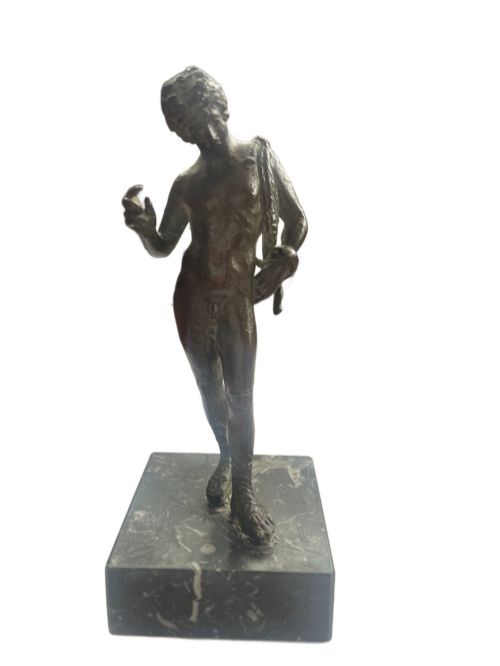
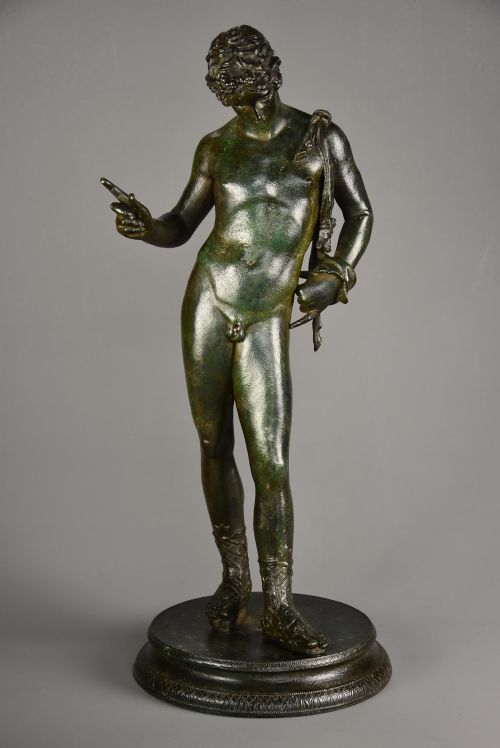
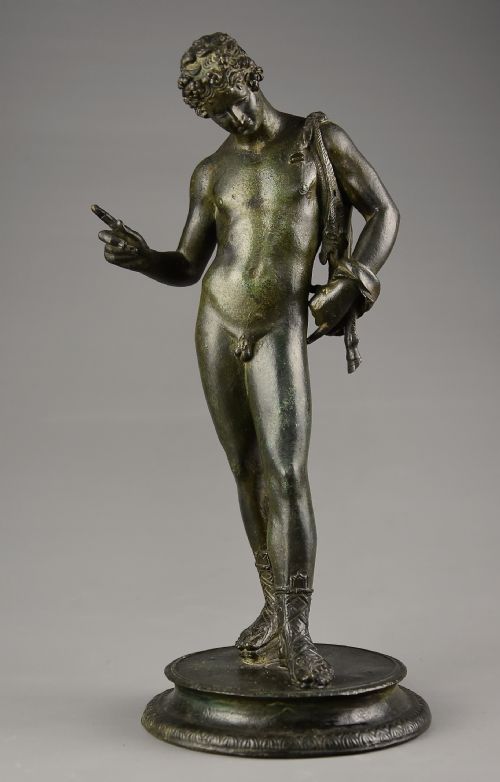


Bronze Narcissus Sculpture
A bronze narcissus sculpture brings the classical world into the room, cast in metal after ancient models from the excavations of Pompeii.
Bronze Narcissus Sculpture
When you search for a bronze narcissus sculpture, you are looking at nineteenth-century Italian souvenirs produced during the Grand Tour, often modelled after ancient figures from Pompeii.
The versions you are most likely to meet on this page are Neapolitan casts depicting the youth after the antique, frequently identified interchangeably with Dionysus or Bacchus.
These figures span the nineteenth century, including specific dates around 1880 and 1890, reflecting the Victorian appetite for classical revival art.
Materials and casting methods
Foundry workers utilised traditional bronze casting methods to replicate ancient statuary, applying patination in dark green or varied tones to simulate the aged surface of buried metal.
Many of these sculptures are mounted directly onto bases formed of fossil marble or standard marble, grounding the metal figure with a heavy stone plinth.
The listings on this site span the nineteenth century, with specific dates recorded for pieces from 1870, 1880, and 1890.
Distinctions in craftsmanship
The distinction between standard souvenir production and finer studio work lies in the crispness of the chiselling and the depth of the metal patination after casting.
The quality of the accompanying marble base, particularly where fossil marble is utilised, alters the overall presence and weight of the piece.
Michele Amodio
The Bronze Narcissus Sculpture Glossary
- Grand Tour
- The traditional travel itinerary undertaken by European nobility and gentry through Italy during the eighteenth and nineteenth centuries, acquiring local souvenirs.
- Neoclassical
- A Western cultural movement drawing inspiration from the classical art and culture of ancient Greece and Rome, evident in nineteenth-century sculpture.
- Patinated bronze
- Metal sculpture treated with chemical solutions to produce a specific surface coloration, ranging from dark green to varied metallic tones.
- Fossil marble
- Limestone containing embedded organic fossils, frequently chosen by Italian workshops for the bases of nineteenth-century cabinet bronzes.
- After the antique
- A descriptive term for a later copy or adaptation modelled directly upon a surviving ancient Greek or Roman sculpture.
Bronze Narcissus Sculpture: Frequently Asked Questions
What is a bronze narcissus sculpture?
It is a nineteenth-century cast depicting a classical figure, often originating from Neapolitan workshops as a Grand Tour souvenir.
These pieces copy ancient originals discovered during archaeological excavations in Italy.
Who was Michele Amodio?
He was a nineteenth-century maker working in Italy whose foundry produced bronze sculptures for travellers.
His works form part of the recorded output associated with Grand Tour souvenirs.
Why are some figures called Bacchus?
The iconography of the youth often overlaps with Dionysus or Bacchus in nineteenth-century cataloguing.
Contemporary scholarship and nineteenth-century souvenir traditions frequently interchanged these classical identities.
How do I display these sculptures?
They suit side tables, desks, or mantelpieces where their marble bases provide stable support.
Keep them away from direct moisture to protect the patinated bronze surface.