
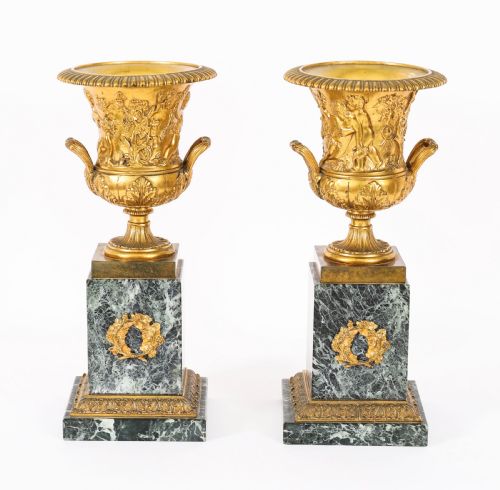

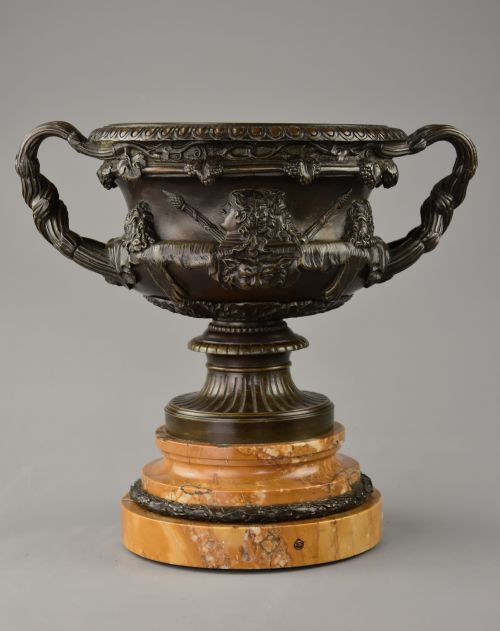
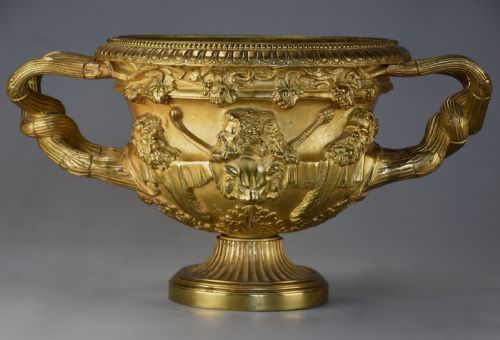
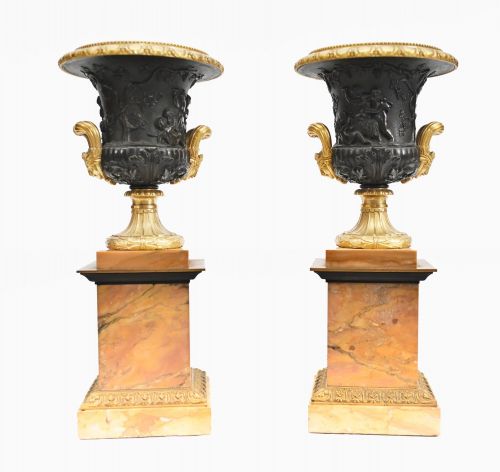


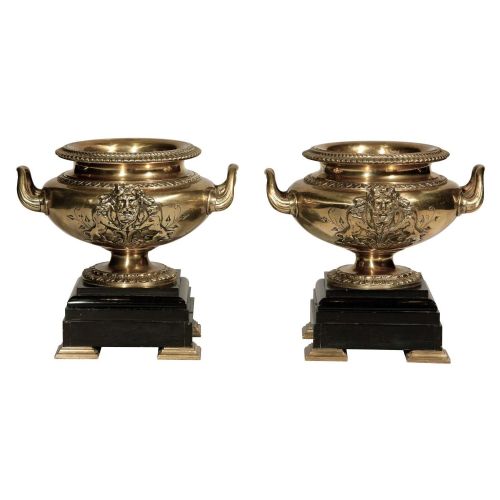


Bronze Campana Vase
These bronze campana vase pieces bring classical antiquity straight into the room through heavy cast metal and grand architectural presence.
Bronze Campana Vase
A bronze campana vase takes its distinctive inverted bell shape from ancient Roman pottery and stone wine-coolers, translating classical proportions into metal. These pieces emerge predominantly across the nineteenth century, driven by the Grand Tour and revivals of ancient Greek and Roman design.
Most examples found here appear as decorative urns, often mounted on heavy marble plinths or paired symmetrically as mantel ornaments. The profile relies on a wide flaring rim, deep bowl tapering smoothly to a stem, and a stepped circular foot.
Makers of the period adapt these ancient archetypes into table ornaments, wine-coolers, and pastille burners. The versions meeting buyers on this page span French Charles X, Regency, and Victorian interpretations of neoclassical form.
How they were made
Foundries construct these pieces primarily through metal casting, utilising bronze alongside gilt bronze, ormolu, and occasionally spelter for later decorative production. Molten metal flows into moulds to capture intricate classical friezes, acanthus leaves, and handles.
Craftsmen mount many of the cast bodies onto contrasting stone bases, specifically incorporating marble and green marble plinths. Surfaces receive distinct finishes, ranging from rich patinated bronze tones to polished highlights of fire-gilt ormolu.
Listings feature periods spanning Regency, Charles X, and Victorian eras, alongside styles rooted in French Neoclassical and Gothic Revival design.
What varies in quality
Quality rests heavily on the crispness of the metal chase work and the depth of the casting detail in motifs like Bacchic figures or classical scrollwork. Finer pieces retain sharp definition across relief panels, whereas lesser examples show softened edges from worn moulds.
The choice and execution of the base separate standard production from superior examples, particularly where dense stones like siena marble or giallo di siena receive precise architectural turning. Heavier, solid metal weights and richer patination distinguish the finest Grand Tour reductions.
The Bronze Campana Vase Glossary
- Campana
- Inverted bell shape derived from ancient pottery, forming the standard silhouette for these classical urns.
- Grand Tour
- Eighteenth and nineteenth century travels through Europe by collectors who acquired these classical souvenir bronzes.
- Ormolu
- Finely ground high-carat gold mercury-gilded to bronze, creating a bright golden surface finish.
- Cassolette
- A decorative vessel featuring a reversible lid, functioning alternatively as a vase or pastille burner.
- Patination
- The surface coloration and ageing achieved on bronze through chemical treatment or natural exposure.
Bronze Campana Vase: Frequently Asked Questions
What is a campana vase?
A campana vase is a vessel shaped like an inverted bell, modeled after ancient Roman garden vases and marble wine-coolers.
Craftsmen in the nineteenth century scaled these classical forms down into decorative bronze ornaments for European interiors.
Where were these urns made?
These decorative objects originate predominantly from French and Italian workshops catering to collectors during the nineteenth century.
Many pieces reflect the classical revival tastes popular among travellers touring Rome and Paris.
How do you display them?
These metal urns suit mantelpieces, pedestals, and side tables where their architectural silhouette stands against a wall.
Pairs look best balanced symmetrically, while larger single examples anchor console tables as standalone focal points.
What is a Warwick Vase reduction?
A Warwick Vase reduction is a smaller scale bronze copy of the massive ancient Roman marble vase discovered at Hadrian's Villa.
Foundries produced these detailed miniatures during the Victorian era as prized cabinet or table ornaments.