

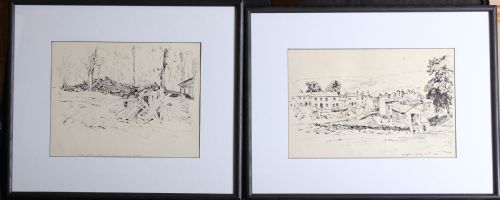
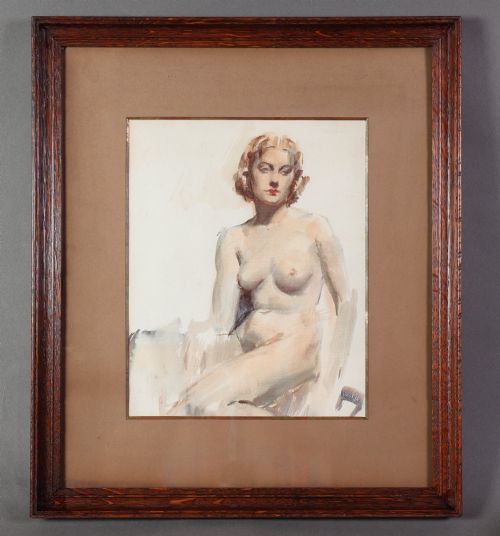
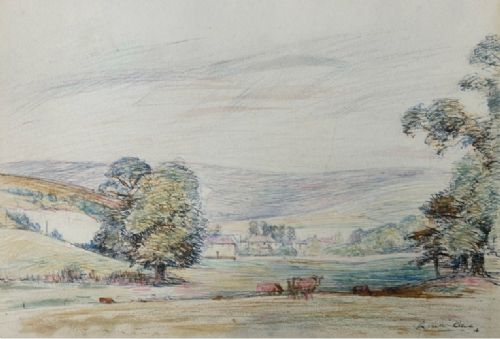


![Pen and Ink Sketch - Female Nudes by William Edward Frost [1810-1877]](https://www.sellingantiques.co.uk/photosnew/dealer_kendallhouse/dealer_kendallhouse_full_1758970795762-8493507346.jpg)
British Watercolour Drawing
When you search for british watercolour drawing, you find works on paper spanning from Georgian townscapes to Mid-Century Modern abstractions.
British Watercolour Drawing
A british watercolour drawing combines pigment applied in aqueous washes with linear elements in ink, graphite, or pencil upon paper supports. These works range from intimate portrait studies and architectural sketches to finished landscape paintings capturing regional scenes.
The selection here encompasses several distinct eras, stretching from nineteenth-century pastoral and figurative compositions through Edwardian views to twentieth-century still lifes and abstracts. Buyers frequently encounter framed works created by named British artists alongside unattributed school pieces.
Landscapes, townscapes, and figurative studies dominate the forms, often executed as original works or preparatory illustrations. Collectors select these pieces for their immediacy of hand and the direct insight they provide into the maker's working process.
How they were made
Makers applied transparent watercolour washes layered over delicate pencil or graphite underdrawing to establish tone and form on paper. Many compositions incorporate pen and ink outlines or pastel and gouache highlights to add definition and depth to the imagery.
Framed behind glass with wooden surrounds, these original works on paper rely on the absorbent qualities of paper to hold delicate pigments. Artists utilised quick observational techniques, sometimes combining acrylic or sepia washes to capture light and atmosphere rapidly.
Listings feature works spanning the 1800s, Victorian era, Edwardian period, and 19th Century, executed on paper with watercolour, ink, and pencil.
What varies in quality
The strength of the composition and the surety of the initial pencil or ink line distinguish exceptional works from standard studies. A confident hand captures movement and architectural detail with economy, whereas weaker pieces rely on laboured or hesitant brushwork.
Condition and preservation play a vital role, particularly regarding the stability of the paper support and the retention of pigment vibrancy. Works retaining their original tonal depth without excessive fading or discoloration command greater appreciation among collectors.
Fred Lawson·Bruce Bairnsfather·George Lorain Stampa·Alfred Young Nutt·James Smetham·Russell Sidney Reeves·Dame Elisabeth Frink·James Tower·William Manners·Charles James Lauder·Stanley Orchart·Raoul Millais·William Edward Frost·Arthur Todd·Adrian Heath·Thomas Rowlandson·Amos Green·Dame Laura Knight·Owen Bowen·Snaffles·Matthew Hale·Josiah Gilbert·Angus Rands·John Baragwanath King·Henry Edridge
The British Watercolour Drawing Glossary
- Watercolour painting
- A work executed with pigments suspended in a water-based solution applied to paper. This medium allows for transparent washes and subtle gradations of tone.
- Works on paper
- A collective term encompassing drawings, watercolours, sketches, and prints executed upon paper supports. These items typically require framing behind glass for protection.
- Gouche
- An opaque water-based paint often used alongside watercolour to create solid highlights and areas of dense colour. It provides greater opacity than traditional transparent washes.
- Pastel
- A dry drawing medium formed of powdered pigment and a binder, shaped into sticks. Artists utilise pastels for soft colour application and velvety textures on paper.
- Graphite
- A form of crystalline carbon used for underdrawing and linear sketching beneath watercolour washes. It leaves a metallic grey mark that varies in tone with pencil hardness.
British Watercolour Drawing: Frequently Asked Questions
How should I frame a watercolour drawing?
Watercolour drawings require professional framing behind glass with acid-free mounts to prevent paper degradation and pigment fading from light exposure.
Keeping these works away from direct sunlight preserves the delicate washes and paper integrity over decades.
What is the difference between a sketch and a finished watercolour?
Sketches focus on rapid observation and line work using pencil, ink, or light washes to capture an immediate impression.
Finished watercolours employ layered pigments and fuller colour palettes to create a resolved composition intended for display.
How do I identify the period of a British watercolour?
Stylistic clues such as costume, architectural details, and framing styles often point towards specific eras like the Edwardian period or Mid-Century Modern.
Signatures, dates inscribed on the paper, and mounting materials also provide reliable evidence for dating an artwork.
Are these watercolours original works?
The listings feature original hand-painted works created directly by the artist rather than mass-produced reproductions or prints.
Each piece bears the unique brushstrokes, paper textures, and pencil underdrawings characteristic of authentic handmade art.